How to Check JAMB Result 2026: SMS and Portal Step-by-Step Guide
How to Check JAMB Result 2026: SMS and Portal Guide

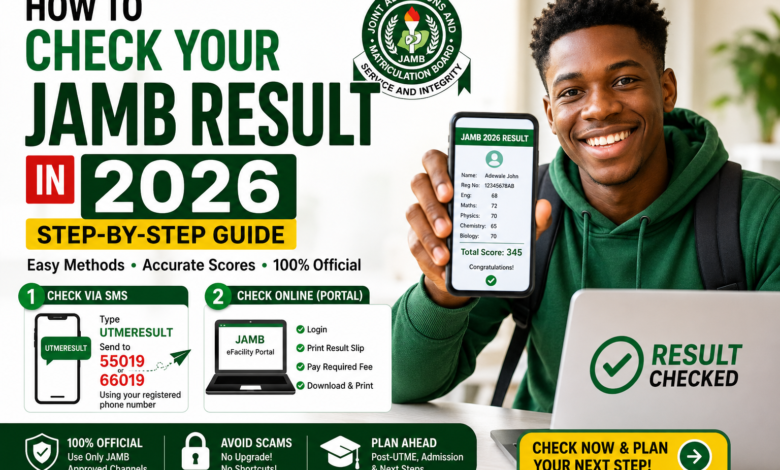
The moment JAMB releases UTME results, millions of Nigerian students reach for their phones at the same time. Some are nervous. Some are checking on behalf of a younger sibling who cannot stop pacing the room. Whatever your situation, the process of how to check JAMB result 2026 does not have to be stressful or confusing.
RECOMMENDED POST: How to Study Smarter Not Harder in 2026: Proven Methods That Actually Work
Quick Answer: How to Check JAMB Result 2026
To check your JAMB result 2026, send the SMS keyword UTMERESULT from the phone number you used during JAMB registration to either 55019 or 66019. The system will reply with your scores in all four subjects and your aggregate total. If you need an official printed copy for admission screening, log in to the JAMB eFacility portal at efacility.jamb.gov.ng and follow the result slip printing process.
JAMB’s official FAQ confirms that candidates use their registered mobile number through the short codes 55019 or 66019 for SMS-based result services.
What Is the JAMB UTME Result 2026?
The JAMB result is the official score released by the Joint Admissions and Matriculation Board after a candidate completes the Unified Tertiary Matriculation Examination. It shows your performance in the four subjects you sat for, combined into a total aggregate score that universities, polytechnics, and colleges of education use during admission processing.
Seeing a good score does not automatically guarantee admission. Your result is only one part of the process. Depending on your chosen institution, you may also need to complete:
- Post-UTME screening
- O’level result upload and verification
- Confirmation of correct subject combination
- Meeting the departmental cut-off mark
- JAMB CAPS admission processing
Understanding How JAMB 2026 Results Are Released
JAMB does not release every result at the same time. Results come out in batches, which means your friend might see their score while yours is still showing ‘No Result Yet.’ That is normal and does not mean anything went wrong.
A few things can affect when your result appears. If the exam centre you used experienced technical problems, biometric verification issues, or if the centre was flagged during quality checks, your result may be held back for review. Results from centres under investigation for malpractice are often released in a separate batch after a formal announcement.
In the 2026 UTME cycle, JAMB results are expected to follow the usual batch-release pattern. If you do not see your result immediately, wait a few days and monitor official JAMB announcements before taking any action.
Method 1: How to Check JAMB Result 2026 via SMS
The SMS method is the fastest option for checking your JAMB result 2026, especially if you have limited data access or the portal is slow due to high traffic. It works on any phone, as long as you have the SIM card you used during registration.
Step-by-Step: Check JAMB Result 2026 by SMS
- Pick up the phone containing the exact SIM card you used during JAMB registration.
- Open your messaging app and start a new SMS.
- Type UTMERESULT in capital letters with no spaces and no punctuation.
- Send the message to 55019 or 66019. Both are official JAMB short codes supported by MTN, Glo, Airtel, and 9mobile.
- Wait a few seconds. A reply will arrive with your scores in each subject and your aggregate total, for example: Eng: 60, Phy: 55, Chem: 68, Bio: 72. Agg: 255.
Cost: Approximately N50 is deducted from your airtime. Ensure you have enough credit before sending. If you have insufficient airtime, the message simply will not go through.
Important Notes for SMS Result Checking
- Use only the SIM card registered with JAMB. Any other number will return an error.
- Type the keyword exactly as UTMERESULT. A space, full stop, or lowercase letter will cause the system to reject the message.
- Save the SMS reply as temporary proof of your score until you print the official result slip.
- If the network is slow and no reply arrives, wait a few minutes before trying again. Repeated messages during peak periods will only use your airtime without speeding up the process.
Troubleshooting SMS Errors When Checking JAMB Result 2026
This phone number was not used for registration: You sent the message from a different SIM. There is no workaround for this. You must use the exact number from your JAMB profile. If you no longer have that SIM, use the online portal method instead.
No response after 10 minutes: Network congestion is the likely cause, especially in the first few days after result release. Try again during off-peak hours such as early morning. Resending repeatedly will not help.
Invalid keyword: You probably added a space or punctuation. Delete the message, retype UTMERESULT carefully, and send again.
Method 2: How to Check and Print JAMB Result 2026 via the eFacility Portal
If you need a formal, printable result slip for Post-UTME registration, admission screening, or university documentation, the JAMB eFacility portal is the correct option. This method also works if you no longer have access to your registered SIM card.
Step-by-Step: Check JAMB Result 2026 on the eFacility Portal
- Open a trusted browser such as Chrome, Firefox, or Safari and visit efacility.jamb.gov.ng.
- Log in using the email address and password you created when setting up your JAMB profile. If you forgot your password, click the Forgot Password link and reset it through your recovery email.
- Once logged in, locate and click on Print Result Slip.
- Select 2026 as the exam year and enter your JAMB registration number when prompted.
- Complete the required payment using your ATM card, USSD banking, or Remita at a commercial bank.
- After payment is confirmed, your result slip will load. Download the PDF immediately, email a copy to yourself, and print at least two physical copies.
Result Slip Fee: What to Expect
JAMB’s official payment and services page lists the result slip as a paid service. At the time of writing, the fee shown was N1,000 plus a N100 service charge. However, fees can change, so always confirm the current amount directly on the official JAMB payment portal before making any payment.
If the portal does not update immediately after payment, do not pay again. Log out, clear your browser cache, and wait 30 minutes before logging back in. If the status still shows unpaid after 24 hours, visit the Contact Us section on the portal or go to a JAMB office with your payment receipt.
Why You Need the Printed JAMB Result Slip
The printed result slip is the official document most universities and polytechnics accept during the admission process. You are likely to need it for:
- Post-UTME registration and screening
- Departmental clearance
- Scholarship applications
- Personal records
Do not wait until your school announces screening before printing your slip. During busy admission periods the portal can slow down significantly. Print early and store both digital and physical copies safely.
SMS vs Portal: Which Method Should You Use to Check JAMB Result 2026?
| Feature | SMS Method | Online Portal |
|---|---|---|
| Best For | Quick score check | Official admission documents |
| Access Method | SMS to 55019 or 66019 | efacility.jamb.gov.ng |
| Internet Required | No | Yes |
| Shows Full Slip | No | Yes |
| Useful for Screening | Limited | Yes, required by most schools |
| Payment | Approx. N50 airtime | Official portal fee, confirm on site |
Use the SMS method if you only want to see your score quickly and have your registered SIM handy. Use the portal when you need an official document for school submission.
Common JAMB Result 2026 Status Messages and What They Mean
Not every candidate will see a score display on the first attempt. Below are the messages you may encounter and what each one actually means.
| Message | What It Means | What to Do |
|---|---|---|
| No Result Yet | Result still processing or not yet uploaded | Wait a few hours and try again |
| Result Withheld | Under JAMB investigation or verification | Wait for official JAMB update; do not pay anyone |
| Wrong Phone Number Used | SIM does not match registered number | Use the exact SIM linked to your JAMB profile |
| Invalid Registration Number | Typing error or wrong exam year selected | Recheck your registration number and year |
| You Did Not Sit For This Exam | Possible registration mismatch | Contact JAMB support with your details |
| Successful Score Displayed | Normal released result | Save the result and proceed to next steps |
Understanding a Withheld JAMB Result 2026
A withheld result is the status that worries candidates most, but it does not automatically signal guilt or failure. JAMB withholds results when there is a suspicion of exam misconduct, unusual answer patterns, significant mismatches between a registration photo and the biometric scan taken at the centre, or when an entire venue is flagged for investigation.
If your result is withheld, the correct approach is to wait for an official JAMB notification. The board usually invites affected candidates to appear before a disciplinary panel. Candidates who are cleared typically receive their results afterward. Do not pay anyone who claims they can release a withheld result. That is always a scam.
JAMB Result 2026 Scams: What Every Candidate Must Know
Every UTME cycle brings a fresh wave of fraudulent websites, apps, and individuals claiming to offer faster result checking, score upgrades, or insider admission processing. None of these are real.
RECOMMENDED POST: Fully Funded Scholarships for African Students 2026: Masters & PhD Opportunities in UK, Germany & Canada
Common Scams to Avoid
Result upgrade offers: JAMB results cannot be altered by any private individual after release. The database is centrally secured. Anyone promising to raise your score from 190 to 250 for a fee is stealing your money.
Fake SMS redirects: You may receive a message that appears to come from JAMB asking you to send your details to a personal number. Genuine JAMB messages only come from the short codes you initiate. JAMB will never contact you first asking for personal information.
Phishing portals: Sites that look similar to the official JAMB website but use different domain names are designed to capture your login details. Always verify the URL. The official portals are jamb.gov.ng and efacility.jamb.gov.ng.
Fake WhatsApp and Telegram agents: People in group chats who claim to check results for a fee or who promise to reveal withheld scores are running scams. At best they take your money and send a fabricated screenshot. At worst they compromise your JAMB profile.
Insider admission claims: Admission in Nigeria is processed through JAMB CAPS, which is automated and merit-based. No private individual can bypass the system.

How to Protect Your JAMB Profile
- Keep your JAMB password private and do not share it with anyone.
- Do not post your registration number in public groups or on social media.
- Use only official JAMB platforms for all transactions.
- If you use a cybercafe for portal access, stay beside the attendant and do not leave your profile open.
- Change your password immediately if you suspect someone has accessed your account.
- Keep the email address and phone number linked to your JAMB profile active.
What to Do After You Check Your JAMB Result 2026
Seeing your score is the beginning of the next stage, not the finish line. The steps below help you move from result checking to admission preparation in an organised way.
1. Compare Your Score Against Departmental Cut-Off Marks
For the 2026 admission cycle, JAMB has approved minimum tolerable admission scores for different categories of tertiary institutions. Universities have a minimum score of 150, Colleges of Nursing have 140, while Polytechnics, Monotechnics, Colleges of Agriculture, Colleges of Education, and Innovation Enterprise Institutions have 100. Individual faculties and departments can still set higher requirements, especially for competitive courses.
Competitive courses such as Medicine, Pharmacy, Law, Nursing, Computer Science, and Accounting often require scores well above the general minimum at top universities. Always check the specific cut-off for your chosen course and institution, not just the general announcement.
Remember that some schools weigh JAMB and Post-UTME performance differently. A strong JAMB score gives you an advantage, but a weak Post-UTME result can still reduce your chances.
2. Prepare for Post-UTME Screening
If your score meets the cut-off for your first-choice school, start Post-UTME preparation immediately. Many institutions now use computer-based tests that cover English comprehension, current affairs, and subject-specific questions. Gather past questions, practise under timed conditions, and familiarise yourself with the format your chosen school uses.
3. Upload or Confirm Your O’Level Result
Many candidates lose admission offers because their WAEC, NECO, or NABTEB result is not properly uploaded to JAMB CAPS. Visit an accredited CBT centre to upload or verify your O’level result if you have not already done so.
4. Monitor JAMB CAPS
JAMB CAPS is where all admission offers are processed. Check it regularly after your school begins consideration rounds. Responding promptly to an offer reduces the risk of losing your slot.
5. Consider Change of Course or Institution
If your score falls short of your original target, JAMB usually opens a window for candidates to change their course or institution during the admission cycle. Use this option carefully. Research realistic alternatives based on your score and subject combination before making any changes, and avoid switching to a course purely because someone told you it is easier to enter.
Options If Your JAMB Score Is Lower Than Expected
A score that falls short of your target does not end your academic journey. Many students who faced this situation have gone on to build strong careers through the right alternative pathway. Consider:
- Less competitive courses at your first-choice university
- State universities and private universities with lower cut-off marks
- Polytechnic diploma programmes
- Colleges of education
- Pre-degree or remedial programmes as a pathway into your desired institution
- JUPEB or IJMB programmes which provide direct entry routes
- Preparing for the next UTME with a better strategy
Make decisions based on accurate information rather than pressure or embarrassment. Scores are one data point in a much longer story.
Expert Tips for Checking Your JAMB Result 2026 Without Problems
- Keep your registered SIM card safe from the time you register until well after admission is confirmed. Losing it forces you to rely entirely on the portal, which can be difficult during high-traffic periods.
- Do not wait until the night before an application deadline to print your result slip. Print it weeks in advance and store both digital and physical copies safely.
- Write your JAMB email address, password, and registration number in a notebook kept offline. Passwords are frequently forgotten under pressure.
- Use a stable internet connection when accessing the eFacility portal. Mobile data can drop during payment processing. A reliable Wi-Fi connection reduces that risk.
- Check the portal during off-peak hours if it is slow. Between 2am and 5am, traffic is significantly lower. Your result is not going anywhere, so waiting a few hours to avoid the rush is worth it.
- Screenshot or photograph every confirmation message and payment receipt. If a problem arises later, these records help resolve it faster.
- If you are helping a younger sibling or friend check their result, stay with them during the process. The emotional reaction that follows needs support, and having someone present makes a difference.
Common Mistakes Candidates Make When Checking JAMB Result 2026
Using the wrong SIM card: The SMS method is tied to the phone number on your JAMB profile. Using any other number will return an error. Check your original registration confirmation email if you are unsure which number you used.
Paying twice on the portal: When the portal hangs after payment, some candidates start a new payment instead of waiting. Recovering a duplicate payment from JAMB is a slow process. Always wait and refresh before attempting another transaction.
Ignoring a withheld result notice: Waiting passively when your result shows as withheld can cause you to miss a panel invitation. Monitor JAMB’s official social media channels and website for updates that affect your status.
Paying someone to check your result: The SMS method costs around N50. The portal slip costs a small official fee. Anyone asking for more than that to check your result is taking advantage of you.
Abandoning admission options after a low score: Scores are not the only factor in your academic future. Use every legitimate pathway available before deciding to wait a full year.
Delaying O’level upload: Many candidates fix their JAMB result and Post-UTME preparation but forget to confirm that their O’level result is properly uploaded. This is a common reason good candidates miss admission.
Frequently Asked Questions: How to Check JAMB Result 2026
How do I check my JAMB result 2026 via SMS?
Send the keyword UTMERESULT in capital letters to 55019 or 66019 from the exact phone number you used during JAMB registration. The system will reply with your subject scores and aggregate total. A small airtime charge of approximately N50 applies.
Why is my JAMB result 2026 not showing?
Your result may still be processing, you may have used the wrong SIM card for SMS checking, or the result may have been withheld for review. Try again after a few hours using the correct number. If it still does not appear after several days, use the JAMB support ticket platform to lodge a complaint.
How much does it cost to print the JAMB result slip?
JAMB’s official payment page listed the result slip fee at N1,000 plus a N100 service charge at the time of writing. Always verify the current fee directly on the official JAMB payment portal before paying, as this figure can be updated.
Can I check my JAMB result 2026 without the internet?
Yes. The SMS method does not require an internet connection. You only need the registered SIM card and enough airtime to send the message.
Can my JAMB result be upgraded or changed?
No. JAMB results reflect your actual performance and cannot be altered by any private person after release. Anyone offering to upgrade your score is running a scam. Do not pay them or share your profile details.
What does it mean if my JAMB result is withheld?
A withheld result means JAMB is reviewing your case. This could relate to malpractice suspicion, biometric inconsistency, or centre-related issues. Wait for an official communication from JAMB. If invited to appear before a panel, attend with any relevant documentation. Do not pay anyone claiming to resolve the status privately.
Do I need the printed result slip for admission screening?
Most universities require the official printed result slip during screening. The SMS reply is only a quick summary. Log in to the eFacility portal and print your full result slip well before your school’s screening date.
Can I use my registration number alone to check the result?
Not via SMS. The SMS method requires the registered phone number. Online, you need your email address and password. Your registration number alone is not sufficient for either method.
What should I do if the portal does not update after payment?
Do not pay again. Log out, clear your browser cache, and wait 30 minutes. Usually the payment status will have updated by then. If it still shows unpaid after 24 hours, contact JAMB through the support portal or visit a JAMB office with your payment receipt.
What should I do if my JAMB score is below the cut-off for my course?
You have several options. You can apply for a change of course or institution through JAMB, look at less competitive programmes, consider polytechnic or college of education routes, or explore pre-degree and direct entry programmes such as JUPEB or IJMB. Research each option carefully before making a decision.
Conclusion
Knowing how to check JAMB result 2026 correctly saves you time, money, and unnecessary stress. The simplest route is to send UTMERESULT from your registered phone number to 55019 or 66019. When you need a formal document for your school, log in to the eFacility portal, complete the official payment, and download your result slip.
Once you have seen your score, shift your focus to the steps that actually lead to admission: comparing your result against your school’s cut-off, preparing for Post-UTME, confirming your O’level upload, and monitoring JAMB CAPS. Avoid anyone promising shortcuts, upgrades, or insider processing. The legitimate routes are well-defined, and following them is the most reliable path forward.
Save your result details today, research your options, and start preparing your documents. The admission season rewards candidates who act with clarity rather than those who react with panic.
This article is based on official JAMB processes and public announcements. Always verify the latest instructions directly on jamb.gov.ng or efacility.jamb.gov.ng, as details can be updated.