Study in Germany for International Students 2026: Tuition-Free Universities, DAAD Scholarships & Visa Guide
Study in Germany for International Students 2026: Beginner-to-Expert Complete Guide


Introduction
Study in Germany for International Students 2026, If you have spent the last few months digging through Reddit threads and WhatsApp groups trying to figure out whether Germany is genuinely affordable, you are not alone. One source says tuition is free, another mentions €1,500 per semester, and the blocked account amount seems to change every time you look.
Here is where things actually stand in 2026: Germany remains one of the most affordable higher education destinations in the Western world, but the details matter more than most guides let on. Over 420,000 international students are currently enrolled at German universities a 9% jump from the previous cycle and the number keeps climbing. Countries like Canada, the UK, and the US are tightening immigration rules and pushing international tuition higher. Germany is moving in the opposite direction.
RECOMMENDED POST: Cheapest Universities in Germany for International Students in 2026
What you will find in this guide: the exact universities that charge nothing and the few that do not, how DAAD scholarships actually work (including real stipend figures and application windows), what the visa process demands step by step, and how students from Africa, Asia, and the Americas navigate the system in practice. Every figure reflects verified 2026 data no recycled 2023 numbers dressed up as current advice.
Why Germany Has Become the Smarter Choice
Germany’s rise as a top study destination did not happen overnight, and it is not just about price. Several converging trends pushed it to the front of the queue.
Public universities in most German states charge international students no tuition. English-taught programs at master’s level have expanded into the hundreds. Germany’s labor market is actively seeking skilled graduates in engineering, IT, healthcare, data science, renewable energy, and logistics. And unlike some countries that offer post-study visas in name only, Germany provides 18 months of legal residence to job-seek after graduation, with credible pathways toward permanent settlement.
For students from African countries specifically, Germany represents something increasingly rare: a globally respected degree, realistic funding options, and post-graduation options that can genuinely reshape a career — without starting that career in debt.
Tuition-Free Universities in Germany: What “Free” Actually Means in 2026
The phrase “tuition-free” is technically accurate for most German public institutions, but the full picture has nuance that affects your budget.
The 15-State Rule
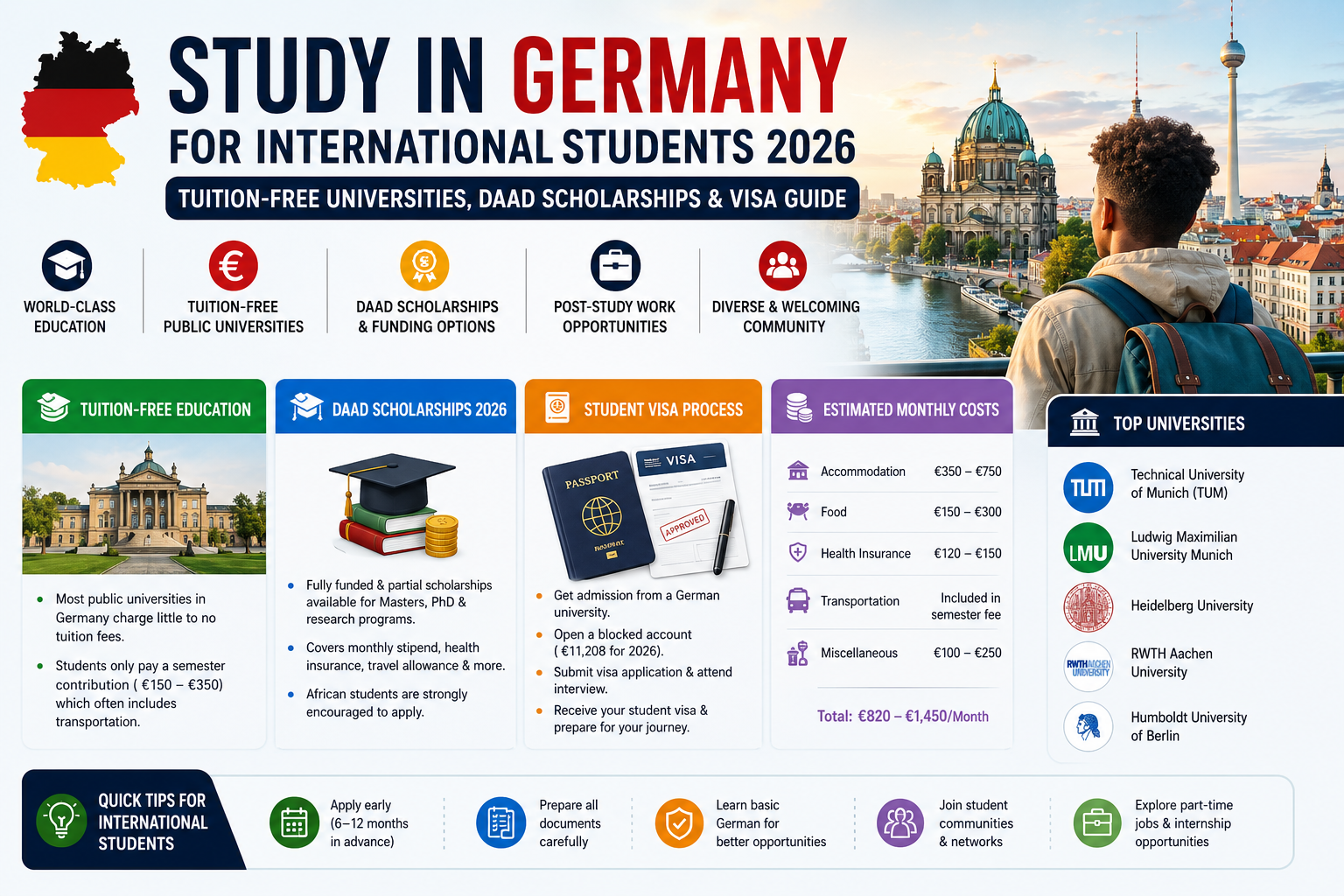
Germany has 16 federal states. In 2026, public universities in 15 of those states charge zero tuition to all students, regardless of nationality. Whether you are from Nairobi, New Delhi, or New York, the policy applies equally. What you do pay is a semester contribution (Semesterbeitrag) — typically €150 to €400 every six months. This covers administrative costs and usually includes a public transport pass valid across your city or region. Think of it as a mandatory services bundle, not tuition.
The Exceptions That Matter
Baden-Württemberg is the one state that charges non-EU students additional fees. Universities there — including Heidelberg, the University of Stuttgart, and the University of Freiburg — levy €1,500 per semester for students from outside the European Union. That is €3,000 annually, which is still modest by global standards but a meaningful line item in any budget.
Technical University of Munich (TUM) broke from the public university norm starting in the 2024/25 winter semester. TUM now charges non-EU students roughly €2,000 to €3,000 per semester for bachelor’s programs and €4,000 to €6,000 per semester for select master’s programs. TUM is a special case — no other Bavarian public university has followed its lead.
Private universities operate on a completely different model, with annual tuition typically ranging from €8,000 to €20,000. If genuinely low-cost education is the goal, the target is public universities outside Baden-Württemberg and TUM.
Top Public Universities Worth Knowing
| University | Location | Notable Strengths | Semester Fee (Approx.) |
| Ludwig Maximilian University (LMU) | Munich | Medicine, Law, Data Science | €150–€300 |
| Humboldt University of Berlin | Berlin | Humanities, Economics, History | €300 |
| Free University of Berlin | Berlin | Political Science, Business | €300 |
| RWTH Aachen University | Aachen | Engineering, Automotive | €300–€330 |
| University of Bonn | Bonn | Mathematics, Economics | €320–€350 |
| TU Dresden | Dresden | Engineering, Computer Science | €290–€300 |
| University of Hamburg | Hamburg | Climate Research, Law | €330–€340 |
| University of Freiburg | Freiburg | Sustainability, Sciences | €170–€350 |
These are all tuition-free for international students. The semester fee shown typically includes the regional public transport ticket.
English-Taught Programs
Germany now offers well over a thousand master’s programs taught fully or substantially in English. Strong subject clusters include engineering, computer science, business and management, public policy, and natural sciences. The language of instruction does not determine whether you pay tuition — most English-taught programs at public universities remain tuition-free. A small number of specialized international programs do carry fees, so always verify on the specific program’s admissions page before assuming.
RECOMMENDED POST: Germany Nursing Apprenticeship for Foreigners 2026
DAAD Scholarships 2026: How They Actually Work
The DAAD (Deutscher Akademischer Austauschdienst) is the largest scholarship organization of its kind worldwide, funded by the German government. If someone says they got “fully funded to study in Germany,” the DAAD was almost certainly involved.
What the Scholarship Covers
DAAD scholarships for 2026 span master’s programs, doctoral research, and short-term courses. Financial benefits typically include:
- Monthly stipend: €992 for master’s students, €1,300–€1,400 for doctoral candidates (increased to €1,400 as of February 2026)
- Round-trip travel allowance
- Health, accident, and personal liability insurance
- Study and research subsidy
- Monthly rent subsidy where applicable
- Family allowance for spouses or children, in some cases
For the DAAD-EPOS program — aimed at young professionals from developing countries — the monthly stipend is €934, and the scholarship includes German language course options of two, four, or six months.
Application Windows for 2026
DAAD deadlines vary by program and country. For the 2026 intake (programs starting October 2026), many deadlines fell between September and November 2025. Key dates:
- September 24, 25, and November 10, 2025 — International Postgraduate Scholarship
- October 15, 2026 — DAAD-EPOS programs starting October 2027 (applications submitted one year in advance)
- December 1, 2025 — Several doctoral and research programs; selection results in April/May 2026
The practical implication: if you are targeting a 2027 start, preparation needs to begin now.
Who Qualifies
Eligibility criteria differ across programs, but common requirements include:
- A bachelor’s degree (for master’s applicants) or master’s degree (for doctoral applicants) from a recognized institution
- Generally no more than 6 years between graduation and the application deadline
- No more than 15 months of prior residence in Germany at the time of the application deadline
- Language proficiency in English (IELTS/TOEFL) or German (TestDaF/DSH), depending on the program
- For EPOS programs: applicants from a developing country with at least two years of professional experience
African students who highlight leadership, community impact, and a clear plan to contribute after returning home consistently stand out in selection.
The Application in Practice
DAAD applications are document-heavy and reward systematic preparation. Required materials typically include:
- Full CV in tabular form (max. 3 pages)
- Motivation letter (1–2 pages) connecting your background specifically to the program and to Germany
- Research proposal for doctoral candidates (max. 10 pages)
- Two letters of recommendation
- Academic transcripts and degree certificates
- Language proficiency test scores
- Copy of passport
Applications go through the DAAD online portal. Selection takes months — for December deadline programs, results typically arrive by April or May of the following year. Plan accordingly.
Beyond DAAD
The DAAD is not the only route. The Deutschlandstipendium provides €300 per month to high-achieving students regardless of nationality. Political foundations — Konrad-Adenauer-Stiftung, Friedrich-Ebert-Stiftung, Heinrich-Böll-Stiftung, and others — offer similar fully funded packages with their own ideological leanings and application processes. The scholarship database at funding-guide.de lists hundreds of options beyond the headline DAAD programs, including those from church organizations and industry bodies. Many go significantly under-applied.
Germany Student Visa: The Complete 2026 Requirements
For non-EU students, the student visa process is where preparation meets bureaucracy. Getting it right the first time matters — processing delays are the most common reason students defer enrollment by a full semester.
Who Needs a Visa
Students from the EU, EEA, and Switzerland need no visa. Nationals of Australia, Canada, Israel, Japan, New Zealand, South Korea, and the United States can enter without a visa but must apply for a residence permit at the local Foreigners’ Authority (Ausländerbehörde) within 90 days of arrival.
Everyone else including students from Africa, most of Asia, Latin America, and the Middle East must obtain a National Visa (Type D) before traveling.
The Blocked Account Requirement
This is the single most important financial document in the visa application. The blocked account (Sperrkonto) proves to German authorities that you can fund your first year without relying on social welfare.
The requirement for 2026 is €11,904 per year €992 per month. This has held steady since the Winter Semester 2024. You deposit the full amount upfront; once you arrive, the bank releases €992 monthly to your regular account.
For Opportunity Card (Chancenkarte) applicants, the required figure is higher: €1,091 per month.
Approved providers include Expatrio, Fintiba, Coracle, and traditional banks like Deutsche Bank. Digital providers are increasingly popular for their English-language interfaces and bundled health insurance options. Opening an account takes a few days; transferring the funds and receiving confirmation typically takes one to two weeks. Do not leave this until the last minute.
Document Checklist
| Document | Notes |
| Valid passport | At least two blank pages; valid 6+ months beyond entry |
| Completed visa application forms | Typed or printed clearly |
| Two biometric photos | No older than 6 months |
| University admission letter (Zulassungsbescheid) | Original or certified copy |
| Blocked account confirmation | Showing €11,904 deposit |
| OR scholarship certificate | If fully funded |
| Health insurance certificate | Travel insurance for entry; statutory insurance after |
| Academic transcripts and certificates | Originals plus certified translations where required |
| Language proficiency proof | IELTS/TOEFL or TestDaF/DSH as applicable |
| Motivation letter | Why Germany, why this program |
| Curriculum Vitae | Tabular format preferred |
Step-by-Step Visa Process
Step 1: Secure Admission. You need the official admission letter before applying for a visa. For the winter semester (October start), most university deadlines fall between April and July. Apply well ahead.
Step 2: Fund the Blocked Account. Open the account with a recognized provider, deposit €11,904, and keep the confirmation document — you will need it at your embassy appointment.
Step 3: Book the Embassy Appointment. This is where many students hit a wall. In high-demand locations like Lagos, Accra, or New Delhi, appointment slots fill weeks or months ahead. Check current wait times on the German mission website for your country and plan accordingly. A realistic minimum is 4–6 months between receiving your admission letter and your program start date.
Step 4: Prepare and Submit Documents. Attend your appointment with every document listed above, certified and translated where required. Incomplete applications are the single most common cause of delays and rejections. The visa fee is approximately €75.
Step 5: Wait for Processing. Standard processing time is 4 to 12 weeks, with peak season (May through August) often running longer. Do not book flights until the visa is in your passport.
Step 6: Convert to Residence Permit. Your entry visa is typically valid for 3 to 6 months. Within that window, register at the local Foreigners’ Authority (Anmeldung), present your enrollment confirmation, proof of accommodation, health insurance, and financial means. You will receive a residence permit valid for up to two years, renewable for the duration of your studies.
Why Applications Get Rejected
Germany’s student visa approval rate is consistently high around 90–95% for well-prepared applications. Rejections are rarely arbitrary. The most frequent causes:
- Blocked account amount incorrect or documentation missing
- Incomplete or incorrectly filled application forms
- Missing health insurance documentation
- Admission letter from an institution not recognized by German authorities
- Inconsistencies between stated study plans and academic background
A rejection is not a dead end. The issue can usually be corrected and the application resubmitted — though the resulting delay can mean missing a semester start.
RECOMMENDED POST: Fully Funded Scholarships for African Students 2026: Masters & PhD Opportunities in UK, Germany & Canada
Cost of Living in Germany for Students: A Realistic 2026 Budget
The DAAD estimates monthly student living costs at €992 to €1,200. In practice the range is wider depending on where you study.
Monthly Cost by City Type
| Expense | Budget City (Leipzig, Chemnitz) | Mid-Range (Cologne, Hannover) | Expensive City (Munich, Frankfurt) |
| Rent (shared flat or dorm) | €250–€350 | €350–€550 | €650–€900 |
| Groceries | €150–€200 | €180–€250 | €200–€280 |
| Health Insurance (statutory) | €140–€150 | €140–€150 | €140–€150 |
| Semester Ticket (monthly equivalent) | €25–€45 | €35–€50 | €50–€75 |
| Phone and Internet | €20–€30 | €25–€35 | €30–€40 |
| Personal and Miscellaneous | €60–€100 | €80–€120 | €100–€150 |
| Estimated Total | €650–€900 | €800–€1,100 | €1,200–€1,650 |
A few things that rarely appear in generic guides:
Rent is the big variable. The German rental market in university cities is genuinely tight. Students in Berlin, Munich, and Hamburg routinely spend two to three months searching. Student dorms (Studentenwohnheim) are the most affordable option at €200–€450 per month, but waitlists can stretch 6 to 12 months. Apply for a dorm the moment your admission is confirmed not after you land.
Health insurance is mandatory. It is non-negotiable for enrollment and for the visa process. Statutory public insurance for students under 30 costs approximately €140–€150 per month, including the nursing care surcharge. TK (Techniker Krankenkasse) and AOK are the most common choices among international students.
The semester contribution includes a transport pass. Unlimited travel on buses, trams, and regional trains within your city or state at €50–€150 per semester. One of the best deals in the whole system.
Also budget separately for initial setup costs: security deposit on a flat (usually two to three months’ cold rent), a phone SIM, a student bank account, and any gap between arrival and your first blocked account withdrawal.
Studying in Germany from Africa: Practical Realities
African students face a distinct set of pathways and requirements that generic guides tend to gloss over.
Qualification Recognition
For Nigerian students, the WASSCE or NECO certificate alone does not grant direct university entry in Germany. Most Nigerian secondary school graduates must first attend a Studienkolleg — a one-year preparatory course that ends with the Feststellungsprüfung (FSP). The key entry requirement is at least five credits at C6 or better, including Mathematics or a science subject. After passing the FSP, you can apply to any German university.
Students who have completed one or two years at a recognized Nigerian university may qualify for conditional or direct entry depending on grades and the target German program. A completed four-year Nigerian bachelor’s degree generally allows direct application to German master’s programs.
A practical advantage for Nigerians: the APS certificate is not required. The APS (Akademische Prüfstelle) verification process applies only to students from India, China, and Vietnam. Nigerian applicants save 3–6 months of processing time as a result.
Ghanaian students follow a similar trajectory. The WASSCE requires the same credit thresholds, with WAEC verification handled through uni-assist or directly by the university’s international office.
Kenyan students with KCSE results of B+ or above, combined with a recognized bachelor’s degree, have a standard path to German master’s programs. Several DAAD programs specifically target Sub-Saharan African applicants, including the Helmut-Schmidt Programme for selected master’s courses starting in September/October 2026.
Visa Logistics from African Countries
German missions in Lagos, Accra, Nairobi, and other African capitals publish country-specific document checklists and current appointment wait times. As of early 2026, appointment availability in Lagos and Accra has been heavily seasonal — slots fill weeks or months ahead of the intended departure date. Build in at least 4–6 months between admission and your program start.
If your visa processing runs past your program start date, contact the university’s international office immediately. Most can arrange deferred enrollment to the following semester.
Budget Planning in Local Currency
For Nigerian students, the blocked account requirement of €11,904 translates to approximately ₦19 million at early-2026 exchange rates. Total first-year costs including travel, visa fees, and initial setup typically run between ₦6 million and ₦9 million — a significant but plannable amount that often compares favorably to private universities at home.
Ghanaian and Kenyan students face the same euro-denominated requirements; the local currency equivalent fluctuates with exchange rates, so budget using euros as the anchor figure and convert closer to your transfer date.
The Goethe-Institut maintains active presences in Lagos, Accra, Nairobi, and other African cities, offering German language courses that meet B1 or B2 requirements for Studienkolleg and university admission. The DAAD and Goethe-Institut also run joint information sessions for African applicants covering document preparation, language planning, and visa timelines.
Working While Studying and Post-Graduation Pathways
Student Work Rights
Non-EU students can work up to 140 full days or 280 half days per year — roughly 20 hours per week during the semester. Germany’s minimum wage in 2026 is €12.82 per hour. Student assistant positions (HiWi roles) at universities typically pay €13–€15 per hour, offer flexible scheduling, and build directly relevant experience.
Student jobs in cafes, warehouses, tutoring, campus roles, and tech internships are all common. German language skills expand options significantly — many roles that pay well enough to meaningfully offset living costs require at least conversational German.
Post-Study Residence
After graduating from a German university, you can apply for an 18-month job-seeking residence permit. During this period, you can work in any field while searching for qualified employment related to your degree. Once you secure a skilled position, you convert to an EU Blue Card or skilled worker residence permit.
Permanent settlement is attainable: after 24 months of qualifying employment and pension contributions (21 months for Blue Card holders with B1 German), you can apply for permanent residency. Germany needs the graduates it produces — the post-study pathway reflects that reality.
Expert Tips for a Successful Application
Start 12 to 18 months ahead. Between language preparation, document gathering, blocked account setup, embassy appointment booking, and visa processing, the timeline from “I want to study in Germany” to sitting in a lecture hall stretches across most of a year. For the 2027 winter semester, the time to begin is now.
Use uni-assist efficiently. Many German public universities process international applications through uni-assist, a centralized service that evaluates your credentials for equivalence. Create an account early, upload your materials once, and apply to multiple universities through the same portal. The fee is €75 for the first application, €30 for each additional one in the same semester.
Apply to several universities. Admission competitiveness varies widely between institutions and programs. Submitting multiple applications particularly through uni-assist significantly improves your odds without proportional extra effort.
Take the housing search seriously. In a DAAD survey, 71% of universities cited affordable housing as a major challenge for international students. Apply for student dorms the moment your admission is confirmed. Use platforms like WG-Gesucht and eBay Kleinanzeigen for shared flats, and budget the security deposit as a separate upfront cost.
Learn basic German regardless of your program’s language. Even in fully English-taught programs, daily life registering your address (Anmeldung), opening a bank account, signing a rental contract, visiting a doctor operates in German. Reaching A2 or B1 before arrival reduces friction considerably. Goethe-Institut courses in many African cities make this achievable.
Keep the blocked account funded for year two. The €11,904 covers your first year. Your residence permit renewal will require the same proof of funds. Budget for this from day one.
Use funding-guide.de proactively. The DAAD scholarship database lists hundreds of programs beyond the headline offerings. Many scholarships from political foundations, church organizations, and industry bodies go significantly under-applied.
Common Mistakes to Avoid
Assuming every public university is free. A five-minute check on the university’s admissions page will tell you whether it sits in Baden-Württemberg (€1,500/semester for non-EU students) or is TUM. This check is worth doing before you invest significant time in an application.
Opening the blocked account too late. You need the confirmation document before your visa appointment. Account setup and international fund transfers combined can take two to three weeks. Build this into your timeline well in advance.
Booking flights before the visa is approved. Processing times are unpredictable, and no embassy will expedite an application because a flight is approaching. Wait until the visa stamp is in your passport.
Ignoring curriculum alignment for master’s applications. German universities check module compatibility carefully. A bachelor’s in Business Administration may not qualify you directly for a master’s in International Management if the module handbooks show content gaps. Compare module descriptions before applying, and address any discrepancies in your motivation letter.
Using outdated blocked account figures. The €992/month requirement has held since 2024, but always confirm the current amount on the German embassy website for your country before initiating a transfer.
Skipping health insurance. Students who arrive without valid insurance cannot complete university registration. It is a non-negotiable requirement for enrollment.
Writing a generic motivation letter. “I am passionate about engineering and believe Germany offers excellent opportunities” does not stand out. Strong letters connect your specific academic background, your career direction, and why this particular program in Germany is the logical next step not just the most affordable one.
Frequently Asked Questions
Can international students really study in Germany for free in 2026? Yes at public universities in 15 of Germany’s 16 federal states. You pay a semester contribution of €150–€400 covering administrative costs and usually a public transport pass. The exception is Baden-Württemberg, which charges non-EU students €1,500 per semester. TUM also charges fees for certain programs. Private universities charge significantly more.
What does the DAAD scholarship cover and who qualifies? The DAAD is Germany’s government-funded academic exchange service offering fully funded scholarships at master’s and doctoral levels. Coverage typically includes a monthly stipend (€992 for master’s, €1,300–€1,400 for doctoral), health insurance, travel allowance, and research subsidies. Most programs require a recognized prior degree, strong academic performance, language proficiency, and for development-focused programs relevant work experience.
How much is the blocked account for the Germany student visa in 2026? €11,904 for a one-year stay, released at €992 per month. This amount has held since the Winter Semester 2024. For the Opportunity Card (Chancenkarte), the requirement is €1,091 per month.
Do I need to speak German to study in Germany? Not for English-taught programs, which now number in the thousands at master’s level. Most require IELTS (typically 6.0–6.5+) or TOEFL. German-taught programs generally require B2 or C1 level, demonstrated through TestDaF or DSH. That said, basic German (A2–B1) makes daily life significantly easier and improves part-time job prospects.
Can international students work while studying? Yes. Non-EU students may work 140 full days or 280 half days per year. The minimum wage is €12.82 per hour. Student assistant roles at universities are especially popular.
How long can I stay in Germany after graduation? Graduates of German universities can apply for an 18-month job-seeking residence permit. During this time, you may work in any field while searching for a skilled position related to your qualifications. Some 2026 sources indicate revisions to extend this to 24 months confirm the current duration on the German Federal Foreign Office website.
Is the APS certificate required for African students? No. The APS requirement applies only to students from India, China, and Vietnam. Students from Nigeria, Ghana, Kenya, and other African countries do not need it, saving several months of processing time.
What are the application deadlines for German universities in 2026? For the winter semester (October 2026), most public university deadlines fall between April and July 2026. Some competitive programs close as early as May 31. Summer semester deadlines (April 2027 start) typically run December 2026 through January 2027. Deadlines vary significantly by institution and program — always check the specific program page.
Conclusion
Germany in 2026 is one of the most compelling destinations for international students who want academic quality, affordability, and a realistic path forward after graduation. The tuition-free model at public universities in 15 of 16 states puts a world-class degree within reach of students who would be priced out of the UK, the US, Canada, or Australia.
But affordable is not the same as cost-free. The blocked account requires €11,904 upfront. Rent in major cities runs €400–€900 per month. Health insurance adds €140–€150 monthly. The visa process rewards early preparation and is unforgiving of procrastination. Go in with a clear budget, a realistic timeline, and a plan for every administrative step.
For students from Africa especially, Germany offers more than a degree it offers access to one of Europe’s largest economies, international career exposure, and post-graduation options that can reshape a professional trajectory in ways that were once difficult to imagine.
Your immediate next action: visit the DAAD scholarship database at funding-guide.de, search for programs matching your field and degree level, and map the application deadlines on a calendar. Whether you are applying from Lagos, Accra, Nairobi, Mumbai, or São Paulo, the timeline starts the moment you treat this as a project rather than a distant possibility.