Visa Sponsorship Jobs in Canada 2026: Complete Guide for International Students & Graduates
Understanding Visa Sponsorship Jobs in Canada 2026

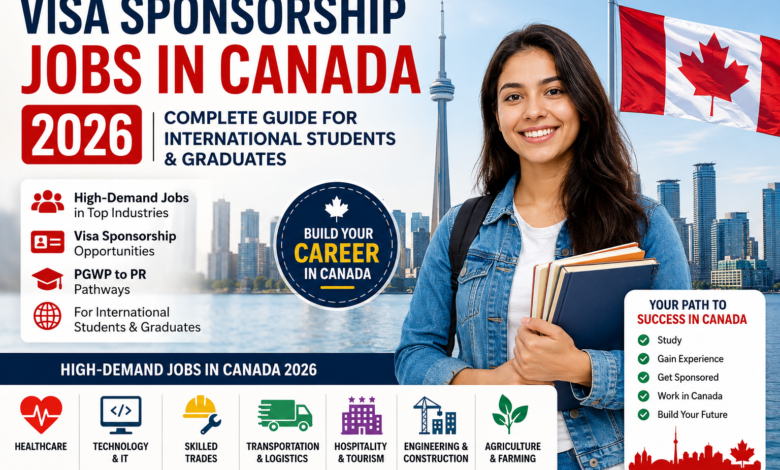
If you are an international student nearing graduation in Canada or someone abroad deciding whether a Canadian degree is still worth the investment one question keeps surfacing in 2026: can you actually get a job that leads to staying here? Can I ever succeed visa sponsorship jobs Canada 2026
The honest answer is yes. But the landscape has changed significantly, and the graduates who succeed are not the ones applying to the most jobs. They are the ones who understand how the system works, target sectors with genuine shortages, and start building their strategy before graduation day.
Canada still faces deep labour gaps across healthcare, skilled trades, technology, and transportation. The government continues to set ambitious permanent residence targets 380,000 new PRs annually through 2028. And for international graduates already inside the country, 2026 actually presents less competition than previous years, partly because study permit numbers were cut nearly in half, dropping from roughly 305,000 in 2025 to 155,000 in 2026.
This guide breaks down exactly what has shifted, which sectors actively sponsor international talent, how the PGWP pathway works under the new rules, and what realistic timelines look like for the study-to-PR journey in 2026. No sugar-coating, no recycled talking points.
What “Visa Sponsorship” Actually Means in Canada
Before searching for sponsored roles, it helps to understand what the term means in the Canadian context because it works differently than in places like the United States.
In Canada, “visa sponsorship” generally means an employer supports a foreign worker’s work permit authorization. That may involve:
- LMIA-supported hiring the employer applies to Employment and Social Development Canada for a Labour Market Impact Assessment, proving no qualified local was available for the role
- LMIA-exempt work permits available through the International Mobility Program for certain multinational transfers, intra-company moves, or trade agreements
- Provincial Nominee Program support an employer backs a candidate’s provincial nomination application
- Permanent residence pathway assistance an employer supports an Express Entry or PNP application over time
Here is the part many guides miss: most international students do not need immediate employer sponsorship right after graduation. The Post-Graduation Work Permit (PGWP) gives graduates an open or employer-specific work authorization that lets them gain Canadian experience first. Sponsorship, in the traditional LMIA sense, often comes later — when the PGWP approaches expiry and both the employer and employee want to extend the relationship.
That sequence matters. Understanding it prevents a lot of confusion and wasted applications.
Why Visa Sponsorship Jobs in Canada Are Trending in 2026
Several converging forces explain the sharp global rise in searches related to Canada work sponsorship especially from Nigeria, Ghana, Kenya, the Philippines, and other regions.
Labour shortages have not resolved. Aging demographics continue affecting healthcare, construction, transportation, skilled trades, and agriculture. Immigration now accounts for nearly 100% of Canada’s labour force growth. The government is not closing doors — it is being more selective about who enters.
PGWP reforms created urgency. Since November 2024, mandatory language testing applies to nearly all PGWP applicants. University graduates need Canadian Language Benchmark (CLB) 7 across all four skills; college graduates need CLB 5. Many graduates who assumed their Canadian degree would serve as language proof were caught off guard. Meanwhile, starting January 2026, new PGWP holders receive employer-specific permits rather than the fully open work authorization that defined the program for decades. Current PGWP holders keep full flexibility until their permits expire but the shift has prompted thousands to rethink their timelines.
Express Entry category-based draws reward in-demand skills. The 2026 categories explicitly target healthcare workers, tradespeople, STEM professionals, transport workers, educators, and French-proficiency candidates. For applicants whose backgrounds align with these areas, the path to permanent residence has actually become clearer.
Provincial Nominee Programs expanded significantly. PNP allocations surged 66% to 91,500 spots in 2026. Combined with a new fast-track transition pathway designed to move up to 33,000 temporary foreign workers and graduates to permanent status, the message from Ottawa is consistent: if you are already in Canada with in-demand skills, the system wants to keep you.
Social media visibility has amplified interest globally. Stories of successful PR journeys, PGWP walkthroughs, and salary comparisons circulate rapidly on YouTube, TikTok, Reddit, and WhatsApp — driving organic search interest that outpaces any formal recruitment campaign.
High-Demand Sectors for Visa Sponsorship Jobs in Canada (2026)
The government’s category-based Express Entry draws are the clearest signal of where genuine labour gaps sit. If your background aligns with one of these sectors, your path to employment and permanent residence moves considerably faster.
Healthcare and Social Services
Healthcare remains the single most reliable area for visa sponsorship potential. Canada has acute shortages across almost every province — over 6.5 million Canadians currently lack a family doctor. Registered nurses, personal support workers, lab technicians, pharmacists, and allied health professionals appear across every provincial shortage list.
A February 2026 physician-only Express Entry draw had a CRS cutoff of just 169, compared to general draws that regularly exceed 500. That gap illustrates how aggressively Canada is recruiting qualified healthcare talent.
| Healthcare Role | Typical Salary (CAD) |
| Registered Nurse | 75,000 – 110,000 |
| Personal Support Worker | 45,000 – 65,000 |
| Medical Laboratory Technologist | 60,000 – 85,000 |
| Pharmacist | 90,000 – 130,000 |
| Healthcare Aide | 38,000 – 58,000 |
Best provinces: Ontario, Manitoba, Saskatchewan, Nova Scotia, and Atlantic Canada all have dedicated healthcare immigration streams.
Important note: Internationally trained doctors and nurses still face provincial licensing requirements. Canadian work experience in healthcare even in a supervised or assistant capacity significantly strengthens a licensing and PR application.
Technology and STEM
Tech hiring has become more selective since the post-pandemic surge, but genuinely skilled candidates still find strong opportunities. Software engineers, data scientists, cyber security analysts, cloud engineers, and AI specialists continue appearing in sponsored roles.
Several major Canadian employers consistently sponsor international talent: Royal Bank of Canada hires software engineers and cyber security specialists. Amazon Canada recruits development engineers and cloud architects. Shopify sponsors software engineers, product managers, and UX designers. Deloitte Canada brings in technology consultants through its global mobility structure. Magna International sponsors mechanical, electrical, and industrial engineers.
| Tech Role | Typical Salary (CAD) |
| Software Engineer | 85,000 – 140,000 |
| Data Scientist / Analyst | 80,000 – 120,000 |
| Cyber security Analyst | 90,000 – 135,000 |
| Cloud Engineer | 100,000 – 150,000 |
| IT Support / Network Specialist | 55,000 – 90,000 |
What separates candidates who get offers from those who do not: Canadian internship or co-op experience, real-world projects or open-source contributions, relevant certifications (AWS, Google, CompTIA), and demonstrated communication skills. A degree alone rarely closes the deal.
Skilled Trades
This is the most consistently underestimated sector among international graduates who focus heavily on white-collar roles. Skilled trades face severe shortages driven by Canada’s housing construction targets and an aging tradespeople demographic.
The strong appeal of trades: they often pay well, require no university degree, benefit from dedicated Express Entry categories, and frequently appear on provincial priority occupation lists.
| Trade Role | Typical Salary (CAD) |
| Electrician | 70,000 – 100,000 |
| Plumber | 65,000 – 95,000 |
| Welder | 60,000 – 85,000 |
| Carpenter | 60,000 – 90,000 |
| HVAC Technician | 62,000 – 88,000 |
| Heavy Equipment Operator | 55,000 – 80,000 |
Experienced trade workers in remote industrial regions can earn well above these figures. Red Seal certification helps considerably, but many employers sponsor apprentices or workers with documented experience.
Transportation and Logistics
The 2026 Express Entry categories include a brand-new transport stream covering commercial pilots, aircraft mechanics, automotive service technicians, and logistics managers. Long-haul trucking remains one of the most consistently immigration-linked occupations in Canada, with ongoing LMIA positions appearing regularly on Job Bank.
| Transport Role | Typical Salary (CAD) |
| Long-Haul Truck Driver | 55,000 – 85,000 (plus overtime) |
| Logistics Coordinator | 50,000 – 75,000 |
| Warehouse Supervisor | 50,000 – 70,000 |
Education
Secondary school teachers, early childhood educators, and subject-specific instructors were added to Canada’s category-based Express Entry selection in 2026. Teacher shortages are reported nationwide, and provinces have moved aggressively to recruit internationally.
Agriculture and Agri-Food
The Agri-Food Pilot continues offering sponsored pathways for agricultural managers, food processing supervisors, and farm operations specialists. Certain agricultural business programs also remain eligible for PGWP, making this a viable route for both study and work.
Hospitality
Not every sponsorship role requires a degree. Hotels, restaurants, and tourism businesses still face chronic staffing shortages. Cooks, bakers, hotel supervisors, and restaurant managers regularly appear in LMIA-supported postings. Salaries in this sector are generally lower than tech or healthcare, but these roles can generate Canadian work experience that supports longer-term immigration pathways.
The Post-Graduation Work Permit is the bridge most international graduates use between completing studies and building a Canadian career. Understanding its 2026 rules is non-negotiable.
Key Changes for 2026
Language testing is now mandatory. Have your IELTS General or CELPIP results ready before applying. University graduates need CLB 7 across all four skills; college graduates need CLB 5. Waiting until after graduation to take this test has caught many applicants off guard.
Field-of-study restrictions apply to college graduates. The eligible fields list was frozen for all of 2026. College and polytechnic graduates must have completed a program linked to long-term shortage occupations. University degree holders bachelor’s, master’s, doctoral remain exempt from field restrictions, which is a critical planning consideration for anyone still selecting a program.
Master’s degrees now carry extra weight. Master’s graduates from qualifying programs receive a three-year PGWP regardless of program length. A one-year master’s that previously yielded only a one-year work permit now provides triple the window to build Canadian experience.
New PGWP holders receive employer-specific permits. The fully open work permit that defined the PGWP for decades no longer applies to fresh applicants from January 2026 onward. Current PGWP holders retain full flexibility until their permits expire.
PGWP Duration by Program Length
| Program Duration | PGWP Length |
| Less than 8 months | Generally ineligible |
| 8 months to 2 years | Approximately equal to program length |
| 2 years or more | Up to 3 years |
| Master’s degree (any length) | 3 years |
The 180-Day Rule
You have exactly 180 days from receiving confirmation of program completion to apply for your PGWP. Miss this window and the eligibility is gone permanently. The clock starts from your final grades or completion letter not convocation. Set a calendar reminder the day you receive that confirmation.
RECOMMENDED POST: Fully Funded Scholarships for African Students 2026: Masters & PhD Opportunities in UK, Germany & Canada
The Realistic PGWP-to-PR Timeline
The most searched question among international students is simple: how long does it actually take to go from graduation to permanent residency? Here is a grounded breakdown based on current processing realities.
The Standard Pathway: 3 to 4 Years Total
Phase 1. Apply for PGWP (Months 1–2) Submit within 180 days of graduation. Have your language test results ready before applying. You can begin working full-time while the application processes, provided you applied before your study permit expired and were eligible to work off-campus.
Phase 2. Accumulate 1,560 Hours of Skilled Work (Months 2–16) this is where strategy separates graduates who reach PR from those who run out of time. You need 12 months of full-time skilled employment in TEER 0, 1, 2, or 3 occupations. Working more than 30 hours per week does not accelerate the count. Part-time work counts proportionally.
Critical distinction: TEER 4 and TEER 5 jobs general labourers, food counter attendants, cashiers, retail sales associates do not count toward Canadian Experience Class eligibility. Taking “any job” after graduation is one of the costliest and most common mistakes graduates make. Even an entry-level administrative coordinator role (TEER 3) moves you forward. A restaurant server position does not.
Phase 3. Enter Express Entry and Wait for ITA (Months 16–20) Once you hit 1,560 hours in a qualifying role, you can enter the Express Entry pool under the Canadian Experience Class. CRS scores in the high 400s to low 500s are competitive in general draws. If your score sits below 500, pivot to a Provincial Nominee Program (which adds 600 CRS points, essentially guaranteeing an ITA) or a category-based draw aligned with your occupation.
Phase 4. PR Application Processing (Months 20–30) After receiving an Invitation to Apply, most successful applicants receive PR confirmation within 6 to 8 months, though IRCC backlogs can extend this.
Accelerated Pathways
PNP Graduate Streams: Several provinces require less than one year of work experience or no experience at all. Ontario’s Master’s Graduate stream requires only a completed degree, CLB 7 language scores, and proof of settlement funds. No job offer needed. A PNP nomination adds 600 CRS points.
Category-Based Selection: If your occupation falls into a priority category healthcare, trades, STEM, transport, education, French proficiency, senior management, or the physician/researcher streams you may receive an invitation through a targeted draw at a substantially lower CRS threshold.
The 33,000 Fast-Track Pathway: Canada’s 2026 Immigration Levels Plan includes a target of transitioning up to 33,000 temporary residents to permanent status through accelerated processing. If you are already in Canada with in-demand skills, the system is actively designed to retain you.
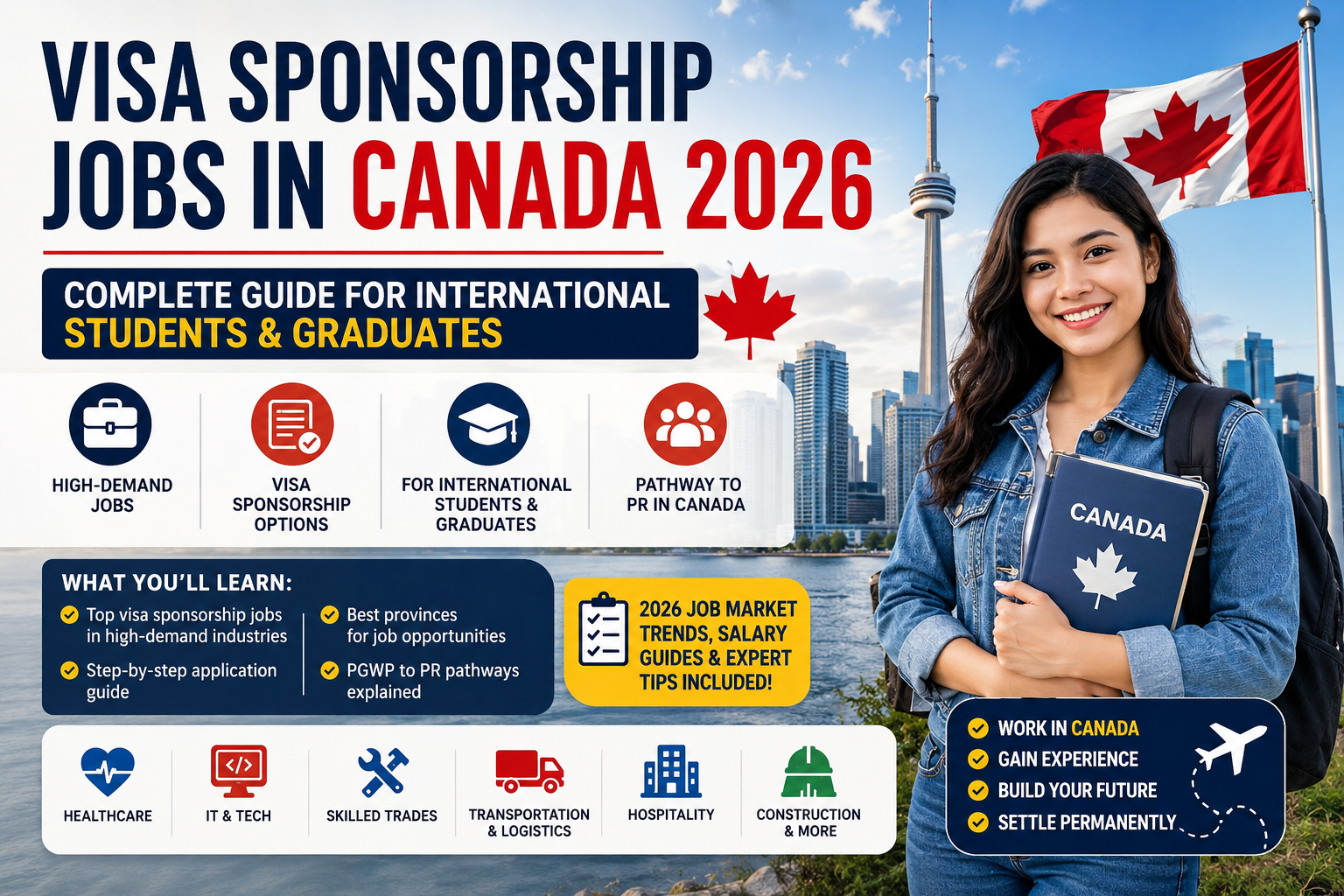
How to Find Legitimate Visa Sponsorship Jobs in Canada
Start With Government Platforms
The single most underutilized resource is Job Bank Canada’s Temporary Foreign Workers portal. Every employer here has been government-verified. As of early 2026, the portal lists over 4,000 active positions where employers have committed to or already received LMIA approval.
Filter by “LMIA approved” rather than “LMIA requested” whenever possible. An approved LMIA means the employer already has government authorization — your work permit application can proceed immediately. “LMIA requested” means the employer has applied but a decision could still take 2 to 4 months.
Cross-reference the quarterly positive LMIA employer list. Employment and Social Development Canada publishes quarterly lists of employers who have received positive LMIA decisions through Canada’s Open Government Portal. If a company appears here, they have successfully navigated the process before a strong indicator they can sponsor again.
Using Commercial Job Platforms Strategically
LinkedIn, Indeed Canada, and Glassdoor all carry relevant postings, but your search terms matter enormously. Instead of only searching “visa sponsorship jobs,” try:
- “LMIA available”
- “foreign worker welcome”
- “international graduates”
- “PGWP eligible”
- “relocation assistance”
These phrases surface postings that generic searches miss.
Red Flags That Signal Scams
Any employer or agent asking for a fee to “guarantee” an LMIA job is operating illegally. Employers cannot recover LMIA costs or recruitment fees from workers. Additional warning signs: job offers that arrive without an interview process, postings that lack verifiable company information, and pressure to provide passport details before any formal offer letter is issued.
The rule is straightforward: if you are paying for a job offer, it is almost certainly not legitimate.
Best Provinces for Visa Sponsorship Opportunities
Ontario has the largest job market finance, technology, and healthcare all concentrate here but also the highest competition and cost of living. Toronto and Vancouver attract enormous numbers of applicants; the volume makes standing out harder.
Alberta offers competitive salaries, lower provincial taxes, and strong demand across oil and gas, skilled trades, construction, and a growing tech ecosystem. Calgary and Edmonton both have active immigration streams and lower living costs than Toronto.
Saskatchewan and Manitoba receive less global attention but often provide easier immigration pathways, lower competition, and strong labour demand in healthcare and agriculture. These provinces actively recruit international graduates through targeted PNP streams.
Atlantic Canada Nova Scotia, New Brunswick, PEI, and Newfoundland continues using immigration programs to attract skilled workers. Healthcare, hospitality, trucking, and skilled trades all see active recruitment. Processing can be faster through Atlantic immigration pathways, and cost of living remains lower than central Canada.
For graduates with flexibility, smaller provinces often provide faster hiring timelines, less crowded immigration queues, and more direct relationships with employers.
Step-by-Step Guide to Getting a Sponsored Job in Canada
Step 1. Choose a high-demand field. Research labor shortages carefully. The government’s Express Entry priority categories are a reliable signal of where genuine demand sits.
Step 2. Confirm PGWP eligibility before enrollment. If you are selecting a college program in 2026, check that your CIP code appears on IRCC’s current eligible fields list. University degree students are exempt from field restrictions, but language requirements still apply to everyone.
Step 3. Book your language test early. Take IELTS General or CELPIP at least one semester before you finish. If you score below the required CLB level, you need time to retake the test before the 180-day PGWP window closes.
Step 4. Gain Canadian experience during your studies. The off-campus work allowance and co-op placements are opportunities, not afterthoughts. As of April 2026, co-op work placements no longer require a separate permit for post-secondary students, removing a major barrier. Even part-time work in your target sector builds references and resume depth.
Step 5. Prioritize TEER 0–3 employment from day one of your PGWP. Track your hours meticulously. Keep employment letters, pay stubs, and T4 slips organized from your first week incomplete documentation is one of the most preventable reasons for PR refusal.
Step 6. Build a Canadian-style resume. One to two pages, achievement-focused with measurable results, clean formatting, Canadian spelling. Many international applicants lose opportunities because of resumes that do not match local expectations.
Step 7 Network before you need it. Canadian hiring culture rewards relationships. Attend career fairs, join LinkedIn industry groups, connect with alumni, volunteer strategically, and reach out to professors with industry connections. Referrals consistently outperform cold applications.
Step 8 Once you have an offer, support the process. If an LMIA is needed, work closely with the employer to provide accurate documentation quickly. Be prepared to explain your specialized value not just your qualifications.
Step 9 Plan for permanent residence from month one. Use your Canadian experience for Express Entry or a PNP. Track your CRS score quarterly. If your score sits below 500 and no category-based draw aligns with your occupation, explore PNP options before your PGWP runs out not after.
Expert Tips for International Students in Canada
Program choice determines your PGWP eligibility. Business administration, hospitality, and general arts diplomas — historically popular with international students — have largely been removed from the PGWP-eligible fields list for college graduates. Healthcare, trades, STEM, agriculture, transport, and education programs dominate the approved CIP codes. If you are still selecting a program, this is the single most important decision you will make.
Learn French if you can. French-language proficiency is arguably the most powerful lever in the 2026 Express Entry system. Category-based draws for French speakers happen regularly, often at lower CRS thresholds than general rounds. Canada’s Francophone immigration target sits at 9% of total admissions for 2026, rising to 10.5% by 2028. Even intermediate proficiency opens Francophone-targeted PNP streams.
Francophone African applicants have a distinct advantage. For graduates from Côte d’Ivoire, Senegal, Cameroon, DR Congo, Rwanda, and other French-speaking African countries, this lever is worth pulling deliberately.
Consider credentials assessment early. If you trained as a healthcare professional or engineer abroad, start the WES or profession-specific credential recognition process during your studies — not after. The timelines are longer than most people expect.
Use immigration consultants for applications, not job searches. A Regulated Canadian Immigration Consultant can help with application strategy and documentation. They cannot get you a job, and any consultant promising employment in exchange for fees is operating illegally.
Start job hunting 3 to 6 months before your PGWP expiry. Waiting until the last two months creates dangerous pressure. The most successful transitions happen when graduates start planning their PR strategy during their study program, not after graduation.
Common Mistakes That Derail PGWP-to-PR Journeys
Missing the 180-day PGWP application deadline. This is irreversible. The clock starts from your completion confirmation, not your convocation. Set a calendar reminder the day you receive that letter.
Assuming a Canadian degree replaces language testing. Even a four-year program taught entirely in English does not substitute for an IRCC-approved language test result from within the last two years. No exceptions.
Working in TEER 4 or TEER 5 roles for too long. Survival jobs are understandable, but every month in a non-qualifying role is a month of your finite PGWP wasted. If you must take a survival job, keep actively searching for skilled work in parallel.
Applying randomly without strategy. Sending hundreds of generic applications rarely produces results. Tailored applications targeting employers familiar with international hiring significantly outperform volume approaches.
Ignoring smaller provinces. The competition in Toronto and Vancouver is fierce. Saskatchewan, Manitoba, and Atlantic provinces often offer better opportunities, faster immigration pathways, and employers who actively want international talent.
Neglecting networking during the study period. Students who begin building professional relationships before graduation often transition into full-time roles faster. Waiting until the job hunt starts puts you months behind peers who did not.
Incomplete employment documentation. Employment letters for PR applications must include job title, duties, hours worked, salary, and dates of employment on company letterhead. Generic letters or missing details trigger automatic refusals.
No-Degree Visa Sponsorship Options
Not every path requires a university credential. Skilled trades offer a viable route for candidates without degrees and trades shortages are as acute as any other sector.
However, a critical nuance applies: general construction labourers and similar positions sit at TEER 4 or 5, which means they do not count toward Canadian Experience Class eligibility. To use a trades job as a genuine PR pathway, you need to reach TEER 2 or 3 roles like carpentry, plumbing, welding, or electrical work which require trade certification or apprenticeship completion, not a university degree.
The practical path often looks like: enter Canada through a skilled trades certificate or apprenticeship program, complete the credential, use PGWP, secure TEER 2 or 3 skilled trade employment, and apply through Express Entry’s Federal Skilled Trades Program or a PNP.
Other non-degree sectors that can support sponsorship: caregiving, certain hospitality supervisory roles, agricultural management, and warehouse or logistics coordination at the supervisory level.
Salary Expectations for International Graduates in Canada
Salaries vary by province, sector, experience, and credential. A higher salary in Toronto may stretch less far than a moderate salary in Alberta or Atlantic Canada, given cost-of-living differences.
| Sector | Entry-Level Starting Salary (CAD) |
| Technology / STEM | 65,000 – 95,000 |
| Healthcare | 50,000 – 85,000 |
| Skilled Trades | 55,000 – 90,000 |
| Transportation / Logistics | 45,000 – 75,000 |
| Hospitality | 38,000 – 60,000 |
A note on trades specifically: experienced tradespeople particularly in remote industrial regions in Alberta, Saskatchewan, or BC regularly earn well above these ranges. It is not unusual for journeyman electricians or industrial welders to earn CAD 95,000 to 120,000 in those markets.
Frequently Asked Questions
Can international students get visa sponsorship directly after graduation? Yes, though the sequence typically runs through PGWP first. The PGWP provides work authorization while you build Canadian experience, which most employers expect before committing to direct sponsorship. In sectors facing critical shortages — healthcare, trades — some employers do sponsor internationally trained professionals more directly, especially if Canadian licensing processes run in parallel.
What are the best sectors for sponsorship in 2026? Healthcare, skilled trades, technology, transportation, education, and agriculture all categories explicitly prioritized in Canada’s 2026 Express Entry draws.
Which province is best for international graduates? There is no single answer. Ontario has the largest market. Alberta offers strong salaries and lower taxes. Saskatchewan, Manitoba, and Atlantic provinces offer easier immigration pathways, lower competition, and employers actively seeking international talent. Your field matters as much as geography.
Is French required? Not always, but French proficiency significantly improves chances across multiple Express Entry categories and opens dedicated PNP streams. For Francophone African applicants especially, it is worth pursuing deliberately.
What happens if my PGWP expires before I receive PR? If you have already submitted a PR application and received an Acknowledgment of Receipt, you may qualify for a Bridging Open Work Permit. If you have not yet submitted a PR application, your options narrow: you need an LMIA-supported work permit from an employer, a PNP nomination with work permit support, or you must leave Canada and apply from abroad.
Are there specific pathways for African applicants? There are no nationality-specific pathways Canada’s system evaluates occupation, language ability, education, and Canadian work experience regardless of origin. However, Francophone African applicants benefit meaningfully from French-language Express Entry draws and Francophone PNP streams that consistently clear at lower CRS thresholds.
Can I get a sponsored job without a degree? Yes, primarily through skilled trades and certain caregiving or agricultural roles. You generally need trade certification, apprenticeship training, or documented professional experience, and the role must sit at TEER 2 or 3 to count toward Express Entry eligibility.
How do I know if an employer’s sponsorship offer is legitimate? Cross-reference the employer on Job Bank’s verified listings and the quarterly LMIA positive employer list published by ESDC. Legitimate sponsorship never requires you to pay any fee upfront. If money changes hands before an offer letter, walk away.
The 2026 Canadian immigration landscape rewards preparation and penalizes assumptions. If you graduated from a university degree program in a high-demand field, have your language test results ready, and target TEER 0 to 3 employment from day one of your PGWP, the path from international student to permanent resident remains genuinely viable and less crowded than in previous years.
If you are a college graduate in a non-priority field, working in a TEER 4 or 5 role, or watching your PGWP approach expiry without a PR application in motion, the urgency is real. Explore PNP graduate streams now. Consider whether an additional credential in a shortage field makes strategic sense. Do not pay anyone for a job offer.
The process is harder, more technical, and less forgiving of missteps than it was three years ago. But for graduates who understand how the system works and move with intention targeting in-demand sectors, building Canadian experience, networking consistently, and staying current on policy Canada is still very much open for building a career and a life.
Start by confirming your PGWP eligibility, reviewing Job Bank’s verified LMIA positions, and identifying one or two provinces whose immigration streams align with your background. Small, consistent steps compound into real outcomes.