Fully Funded Scholarships for African Students 2026: Masters & PhD Opportunities in UK, Germany & Canada

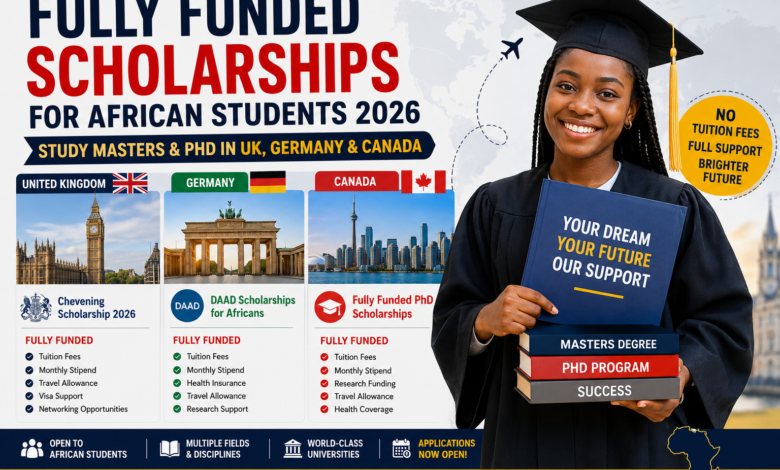
Fully Funded Scholarships for African Students 2026: Step-by-Step Application Process
There is a WhatsApp group circulating among Nigerian graduates right now. The pinned message lists five Fully Funded Scholarships for African Students 2026 entry opening. What it does not say is that three of those programmes will reject you instantly if your personal statement reads like a template pulled from a random blog.
That gap between knowing a scholarship exists and understanding how to actually win it is where most African applicants lose.
RECOMMENDED POST: Commonwealth Scholarship 2026–2027 Eligibility, Benefits & Winning Application Tips
The financial math is brutal. A standard master’s degree abroad now costs anywhere from $25,000 to $70,000 or more, before accommodation, health insurance, flights, or daily expenses. For most families across Nigeria, Ghana, Kenya, Uganda, and other African countries, self-funding that journey is simply not realistic. That is precisely why searches for fully funded scholarships for African students have grown sharply and why programs like Chevening, DAAD, and Vanier Canada continue to attract tens of thousands of African applicants each cycle.
This guide does not recycle the same surface-level lists. It gives you the precise eligibility requirements for each major program, the essay and motivation letter strategies that committees respond to, a month-by-month application calendar, and the specific mistakes that quietly eliminate strong candidates before they ever reach an interview.
Why These Programs Matter More Than Ever in 2026
Higher education costs keep rising while the skills demands of governments, international organizations, NGOs, and private employers grow more specific. The UK, Germany, and Canada fund these programs because they want future leaders who will contribute globally including in Africa. That alignment between what funders need and what strong African candidates offer is genuine, and it is worth understanding.
African scholars have gone on to lead government ministries, direct NGOs, run hospital systems, build businesses, and shape agricultural policy. The networks formed during these programs regularly span decades. This is not an aspirational claim it is the documented record that keeps governments renewing these investments year after year.
At the same time, scholarship committees are increasingly sophisticated. They read hundreds or thousands of applications per cycle and can identify a generic essay within the first paragraph. Academic records alone rarely win anything in 2026. What wins is a convincing story, backed by evidence, tied to a specific and credible future plan.
RECOMMENDED POST: Greece Scholarships for International Students 2026: Eligibility, Benefits and How to Apply
2026 Fully Funded Scholarships Comparison Table
| Scholarship | Country | Degree Level | Key Benefits | Approximate Deadline (2026 Entry) | Success Rate |
| Chevening Scholarships | UK | 1-year Master’s | Full tuition, £1,300–£1,600/month stipend, return flights, visa fees | Opens August 2025, closes November 4, 2025 (next cycle August–November 2026) | 3–5% |
| DAAD EPOS & Development-Related | Germany | Master’s & PhD | €934–€1,400/month + insurance, travel, rent subsidy, family allowance | Varies: August–December 2025, some into April 2026 | 15–25% |
| Vanier Canada Graduate Scholarships | Canada | PhD (3 years) | CAD $50,000/year | University nomination window: July–November 2025 | ~10% |
| Commonwealth Shared Scholarships | UK | Master’s (1 year) | Full tuition, stipend, airfare, thesis grant | October–December 2025 (tentative) | Varies |
| Mastercard Foundation Scholars | Multiple | Undergraduate & Master’s | Full tuition, living expenses, travel, mentorship | Varies by partner university | Varies |
| Erasmus Mundus Joint Masters | Europe (multi-country) | Master’s | Tuition, monthly stipend, travel, relocation | Varies by consortium | Competitive |
Always verify deadlines and benefits directly on official program websites. Adjustments occur annually.
Chevening Scholarships 2026: What African Applicants Must Get Right
The UK government’s Chevening programme is one of the most recognizable scholarships in the world — and one of the most misunderstood. Many applicants assume it rewards the highest GPA. It does not. Chevening is a leadership scholarship. The academic requirement is a floor, not the ceiling that determines who wins.
Nigeria, Ghana, Kenya, Uganda, and Tanzania consistently produce among the highest numbers of Chevening scholars globally. The 2026/2027 application opened in August 2025 and closed in early November. The next cycle follows the same pattern.
What Chevening Covers
- Full university tuition at any eligible UK institution
- Monthly living allowance (approximately £1,300–£1,600 depending on location)
- Return economy flights
- Arrival and departure grants
- Visa application fees
- Access to an exclusive global alumni network
Eligibility Requirements for African Applicants
- Citizenship of a Chevening-eligible country Nigeria, Ghana, Kenya, Uganda, South Africa, Tanzania, Rwanda, Cameroon, and most African nations qualify. Check the official list for any country under specific UK sanctions.
- An undergraduate degree equivalent to a UK 2:1 or above. For Nigerian applicants, that typically means a Second Class Upper Division.
- At least two years of work experience, totalling 2,800 hours. This is cumulative: paid roles, internships, volunteering, NGO work, entrepreneurship, and community projects all count. Work during your undergraduate degree qualifies if you averaged at least 10 hours per week. Only experience gained after secondary school counts pre-university activities do not.
- Application to three distinct eligible UK master’s courses. You do not need conditional or unconditional offers at the time of applying.
- A sincere commitment to returning to your home country for at least two years after graduation. Chevening panels take this seriously vague answers on this point cost applicants dearly.
The Essay Problem No One Names Directly
Chevening requires four essays of up to 500 words each: Leadership and Influence, Networking, Studying in the UK, and Career Plan. The Leadership essay is where most rejections happen not because candidates lack experience, but because they confuse holding a title with demonstrating influence.
The committee does not care that you were Vice President of the Student Union. They want a specific incident where your actions changed something measurable. Did you revamp a mentorship programme and increase attendance by 60%? Did you convince your department head to adopt a new system that cut processing time by two working days? Did you start a free after-school coding club in Ibadan that grew from five students to seventy-five?
That last example is leadership. Describe it with dates, obstacles you overcame, what specifically changed, and what happened after.
The Career Plan essay needs surgical precision. Not “I want to return to Nigeria and improve agriculture.” Instead: “I will join the Federal Ministry of Agriculture’s policy unit to adapt precision-farming frameworks studied during the MSc in Sustainable Agriculture at Newcastle University, targeting a 15% yield improvement for smallholder maize farmers in Kaduna State by 2030.” The more specific the plan, the more credible the return commitment reads.
Chevening Application Timeline for 2026/2027 Entry
| Phase | Timeframe | Action |
| Preparation | May–July 2025 | Shortlist three UK courses on the Chevening finder. Notify two referees (one academic, one professional where possible). |
| Drafting | August 2025 | Portal opens. Draft all four essays within the first two weeks. Do not wait for the portal to write. |
| Polishing | September–October 2025 | Get feedback from a Chevening alumnus via LinkedIn. Cut every sentence that does not earn its place. Submit UK university applications. |
| Submission | Early November 2025 | Submit. Deadline was November 4, 2025. |
| Shortlist | February–March 2026 | If shortlisted, prepare for a competency-based interview at the British High Commission. Practice the STAR method under timed conditions. |
| Offer | July 2026 | Unconditional offer deadline. You need at least one confirmed place. |
| Departure | September 2026 | Travel. |
DAAD Scholarships for Africans 2026: Germany’s Fully Funded Pathway
Germany’s DAAD is not a single award it is a family of programmes administered by the German Academic Exchange Service. The one African students win most consistently is the Development-Related Postgraduate Courses (EPOS) scheme, which funds master’s degrees and short courses in fields directly tied to global development: agriculture, public health, environmental science, regional planning, renewable energy, data science, and engineering.
The particular appeal of Germany for African students goes beyond the scholarship. Most public universities charge no tuition or minimal semester fees. Living costs, while not cheap, are lower than London. And hundreds of master’s programmes are taught entirely in English, which means you can start without German — though picking up A1 to A2 level helps daily life considerably.
What DAAD Scholarships Typically Cover
- Monthly stipend: €934 for master’s students, €1,300–€1,400 for PhD candidates
- Health, accident, and liability insurance
- Return travel allowance
- Study and research grant
- Rent subsidy and family allowance where applicable
- Pre-study German language course (two, four, or six months) if the programme is in German or if the institution requires it
DAAD EPOS Eligibility for African Applicants
- Citizenship of a developing country. Every African nation qualifies under the OECD DAC list.
- A bachelor’s degree of at least four years or equivalent, with above-average grades.
- At least two years of professional work experience after graduation. DAAD counts post-degree employment, not internships or work done during your undergraduate studies.
- No more than six years since your last degree though this varies by course, so always read the specific course description carefully.
- Language proficiency: IELTS 6.0–6.5 or TOEFL iBT 80+ for English-taught programmes; TestDaF TDN 4 or DSH-2 for German-taught programmes.
DAAD does not charge an application fee. If anyone contacts you offering to process a DAAD application for payment, treat it as a scam and walk away.
The Motivation Letter That Actually Wins DAAD
Most rejected DAAD applications fail on the motivation letter not the transcripts. The common pattern: candidates repeat their CV in prose, sprinkle in phrases about “international exposure” and “broadening horizons,” and say nothing that could not apply to any other candidate from any other country.
The DAAD motivation letter has one job: convince the selection committee that you are the missing link between this specific German programme and a concrete, documented development problem in your country.
Start by naming the problem with evidence. For example: “According to Nigeria’s Federal Ministry of Agriculture, an estimated 40% of the tomato harvest is lost annually due to post-harvest handling gaps. My three years at a Jos-based agribusiness exposed me to this directly.” Then identify which modules in the German programme address that gap. Use the published module handbook. Reference specific professors or research clusters. Show that you understand what the course actually teaches and why that knowledge, applied in your context, produces measurable benefit.
A Ugandan water engineer who received an EPOS scholarship built her entire letter around one rural district where only 30% of boreholes were operational. She mapped each semester of the MSc directly to a step in solving that system failure. She was awarded the scholarship on her first application.
DAAD Document Checklist
- DAAD application form (downloaded from the official portal)
- CV in reverse-chronological, tabular format no unexplained gaps
- Motivation letter, maximum two A4 pages
- Research proposal (PhD applications only)
- Two recommendation letters from recent employers or professors
- Academic transcripts and degree certificates (original and translated if necessary)
- Language proficiency certificate
- Signed reference forms if the specific course requires them
Deadlines for DAAD EPOS courses vary by programme. Most fall between August and December 2025, with some running into April 2026. The DAAD scholarship database at funding-guide.de is the only authoritative source. Do not rely on a blog post from a previous year.
Vanier Canada Graduate Scholarships 2026: Fully Funded PhD for Africans
Canada’s Vanier CGS is among the most generous doctoral awards available to international students anywhere in the world and it is open to Africans without nationality caps. The scholarship pays CAD $50,000 per year for up to three years, which covers tuition, living costs, and research expenses at most Canadian universities.
The critical distinction: you cannot apply to Vanier directly. You must be nominated by the Canadian university where you plan to pursue your PhD. Before any application exists, you need a professor willing to supervise your research and put your name forward to their institution’s internal scholarship committee.
How to Secure a Vanier Nomination as an African Applicant
Start this process no later than April or May of the year before your intended intake. University internal nomination deadlines typically fall between July and November.
- Identify universities with strong research concentrations in your field. For agriculture and food systems, look at Guelph and Saskatchewan. For public health, the University of Toronto and McGill. For engineering, UBC and Waterloo. For AI and data science, Vector Institute affiliates and Mila at McGill.
- Find three to five potential supervisors whose recent publications intersect with your interests. Read their last two or three papers carefully.
- Write a targeted email under 200 words. Reference a specific paper. Propose one concrete research question that connects their work to a documented challenge in your home country. Close with a direct ask: “Would you be open to a brief conversation about PhD supervision and potential Vanier nomination?”
- If they respond positively, arrange a video call. Discuss your research plan in detail. Ask directly whether the department nominates international students for Vanier.
- If a supervisor agrees, work with them on the nomination package: a research proposal, a leadership statement, and two letters of reference. Vanier weights academic excellence, research potential, and leadership equally all three pillars matter.
Even without Vanier, Canadian doctoral programmes often come with baseline funding packages: Ontario Trillium Scholarships, UBC’s Four Year Doctoral Fellowship, and various institutional awards can cover tuition and provide a living stipend. Vanier is the ceiling worth aiming for.
Commonwealth Shared Scholarships and Other Options Worth Knowing
Commonwealth Shared Scholarships are often overlooked by African applicants who focus exclusively on Chevening. The scheme is also fully funded tuition, stipend, airfare, and thesis grant but it is tied to specific master’s courses at partner UK universities. You choose from a published list rather than applying to any UK programme you want. The advantage is a smaller and more targeted applicant pool. Applications typically open around October 2025 for the following year’s entry.
Eligibility mirrors Chevening on the return commitment and bachelor’s degree requirements. Work experience is helpful but not always mandatory check the specific course page. Commonwealth African nations all qualify: Nigeria, Ghana, Kenya, Uganda, Cameroon, Tanzania, Rwanda, and many others.
Mastercard Foundation Scholars Program funds academically talented and economically disadvantaged African students at partner universities across the US, Canada, Europe, and Africa itself. Deadlines vary by partner institution, so check each one individually.
Erasmus Mundus Joint Masters are multi-country European programmes that place students at two or three universities across the programme cycle. Funding includes tuition, a monthly stipend, travel, and relocation support. For African students who want European exposure across multiple countries rather than one, Erasmus is worth serious consideration.
Best Fields for Scholarship Availability in 2026
Some disciplines consistently attract more funding than others, particularly from development-oriented programmes like DAAD and Commonwealth. If your background sits in one of these areas, you will find more options:
- Public health and epidemiology
- Agricultural science and food systems
- Climate science and renewable energy
- Environmental policy and water management
- AI, data science, and engineering
- Development economics and public policy
- STEM research broadly
- Education policy and governance
This does not mean candidates in humanities or social sciences cannot win Chevening in particular funds a wide range of disciplines. But knowing where development-scholarship funding concentrates helps you position your application strategically.
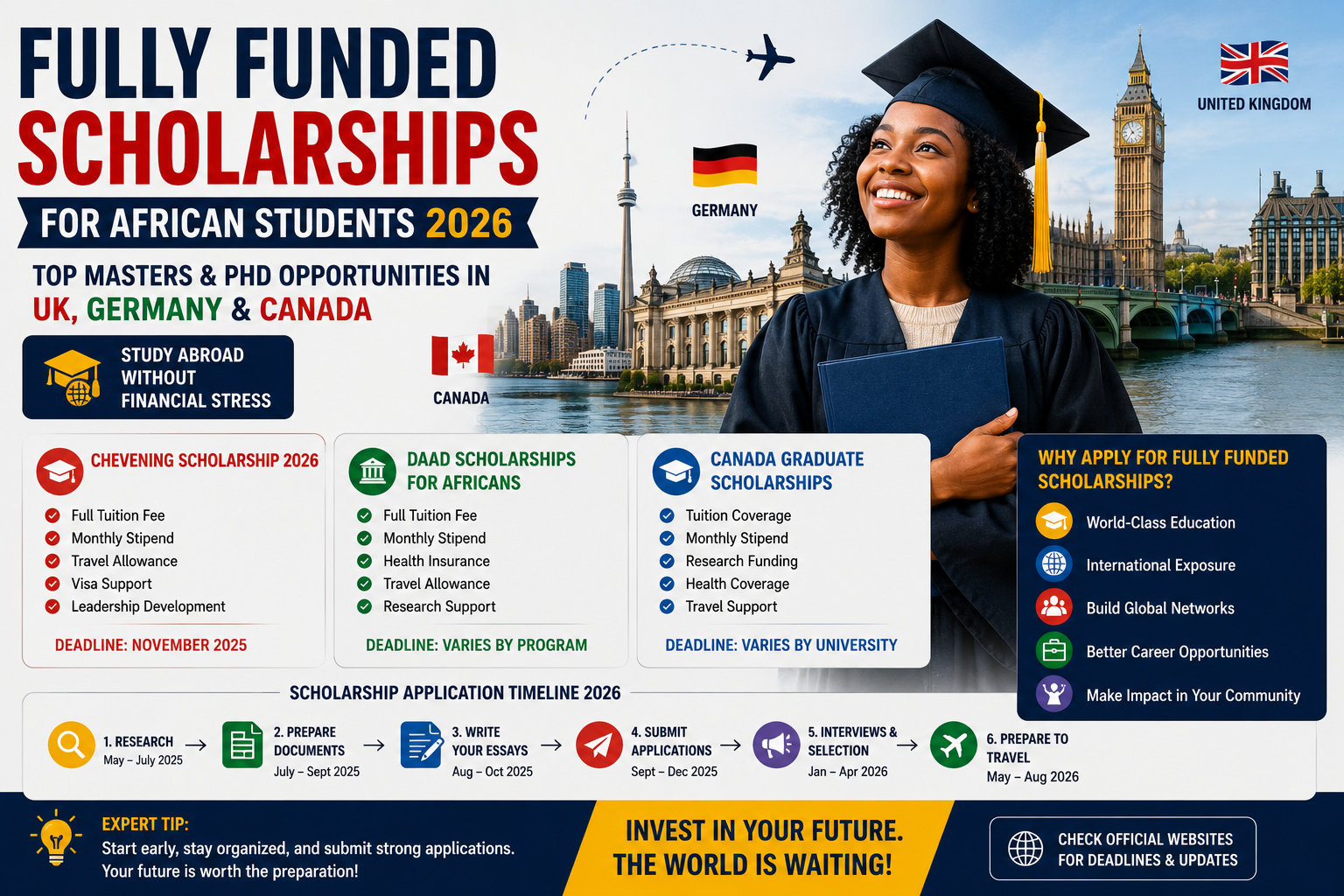
12-Month Application Calendar: Phase by Phase
Most failed applications are not caused by lack of talent. They fail because preparation started too late. A rushed essay is recognizable. A referees letter submitted at the last minute often reads like one.
May to July 2025: Build the Foundation
- Choose a primary scholarship and a backup.
- For Chevening: shortlist three eligible UK courses using the Chevening course finder. Note entry requirements for each.
- For DAAD: identify two or three EPOS courses that align with your professional background. Download and read the module handbooks.
- For Canada: start emailing potential PhD supervisors. These conversations take time.
- Contact referees now. Give each person a one-page briefing: what you are applying for, why, and what you want them to emphasize.
July to August 2025: Start Writing
- Chevening opens in August. Start drafting all four essays the same week the portal goes live — or earlier, since the prompts are publicly available year-round.
- Begin formal university applications for UK and German programmes. Do not wait for scholarship results.
- DAAD: confirm specific deadlines in the database and gather transcripts, language scores, and reference letters.
September to October 2025: Refine Everything
- Get feedback on Chevening essays from an alumnus if possible, or a mentor who can read critically. Cut ruthlessly.
- Tailor the DAAD motivation letter to each course’s specific curriculum and research focus.
- For Vanier: your supervisor should be finalizing the nomination package. Your research proposal needs to be strong and specific.
November 2025: Submit
- Chevening deadline: November 4, 2025.
- Most DAAD EPOS deadlines fall in this window.
- Vanier national nomination deadline closes in November (university-specific internal deadlines vary from July to October).
December 2025 to January 2026: Language Tests and University Offers
- Book IELTS or TOEFL if not already taken. Test centres in Lagos, Accra, and Nairobi fill up weeks in advance — do not leave this to the last minute.
- Monitor UK and German university portals. Secure at least one unconditional offer for Chevening by mid-July 2026.
February to April 2026: Interviews and Results
- Chevening shortlisted candidates receive interview invitations from the British High Commission. Practice competency-based responses using the STAR method under timed conditions.
- DAAD selection panels convene.
- Vanier results are announced, typically in April.
May to August 2026: Finalize
- Accept your offer.
- Apply for your visa. For Chevening recipients, the Immigration Health Surcharge (£776 per year) is covered but understand what it is before your visa appointment. German visas require a blocked account unless you hold a full DAAD scholarship certificate.
- Arrange accommodation early. University halls fill quickly.
- Book flights and confirm arrival dates with your host institution.
What Scholarship Committees Actually Look For
Understanding the evaluation criteria behind each programme changes how you approach every document in your application.
Authentic storytelling not motivational clichés. Reviewers can identify a manufactured narrative within two paragraphs. The applicants who stand out describe real experiences, including failures and how those shaped their thinking.
Quantified evidence specificity that could only come from lived experience. “Led a team that increased school enrollment by 40%” is concrete. “Contributed to improving educational access” means nothing. If you ran a programme, name the numbers: participants, outcomes, timeline, what changed.
Scholarship-specific framing Chevening rewards leadership and influence. DAAD values development relevance and academic rigour. Vanier prioritises research excellence. The same experience should be framed differently for each.
Credible future plans the return commitment for UK and German scholarships is non-negotiable, and it needs to be backed by a realistic plan. “Work for an NGO in Lagos” is not a plan. “Join the Lagos State Ministry of Health’s maternal health taskforce, applying epidemiological modelling learned during the UCL MSc to reduce maternal mortality in Alimosho LGA” is a plan.
References that say something specific supply your referees with a bullet-point list of your relevant achievements and each scholarship’s evaluation criteria. A generic letter about being “hardworking and dedicated” does nothing. References that name specific projects, results, and skills are what committees remember.
Common Mistakes That Eliminate Strong Candidates
Using one personal statement across multiple scholarships. Chevening’s prompts are nothing like DAAD’s. A DAAD motivation letter is not a Canadian research proposal. Each document needs to be written for that programme’s criteria. A recycled paragraph stands out immediately and not in a good way.
Vague return-to-home-country statements. If the scholarship requires post-graduation return (Chevening, DAAD, Commonwealth all do), you must explain exactly where you will work and on what problem. Vagueness reads as uncertainty about the commitment itself.
Underestimating or overcounting Chevening work experience. Some applicants include experience that does not count; others omit experience that does. Read the official guidance carefully. Pre-graduation activity counts only if you averaged at least 10 hours per week during undergraduate studies.
Waiting until the final week to finalize documents. Applications assembled in a rush feel like it. Transcripts take time to request and translate. References from busy professionals need advance notice — not 48 hours.
Choosing programmes based solely on funding, not fit. Committees assess whether your background and stated goals align logically with the programme. An applicant with a marketing background applying for an agricultural engineering MSc with no relevant experience raises questions.
Sending form emails to Canadian professors. “Dear Sir, I am interested in your research” emails are ignored. A specific, brief email referencing two papers and proposing a one-sentence research question has a meaningfully higher response rate.
Ignoring DAAD deadline variations. DAAD EPOS deadlines change from year to year and vary by course. Checking a cached blog post or a previous year’s screenshot has caused serious applicants to miss their window. The DAAD funding database is the only reliable source.
Expert Tips From People Who Have Done This
- Connect with Chevening, DAAD, and Vanier alumni from your country on LinkedIn. Their insight on essays, interviews, and what actually tripped them up is more specific and honest than any generic guide.
- For Chevening, reach out to the British High Commission alumni network in your country — many host pre-application information sessions or informal Q&A events.
- For DAAD, contact the DAAD Information Centre in your country. Most African capitals have one, and they offer free application support, including feedback on motivation letters.
- Apply to multiple scholarships strategically. Even excellent candidates face rejection. Running two or three strong, tailored applications increases options without compromising quality.
- Prepare for Chevening interviews by recording practice responses to competency questions and watching the playback. Time compression under interview conditions is a skill that needs rehearsal.
- For Canadian PhD programmes, being persistent but courteous in follow-up emails to professors is expected. One email rarely gets a response. Two to three, spaced a few weeks apart, is normal.
Frequently Asked Questions
What are the best fully funded scholarships for African students in 2026?
Chevening (UK), DAAD development-related master’s and PhD programmes (Germany), Vanier Canada Graduate Scholarships, Commonwealth Shared Scholarships (UK), Erasmus Mundus Joint Masters (Europe), and the Mastercard Foundation Scholars Program consistently rank as the strongest options for African applicants. Each covers tuition, living costs, health insurance, and travel.
Does Chevening require work experience?
Yes. The minimum is 2,800 hours after your undergraduate degree roughly two years of full-time work. The count is cumulative and includes paid employment, internships, volunteering, NGO roles, and entrepreneurship. Work during undergraduate studies counts if you averaged at least 10 hours per week.
How competitive is DAAD for African applicants?
Highly competitive. Some EPOS courses receive several hundred applications for 15 to 25 available spots. Strong transcripts, a motivation letter that maps the German curriculum to a specific home-country development problem, and complete, accurate documentation are the main differentiators.
Can I apply for both Chevening and a Commonwealth Shared Scholarship in the same year?
Yes. They are separate schemes with separate application processes. Applying to both is a smart way to increase your chances of securing full UK funding. If offered both, you accept one.
How does the Vanier nomination process work?
You cannot apply directly. A Canadian university must nominate you. That means securing a PhD supervisor who agrees to your research plan and puts your name forward to their institution’s scholarship committee. The committee selects candidates for the national competition. University internal deadlines typically run from July to October 2025 for the 2026 cycle.
Is IELTS required for DAAD scholarships?
If the programme is taught in English, the host university will almost always require IELTS (typically 6.0–6.5) or TOEFL iBT (typically 80+). Some programmes accept documented evidence of previous English-medium education. German-taught programmes require TestDaF TDN 4 or DSH-2. Always check the specific course page the language certificate requirement is non-negotiable.
Are there fully funded scholarships that do not require returning to Africa after graduation?
Most government-funded scholarships Chevening, DAAD, Commonwealth include a return requirement of two or more years. Some university-specific or private foundation awards do not carry this obligation. Canadian PhD programmes frequently lead to post-graduation work permits under Canada’s immigration system and do not legally require return, making them appealing to applicants whose long-term plans are less fixed.
Which fields have the most scholarship availability for Africans in 2026?
Public health, agriculture, climate science, renewable energy, environmental policy, AI, data science, and development economics attract the most dedicated funding, particularly from development-oriented programmes like DAAD and Commonwealth. Chevening funds a broad range of disciplines but continues to prioritise applicants working in governance, policy, and public service.
Where to Go From Here
Reading about scholarships is the easy part. The gap between knowing and doing is where most applicants stay stuck indefinitely.
Here is a concrete next step. Open a document. Write a single paragraph right now, before this browser tab closes describing the development problem in your country that your proposed studies will address. Make it specific. Include at least one number. Then identify the scholarship that best matches your field and timeline, and note its deadline in a calendar.
If you are targeting Chevening, the next application window opens in August 2026. Your essays should be drafted before the portal goes live. If it is DAAD, check the funding-guide.de database today for your chosen course. If Canada is the direction, send the first professor email before this week ends.
The difference between someone who wins a fully funded scholarship and someone who only ever plans to apply is almost never talent. It is the willingness to start earlier than feels comfortable, to revise more than feels necessary, and to treat the application itself as a project worth professional-level effort.
The seats exist. African scholars fill them every year. Yours is still available.