How to Study Smarter Not Harder in 2026: Proven Methods That Actually Work
How to study smarter not harder (2026 guide): study techniques that actually stick

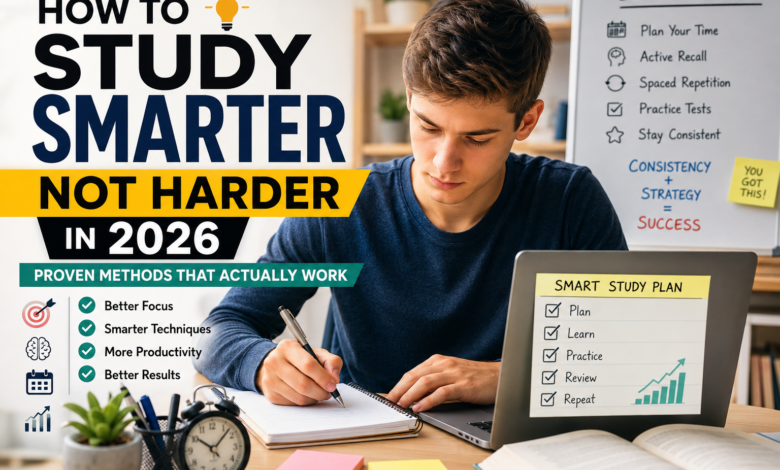
You’ve done it before. Highlighters out, textbook open, three hours gone and at the end of it, you couldn’t explain the chapter if someone paid you. That feeling isn’t a sign you’re lazy or incapable. It’s a sign you’ve been handed the wrong tool for the job.
Most students aren’t failing because they don’t put in effort. They’re struggling because the methods they rely on rereading, highlighting, marathon study sessions are optimized for feeling productive, not for becoming competent. There’s a real difference, and it shows up at exam time.
This guide is built around one idea: how to study smarter not harder means changing what happens inside your study sessions, not just how long they run. You’ll get the science behind why certain techniques work, a practical loop you can start using today, and a realistic plan that holds up on busy days, not just perfect ones.
Whether you’re a high school student juggling coursework, a university student facing finals, or a professional upskilling in your field this is a system you can actually use.
Why Studying Harder Doesn’t Work (And Why It Feels Like It Should)
Here’s the uncomfortable truth: the most common study habits rank among the least effective in educational research. A landmark review of ten popular learning strategies found that highlighting and rereading two of the most widely used methods had low utility for long-term retention. Students don’t use them because they work. They use them because they feel like work.
Psychologists call this the fluency illusion. When you read a page you’ve seen before, the material feels familiar. That familiarity gets mistaken for understanding. Then the exam arrives, the page isn’t in front of you, and the answers don’t come because recognition and retrieval are completely different cognitive tasks.
Add in the reality of studying in 2026 constant notifications, AI tools that summarize everything instantly, and social media algorithms built to steal your attention — and passive study methods become even less effective. Fragmented focus prevents the kind of deep encoding that makes information stick.
The fix isn’t more hours. It’s better mechanics.
RECOMMENDED POST: Chevening Scholarship 2026 for African Students Complete Guide & Essay Tips
When you measure actual retrieval instead of time at a desk, everything changes.
The 2026 Study Mindset: Active Output Over Passive Consumption
Smart studying in any era shares two features. The best systems in 2026 are no different:
They require active output. Answers you produce from memory, concepts you explain in your own words, problems you solve without a worked example in front of you.
They include fast feedback. Checking your answers quickly, comparing your recall to a solution, reviewing an error log so you correct mistakes before they get reinforced.
If your study sessions don’t include both of those things, you’re training recognition, not mastery. Recognition doesn’t hold up under exam conditions.
The Core Smart-Study Loop (Works for Any Subject)
Before diving into individual techniques, here’s a repeatable framework that ties everything together. Run this loop in a single session or spread it across days.
Step 1: Prepare (2 to 10 minutes)
Define what you’re studying and what “knowing it” looks like. A question set? A set of terms? The ability to solve a specific problem type? Vague goals produce vague results.
Step 2: Retrieve (10 to 35 minutes)
Use an active recall method practice questions, free recall writing, flashcard prompts, or explaining a concept from memory. No notes until after you’ve tried.
Step 3: Correct (5 to 15 minutes)
Check the right answers. More importantly, understand why your recall failed wrong formula, missing detail, confused concepts, misread question. The reason matters as much as the fact.
Step 4: Strengthen (10 to 20 minutes)
Apply spaced repetition to what you missed. Mix a small amount of older material into the session so your brain stays flexible and doesn’t just remember the last thing it touched.
Step 5: Reflect (1 to 3 minutes)
Note your most common error type and the smallest useful next step. This sets up the next session and makes restarting easier.
Simple structure. The power comes from doing it consistently, not from doing it perfectly.
Best Study Methods in 2026: Ranked by Effectiveness
Different subjects and learning goals call for different tools but effectiveness almost always tracks back to one thing: how often you make your brain retrieve.
1. Active Recall Study Method — Top Tier
Active recall means producing information from memory rather than re-reading it. It strengthens the neural pathways associated with that memory far more than any passive review.
Practical ways to use it:
- Write everything you remember about a topic before opening your notes (the “blank page” method).
- Answer practice questions without peeking.
- Explain a concept out loud as if teaching someone even to an empty chair.
- Use flashcards that require you to produce an answer, not just recognize one.
Example for science students: Instead of rereading the cellular respiration chapter, write the steps from memory, draw the pathway arrows, then answer: “Where does glycolysis occur, and what’s the net ATP yield?” Check your diagram against a labeled version and log what you missed.
The act of struggling to retrieve even getting things wrong signals to your brain that this information needs to be retained. That’s the mechanism. Don’t avoid the difficulty.
2. Spaced Repetition Techniques — Top Tier for Long-Term Memory
Hermann Ebbinghaus mapped the forgetting curve in the 19th century: we lose information exponentially if we don’t reinforce it. Spaced repetition works by scheduling reviews at the optimal moment — right before you’re about to forget.
A practical manual schedule:
| Review Session | When to Review |
|---|---|
| 1st Review | Same day (within a few hours) |
| 2nd Review | Day 2 |
| 3rd Review | Day 4 |
| 4th Review | Day 8 |
| 5th Review | Day 15 |
| 6th Review | Day 30 |
Each session should involve active recall, not re-reading. In 2026, apps like Anki and RemNote automate this scheduling based on how well you recalled each item. You focus on the learning; the algorithm handles the timing.
What to use spaced repetition for: vocabulary, formulas, key concepts, process steps, dates and events — anything that must be retrieved reliably.
What not to overdo: items you already consistently recall, large text chunks with no specific retrieval target, or concepts you can easily look up during practice.
3. Interleaving — When You Need to Apply Knowledge, Not Just Know It
Most students block their practice: three hours of algebra, then three hours of biology. Interleaving flips this by mixing different problem types or subjects within a single session.
It feels harder. That’s the point. Constantly switching forces your brain to figure out which strategy fits which problem — which is exactly what an exam requires. Research on both motor skills and academic subjects consistently shows that interleaving improves long-term performance, even though short-term performance feels messier.
A simple start: take 10 questions from your current chapter and 5 from something you studied three weeks ago. Do them in mixed order. The rustiness on older material is the signal your brain needs to reinforce it.
4. The Feynman Technique — For Genuine Understanding
If you can’t explain something simply, you don’t understand it deeply yet. The Feynman Technique makes that gap visible.
How it works:
- Choose a concept.
- Explain it in plain language, as if teaching a beginner.
- Identify where your explanation breaks down or gets vague.
- Return to your source material for those specific gaps.
- Simplify and explain again.
Particularly effective for science, math, history, and any essay-based subject where surface-level recall isn’t enough.
5. Retrieval-First Note Taking — Smarter from the Start
Instead of notes as a transcript, build notes as a set of future questions:
- “If I see X, what do I do?”
- “What are the exceptions to this rule?”
- “What’s the functional difference between A and B?”
This reframes the entire reading or lecture experience as material for future retrieval, not a record of what you covered.
6. Summaries — Useful Only After Retrieval
A good summary is a recovery tool, not a starting point. Attempt recall first, then summarize to close the gaps you found. Summaries done this way are far more useful than summaries produced during reading, because they reflect actual knowledge gaps instead of passive familiarity.
Spaced Repetition and Active Recall: How They Work Together
These two techniques are more powerful in combination than either is alone. Active recall on day one. Another recall session on day two. A short gap, then recall again on day four. You’re not just re-exposing yourself to the information — you’re repeatedly retrieving it at the exact moment it’s beginning to fade. That’s the sweet spot for durable memory.
A 20-minute spaced review of material from three days ago is often worth more than a full hour of new input, if that material is sitting on the edge of being forgotten.
Study Techniques for Students With Real Schedules
Perfect motivation doesn’t exist. Here are methods that work around busy days, exhaustion, and uneven energy.
The Recall Block (20 to 25 minutes)
- 20 minutes: retrieval practice — questions, flashcards, recall writing.
- 5 minutes: check answers and correct.
Do 2 to 4 blocks per session depending on energy. Each block is complete on its own — you don’t need to finish a unit to have a productive session.
The Two-Question Rule for Busy Days
If time is genuinely short, still do retrieval. Choose two high-quality questions, answer from memory, check and correct. It sounds minimal, but it prevents your learning momentum from disappearing entirely between sessions.
The Error Log Method
Keep a simple running list:
| Topic | My Answer | Correct Answer | Why I Missed It | Prevention |
|---|
This turns mistakes into a personalized study map. Over time, patterns emerge — and those patterns tell you exactly where to spend your limited time.
The Explain-Then-Verify Technique
Explain a concept out loud or in writing without notes. Then verify using your material. Especially effective for history, biology, and any subject where reasoning and connection matter more than raw memorization.
Pomodoro and Time Structure: Matching the Block to the Task
The classic Pomodoro Technique — 25 minutes of work, 5-minute break — still works well for flashcards and short problem sets. For deeper analytical work like writing or complex problem-solving, a 50/10 split (50 minutes focused, 10 minutes away from screens) tends to work better because it gives you time to gain momentum before pulling you out.
The real upgrade in 2026 is digital enforcement. Focus apps, custom device modes that silence everything except essential contacts, and accountability tools like Focusmate (live coworking with a real partner over video) protect those work blocks from the attention economy that’s constantly trying to reclaim them.
One caution: don’t turn breaks into micro-scrolling sessions. Social media during a study break floods your brain with dopamine and pulls your mental context completely away from what you were studying. Stand up, stretch, look out a window, drink water. Let your brain idle in a way that doesn’t hijack the next session.
Effective Study Habits: Build a System, Not a Mood
Good habits aren’t about willpower. They’re about friction and structure.
Plan Backward from the Exam
If you know your exam date, build your plan from there:
- What topics and formats will be tested?
- What do you need to practice most (often not what you’ve read most)?
- When can you schedule retrieval sessions early enough that last-minute review is light, not frantic?
Match Time Blocks to Attention Span
15 to 25 minutes for flashcards or short problem sets. 45 to 90 minutes for mixed practice and deeper problem-solving. Starting sessions with retrieval — even 5 minutes of recall prompts — immediately tells you what you actually know versus what feels familiar.
End with a Next Action
Before stopping, write exactly what you’ll do in the next session. “Tomorrow I’ll reattempt the three question types I missed today.” This eliminates the restart overhead that kills consistency.
Consistency Over Intensity
On low-energy days, shrink the session rather than skipping it. 15 minutes of gentle retrieval keeps the habit intact and sidesteps the guilt spiral that often turns a missed session into a missed week.
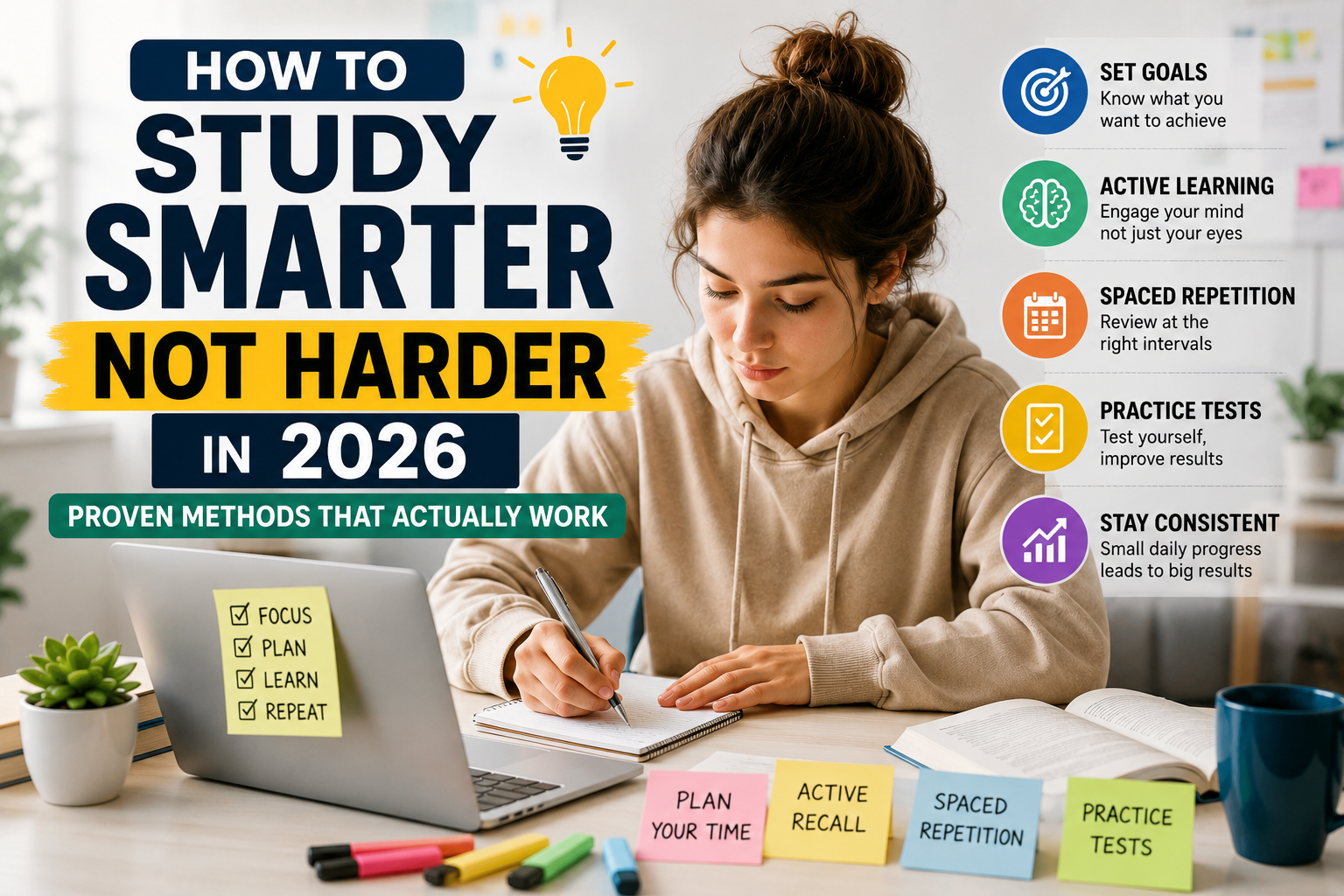
Environment Design: Make Focus the Default
Your surroundings shape concentration more than most students realize. A dedicated study space signals “work mode” to your brain. A cluttered, notification-heavy space signals the opposite.
Practical setup:
- Clear desk with only current materials.
- Good lighting — natural light where possible, a warm lamp otherwise.
- Noise control — noise-cancelling headphones, ambient sound, or silence depending on what your work requires.
- Phone in another room during study blocks. Physical separation outperforms willpower every time.
In 2026, grayscale mode on your phone is a surprisingly effective deterrent. Apps look a lot less appealing in black and white. On most devices, you can automate this during your study hours via digital wellbeing settings.
Sleep, Exercise, and Nutrition: The Biology You Can’t Outsmart
This isn’t wellness advice for its own sake. Sleep is when memory consolidation happens. During deep sleep, your brain reactivates and strengthens the neural patterns formed during the day. A 90-minute study block after a full night’s sleep produces significantly better retention than three hours of studying after four hours of sleep.
If you’re choosing between one more hour of review and one more hour of sleep the night before an exam — choose sleep. You’ll retrieve more of what you already know, and your reasoning will be sharper.
Moderate aerobic exercise increases BDNF, a protein that supports neuroplasticity. A 20-minute walk between study blocks works as a mental reset and mood boost — both of which directly affect motivation and encoding quality.
For nutrition: stable blood sugar improves focus. Protein and fiber with meals, water at your desk, and avoiding a large sugar spike an hour into your session are more useful than any supplement marketed to students.
Study Tips for Exams: Practice Like the Test, Not Like the Textbook
Exams test recall speed, method selection under pressure, application of concepts to new contexts, and reading comprehension of tricky questions. Studying the chapter is not the same as training for those conditions.
The Three-Pass Exam Preparation Plan
Pass 1 — Foundation: Learn and retrieve basics. Keep timing flexible. Build understanding.
Pass 2 — Application: Mixed questions. Focus on choosing the correct approach, not just knowing the answer.
Pass 3 — Speed and Accuracy: Timed sets, error review, and targeted drilling of weak spots.
This creates both knowledge and performance. One without the other usually falls short on exam day.
The Blank Page Method
The day before a test, pull out a blank sheet and reconstruct the entire subject from memory key concepts, formulas, connections between ideas. Gaps appear quickly. Then, and only then, open your notes to fill in what’s missing. It’s active recall scaled to the whole subject, and it’s one of the most efficient pre-exam tools available.
A Practical 14-Day Study Plan
Adapt this to your schedule. The goal isn’t perfection — it’s building a system where you consistently learn from feedback.
Days 1 to 3: Retrieval quiz (30 to 40 minutes), correct mistakes, create flashcards or retrieval-style notes for what you missed. Optional third block for mixed practice.
Day 4: Interleaving day. Mix two related topics and focus on choosing the right approach rather than just applying a memorized method.
Day 5: Error log focus. Review your top five error types and do targeted practice until accuracy improves.
Days 6 to 7: Lighter days — two recall blocks is enough. Maintain consistency and refresh memory without overloading.
Days 8 to 10: Spaced repetition begins in earnest. Review earlier cards and missed items. Add new cards only after accuracy on existing ones is stable.
Days 11 to 14: Exam-style sets with timing. Review errors thoroughly after each. Add weak-spot items to your review queue. Use the blank page method for full-subject reconstruction.
Common Mistakes and How to Fix Them
Rereading as the primary strategy. It creates familiarity, not mastery. Fix: switch to retrieval-first. Rereading becomes a verification step only after you’ve attempted recall.
Highlighting without testing. After reading, close the material and attempt recall. Highlight only what you missed during that test — not what seems important while reading.
Cramming in large blocks. Break material into smaller sessions across multiple days with spaced repetition for retention. Cramming produces quick forgetting.
No error analysis. A mistake without a diagnosis repeats. Keep an error log and categorize: concept gap, miscalculation, misread question, wrong strategy selection.
Flashcards only for definitions. Add application prompts: “When would you use X instead of Y?” and “What are the steps and why?” and “Create an example.” Definitions alone don’t build usable knowledge.
Confusing familiarity with mastery. If you can’t reproduce it without the page, you don’t fully know it yet. Mini quizzes and blank-page recall expose this gap before the exam does.
Studying while exhausted. Mental fatigue reduces encoding quality dramatically. If your attention keeps fragmenting and you can’t recall what you read two minutes ago, stop. Sleep or rest will do more for your results than zombie studying.
Expert Tips: What High-Performing Students Actually Do
They study what they can’t do yet. Most people gravitate toward comfortable material. Strong students treat difficult topics as priority because they produce the biggest gains per hour.
They keep sessions short enough to stay honest. Long sessions let students hide behind “time spent” and avoid the discomfort of testing. Short, high-accountability blocks force real engagement.
They ask better questions. Instead of “What is photosynthesis?”, they ask: “What changes if light intensity decreases?” and “How does oxygen production relate to total energy conversion?” Better questions reveal whether understanding is real or superficial.
They use the two-question rule to maintain momentum. They never let a full day go by without some retrieval, even a minimal amount. Habits preserved on bad days are habits that survive.
They don’t treat studying as one activity. Retrieval, feedback, correction, and spaced review are separate things that they deliberately combine. That variety reduces burnout and covers all the cognitive bases.
They use habit stacking. A new study habit gets tied to something that already happens automatically: “After I pour my morning coffee, I do 10 minutes of flashcard review.” The existing habit acts as a reliable trigger. This works far better than waiting to feel motivated.
Quick Reference: Choosing the Right Method
| Goal | Best Method | Example |
|---|---|---|
| Learn new facts | Active recall with flashcards | Prompt, answer, check |
| Remember long-term | Spaced repetition | Review missed items sooner |
| Improve exam performance | Timed mixed practice | Short past-paper sets |
| Build deeper understanding | Retrieve, explain, verify | Teach from memory, then check |
| Reduce repeated mistakes | Error log | Categorize misses and drill them |
| Complex subjects | Feynman Technique | Explain simply, find gaps, refine |
| Sustained focus | Pomodoro or 50/10 blocks | Single-task with timed intervals |
AI Tools in 2026: Useful Support, Not a Replacement for Thinking
AI learning tools are mainstream now and they can genuinely help when used properly. Generating practice questions, explaining concepts from a different angle, summarizing dense material, scheduling revision, and providing instant feedback are all legitimate uses.
The problem is overdependence. If AI replaces the retrieval process entirely, you’re back to passive learning with better aesthetics. The students getting the most from AI tools use them to create material they then actively recall not as a shortcut around the thinking itself. Always verify AI outputs, and never submit AI-generated work as your own.
Frequently Asked Questions
What is the best study method overall?
The combination of active recall and spaced repetition techniques has the strongest research support across almost every subject. If you implement nothing else from this guide, start testing yourself from memory and spacing those sessions over time. For exams specifically, add timed practice and error review so you train both knowledge and performance under pressure.
How do I study smarter not harder when I have very little time?
Use the two-question rule — even two focused retrieval questions on a busy day keep your momentum alive. Start every session with active recall rather than reading, correct mistakes as you go, and use a spaced repetition app to automate review scheduling so you’re not reinventing your plan each day.
What is the active recall study method exactly?
It means actively producing information from memory rather than passively reviewing it. Flashcards that require you to generate an answer, practice questions answered without notes, explaining a concept out loud, and blank-page reconstruction are all forms of active recall.
Does spaced repetition work for every subject?
It works well for any content that must be retrieved reliably: vocabulary, formulas, key concepts, historical dates, and step sequences. For writing-heavy subjects, combine it with retrieval practice timed outlining, rewriting from memory, and practice prompts — rather than card-based review alone.
How can I improve productivity for students without sacrificing learning depth?
Define each session by its output, not its duration. “I’ll answer 25 retrieval questions on this topic” produces better results than “I’ll study for two hours.” Keep one dashboard for deadlines, review schedules, and your error log. When information is scattered, effort leaks.
What are the best study tips for exams specifically?
Simulate exam conditions early and often: past papers, mixed question sets, timed sections. After each simulation, review every error through a diagnostic lens — what pattern do your mistakes follow, and what’s the root cause? Fill those specific gaps with targeted active recall, not general rereading.
Can these techniques work for ADHD or learning differences?
Many of them particularly active recall, shorter work intervals, and deliberate environmental design can be highly effective for ADHD because they provide clear external structure, high stimulation, and immediate feedback. Adapt time frames as needed and consult a qualified professional for personalized strategies.
Conclusion: Change What Happens During Study, Not Just How Long It Runs
The students who perform well consistently aren’t always the ones studying the most. They’re usually the ones whose sessions are built around retrieval, feedback, and correction — not around time at a desk.
How to study smarter not harder comes down to this: use active recall so your brain practices retrieval, apply spaced repetition techniques so memory doesn’t decay between sessions, train exam performance with timed and mixed practice, and track your errors so you fix what’s actually broken rather than reviewing what already feels comfortable.
You don’t need a perfect plan or perfect motivation. You need a loop you can run today — one retrieval block, one correction session, one note about what to revisit next. Start there. Layer in the rest as the system becomes habitual.
Pick one subject you’re currently working on. Do a 20-minute active recall session right now. Write down the top three things you got wrong. That error log is your personalized study plan more targeted than anything a generic schedule could provide.