Cheapest Universities in Germany for International Students in 2026
How the Cheapest Universities in Germany for International Students Actually Work

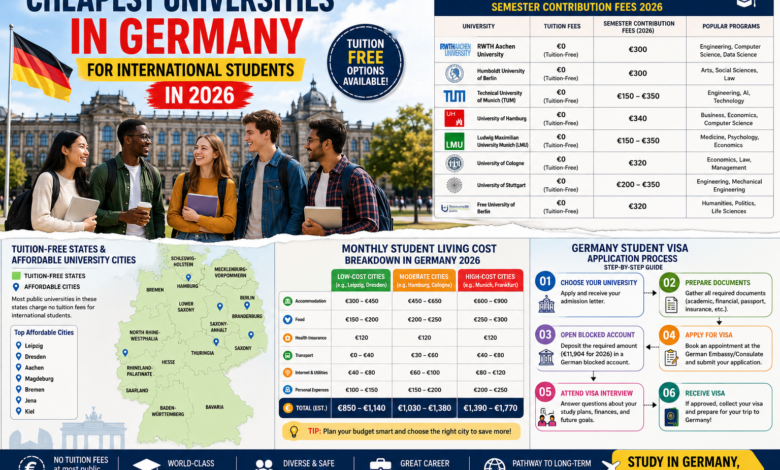
Germany is not just the land of autobahns, castles, and engineering precision. For hundreds of thousands of international students, it has become a serious answer to one very painful question: where can I get a world-class degree without drowning in debt? You can see a lot of cheapest universities in Germany for international students, it really exist.
RECOMMENDED POST: Study in Germany for International Students 2026: Tuition-Free Universities, DAAD Scholarships & Visa Guide
If you have been staring at tuition prices in the US, UK, or Canada and feeling your stomach drop, you are not alone. The fear of unaffordable education is real, and it pushes talented people to delay their dreams for years. What makes Germany different is not just reputation — it is policy. Most public universities charge no tuition at all, even for non-EU international students.
But “cheapest” covers more ground than just tuition. It means the semester contribution, living costs, health insurance, the blocked account requirement, and whether the program you want is actually available in English. This guide covers every layer with updated 2026 figures, city-by-city cost breakdowns, honest visa advice, and the kind of practical insight that only comes from understanding the system in full.
What you will learn:
- Which German universities are genuinely free or ultra-low-cost for international students
- How semester contributions work and why they are not hidden fees
- The cheapest English-taught options and where to find them
- 2026 blocked account requirements and student visa realities
- Step-by-step application guidance
- Real monthly budgets by city type
- Expert tips to avoid expensive mistakes
Why Germany Remains the Best Affordable Study Destination in 2026
Most countries treat international students as a revenue stream. Germany, for the most part, treats them as future skilled workers and long-term contributors to society. That philosophy is built directly into the funding model. Public universities are heavily subsidized by federal and state governments, which means they do not need tuition fees to survive financially.
In 2014, all German states abolished tuition fees at public universities. Baden-Württemberg reintroduced fees for non-EU students in 2017, and a small number of executive or professional programs have always carried a price tag. But as of 2026, the vast majority of public universities across 14 of Germany’s 16 federal states remain tuition-free for international students regardless of nationality.
The real-world advantages extend beyond cost:
- Zero tuition at public universities in most federal states, including for non-EU internationals
- Over 350 English-taught degree programs, mostly at master’s level, available tuition-free
- Strong post-study work options — up to 18 months to find a job after graduation
- World-class research institutions, including names like LMU Munich, RWTH Aachen, TU Berlin, and Heidelberg
- Pathways to EU long-term residence for qualified graduates
Do not confuse low cost with low quality. Germany’s public universities are research powerhouses. The fact that they are nearly free is not a compromise — it is a policy choice that benefits students globally.
Understanding the Real Costs: It Is Not Just Tuition
When someone says “study in Germany for free,” they are telling you a partial truth. There is no tuition fee at most public universities, but you still need to prove you can support yourself financially. Here is the complete cost picture for 2026:
1. Semester contribution (Semesterbeitrag) Typically between €150 and €420 per semester depending on the university and state. This covers student union administration, sports facilities, and — crucially — a regional public transport pass that can be worth far more than the contribution itself.
2. Health insurance Around €110 to €130 per month for a standard student public insurance plan. This is non-negotiable — you cannot enroll at a German university or obtain a residence permit without it.
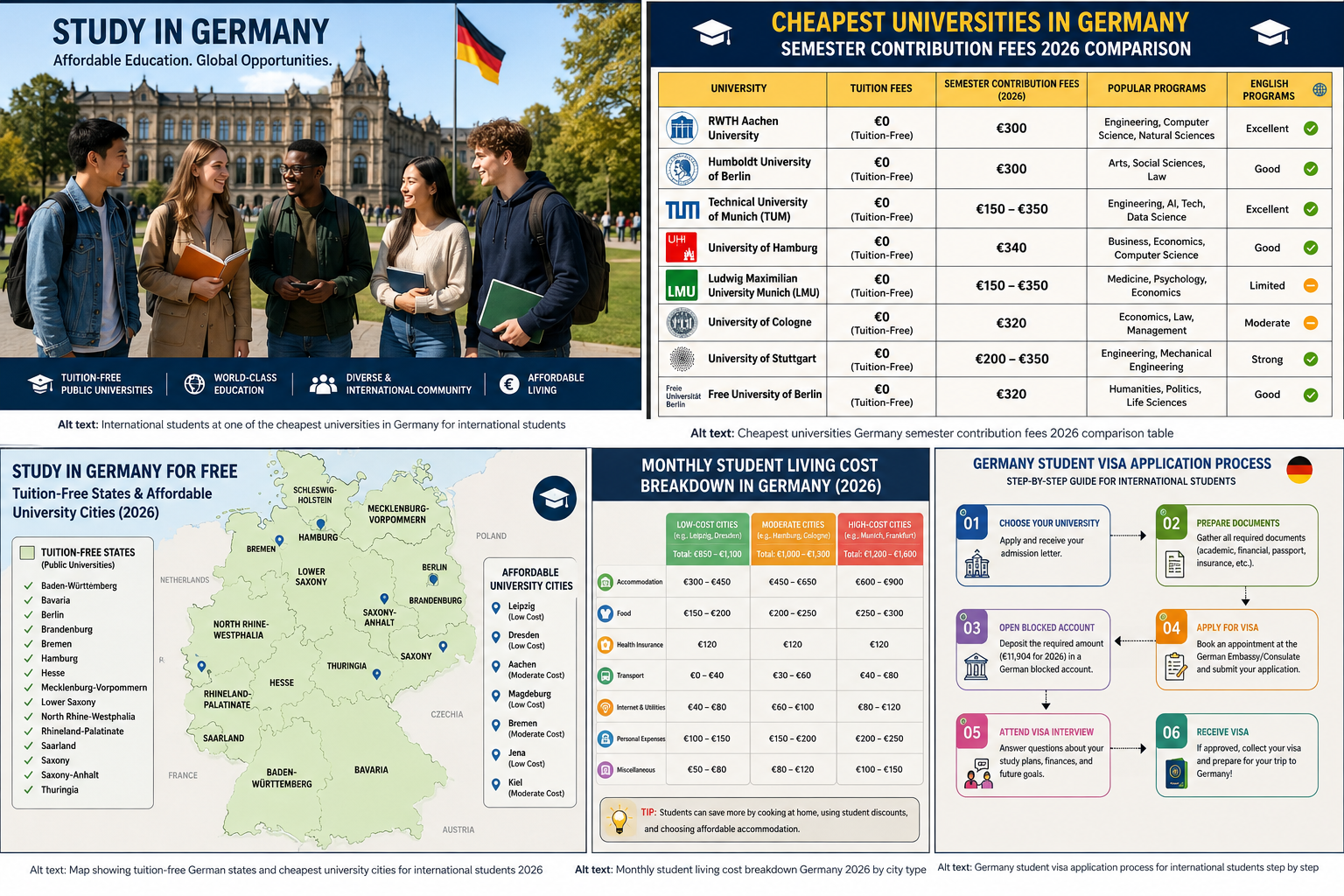
3. Living expenses The biggest cost overall. Rent, food, phone, study materials, and social life. In 2026, a realistic monthly budget in a mid-sized German city runs between €850 and €1,100. Munich and Frankfurt push that higher; cities like Leipzig, Chemnitz, and Magdeburg bring it down considerably.
4. Blocked account (Sperrkonto) As of 2026, the required amount is €11,904 for one year, equating to €992 per month. This must be deposited into a German blocked account before applying for a student visa. It is proof of financial self-sufficiency, not a fee — you withdraw it monthly as a living allowance.
5. State-specific or program-specific tuition Baden-Württemberg charges non-EU students €1,500 per semester at public universities. Some specialized master’s programs taught in English may charge €2,000 to €10,000 per semester, though this is still far below UK or US equivalents.
The bottom line: you can attend a tuition-free German university and still spend roughly €11,000 to €13,000 per year on living costs. That is not nothing, but compare it to annual tuition alone at a mid-tier US university ($30,000 or more) and the financial case for Germany is stark.
RECOMMENDED POST: Fully Funded Scholarships for African Students 2026: Masters & PhD Opportunities in UK, Germany & Canada
Cheapest Universities in Germany for International Students (2026)
The following are public universities that charge zero tuition for most programs, regardless of nationality. Semester contributions are approximate and based on the 2025/2026 academic year. Always verify the exact Semesterbeitrag on each university’s official website before applying.
| University | Location | Tuition (Non-EU) | Semester Contribution | Notable Strengths |
|---|---|---|---|---|
| FAU Erlangen-Nürnberg | Erlangen/Nuremberg, Bavaria | €0 | €72–€110 | Engineering, medicine; one of the lowest contributions nationally |
| LMU Munich | Munich, Bavaria | €0 | €150–€200 | Globally top-ranked; prestige without tuition; high city living costs |
| Technical University of Munich (TUM) | Munich, Bavaria | €0 | €150–€350 | AI, engineering, biotechnology; fast-growing global reputation |
| TU Chemnitz | Chemnitz, Saxony | €0 | €167 | Low overall costs; good English master’s options |
| University of Leipzig | Leipzig, Saxony | €0 | €210–€270 | Affordable city; strong humanities and medicine |
| TU Dresden | Dresden, Saxony | €0 | €215 | Top-tier technical university; lower living costs than western cities |
| University of Göttingen | Göttingen, Lower Saxony | €0 | €285 | Physics, mathematics, agriculture; small-city affordability |
| RWTH Aachen University | Aachen, NRW | €0 | €294–€350 | Best engineering school in Germany; strong industry links |
| TU Berlin | Berlin | €0 | €310–€315 | Top technical university; Berlin startup ecosystem |
| Freie Universität Berlin | Berlin | €0 | €311–€360 | Humanities, political science; diverse English-taught programs |
| Humboldt University of Berlin | Berlin | €0 | €300 | Arts, social sciences, international relations |
| University of Bonn | Bonn, NRW | €0 | €250–€330 | Natural sciences, economics; NRW transport ticket included |
| University of Cologne | Cologne, NRW | €0 | €320 | Economics, management; vibrant student city |
| University of Hamburg | Hamburg | €0 | €333–€340 | Business, computer science, natural sciences; port-city opportunities |
| Leibniz University Hannover | Hannover, Lower Saxony | €0 | €420 | Semester ticket covers entire Lower Saxony state network |
Note: Some universities list small additional administrative fees for international students, typically below €100, often already included in the figures above. Verify the specific program page before applying.
State-Specific Fees: Where You Might Pay Something
To avoid surprises, here is where exceptions apply in 2026:
Baden-Württemberg charges non-EU international students €1,500 per semester at all public universities. This affects major institutions including Heidelberg University, University of Freiburg, University of Stuttgart, and Karlsruhe Institute of Technology. Still relatively affordable by international standards, but not free.
Saxony passed legislation in 2025 permitting universities to charge tuition for non-EU students in specific circumstances mainly non-consecutive master’s or programs with low local demand. Standard bachelor’s and consecutive master’s programs at University of Leipzig and TU Dresden remain tuition-free in practice. The law exists but is not broadly applied.
Bavaria passed a similar permissive law in 2023, but as of 2026, LMU Munich and TU Munich have not implemented general tuition charges for bachelor’s or consecutive master’s programs. Some non-consecutive professional master’s courses may have fees. Check individual program pages directly.
The rule of thumb: verify the fee status on the official program page every time, regardless of what general guides say. University policies shift, and state laws create room for exceptions that individual institutions may or may not act on.
Cheapest English-Taught Universities in Germany for International Students
Not every student can achieve C1 German proficiency before applying, and that is a reasonable starting point. The number of English-taught programs at German public universities has grown significantly, particularly at master’s level.
Here are standout options for English-taught programs with zero tuition:
RWTH Aachen University: Multiple master’s in mechanical engineering, electrical engineering, data science, and computer science. High English program availability with direct access to Germany’s industrial heartland.
TU Berlin: English master’s in urban management, environmental engineering, innovation management, and computer science. Located in Germany’s most internationally diverse city.
University of Hamburg: MSc in Intelligent Adaptive Systems, MSc in Physics, and growing options in natural sciences and business.
University of Göttingen: MSc in Molecular Biology, MSc in Cardiovascular Science, MSc in Forest Sciences, and international economics tracks.
TU Dresden: MSc in Organic and Molecular Electronics, MSc in Computational Engineering, and several other technical master’s programs.
University of Bonn: MSc in Economics and MSc in Computer Science available in English.
Freie Universität Berlin: Broad English program catalog, particularly strong in humanities and international studies.
Rhein-Waal University of Applied Sciences: One of the few institutions in Germany with a significant number of bachelor’s programs taught entirely in English. An often-overlooked option for students who need English at undergraduate level.
For students from Nigeria, India, Bangladesh, and other countries where German language training is less accessible, these programs represent the most practical entry point. You can apply with IELTS or TOEFL scores and start learning German after arrival a skill that will pay dividends in daily life and employment even if your coursework remains in English.
Cost of Living by City: What You Will Actually Spend
The blocked account provides the minimum figure, but real monthly costs vary substantially by location.
Budget Cities (Eastern and Smaller Cities)
Leipzig, Dresden, Chemnitz, Magdeburg, Halle
- Shared room (WG): €250–€380
- Groceries: €150–€220
- Health insurance: €110–€125
- Semester ticket: usually included in contribution
- Phone and utilities: €50–€80
- Study materials and leisure: €80–€120
- Realistic total: €650–€950/month
These cities offer genuine affordability without sacrificing quality. TU Dresden, University of Leipzig, and TU Chemnitz are serious institutions choosing them over Munich saves €3,000–€6,000 per year in living costs.
Mid-Range Cities
Berlin, Aachen, Hannover, Bonn, Cologne
- Shared room: €380–€550
- All other expenses slightly higher
- Realistic total: €900–€1,250/month
Berlin deserves a note: it is more expensive than eastern cities but significantly cheaper than Munich, with an unmatched international community, English-speaking environment, and access to Europe’s most active startup ecosystem.
Expensive Cities
Munich, Frankfurt, Hamburg, Stuttgart
- Shared room: €500–€700
- Total costs can exceed €1,400/month without careful management
Munich in particular requires honest planning. LMU Munich and TU Munich are exceptional universities — but a student saving on tuition while paying Munich rents may end up spending more than they would at a paid university in a cheaper city elsewhere in Europe.
How to Apply to Affordable German Universities: Step-by-Step
Step 1: Find Your Program
Use the DAAD (German Academic Exchange Service) database at daad.de or search directly on university portals. Filter by degree level, language of instruction, and subject. Build a shortlist of three to five programs across different cities and states.
Step 2: Check Entry Requirements
German universities assess subject relevance and grades carefully. You will generally need:
- A higher secondary school certificate recognized as equivalent to the German Abitur (check the anabin database for your country)
- For master’s programs: a relevant bachelor’s degree, usually with a minimum grade equivalent to 2.5 or better on the German scale
- Language proficiency: German-taught programs require TestDaF or DSH at C1 level; English-taught programs require IELTS (usually 6.5 or higher) or TOEFL (90 or above)
- Some programs require TestAS (the German aptitude test for international students)
Step 3: Submit Your Application
Most international applications are processed through uni-assist, a centralized service that charges €75 for the first application and €30 for each additional one. Some universities accept direct applications through their own portals.
Deadlines are firm and rarely extended. For the winter semester (starting October), most application deadlines fall between March and July 15. For the summer semester (starting April), deadlines are typically between October and January 15.
Step 4: Open a Blocked Account After Admission
Once you receive the Zulassungsbescheid (admission letter), open a blocked account immediately. As of 2026, you need to deposit €11,904. Providers include Expatrio, Fintiba, Coracle, and Deutsche Bank. The process takes one to two weeks, so do not delay.
Step 5: Apply for the Student Visa
The German student visa application requires:
- Valid passport
- University admission letter
- Blocked account confirmation
- Health insurance certificate (public student insurance or recognized equivalent)
- Academic transcripts and certificates with certified translations
- Motivation letter — specific, structured, and tied to your career direction
- Proof of language proficiency
- Completed visa application forms
For Nigerian applicants, the German Embassy in Lagos and the Consulate General in Abuja handle student visa applications. Processing can take several months during peak seasons. Book your appointment as early as possible — appointment slots fill well in advance.
A strong motivation letter matters more than many applicants realize. The embassy wants to see a clear study plan, a logical academic progression, and how the degree connects to your future career. Generic letters with no specifics are a red flag.
Step 6: Arrive, Enroll, and Register
Upon arrival in Germany, you must register your address at the local Bürgeramt within 14 days — this is a legal requirement, not optional. Enroll at the university in person, activate your health insurance, and then apply for a residence permit for study purposes at the Ausländerbehörde before your entry visa expires. Missing any of these steps can affect your legal status.
Living on a Budget: Practical Strategies That Work
Choose a city with lower rent. The quality difference between studying at TU Chemnitz and LMU Munich is far smaller than the rent difference. Eastern German cities and smaller western cities like Göttingen or Kaiserslautern consistently offer the best cost-to-quality ratio.
Live in a shared flat (WG). Student dormitories are limited in supply and often have waiting lists of six to twelve months. A WG room is the standard student setup in Germany — more affordable than private apartments and a far better way to build social connections. Use WG-Gesucht.de or Studenten-WG.de to search.
Use your semester ticket. The €250–€420 you pay every semester unlocks regional train networks across the state. Weekend trips, commutes, and occasional travel within your region become essentially free. It is one of the most underappreciated financial benefits of the German system.
Shop at discount supermarkets. Aldi, Lidl, Netto, and Penny keep grocery bills manageable. Student meal halls (Mensa) serve full meals for €2–€4 with your student ID — eating there regularly saves €150–€200 monthly compared to cooking alone or eating out.
Work part-time within legal limits. Non-EU international students can work 140 full days or 280 half days per calendar year without needing additional permission. A student assistant (Hiwi) position at the university pays €10–€15 per hour and fits flexibly around coursework. Even a mini-job capped at €538 per month is tax-free and takes meaningful pressure off your monthly budget.
Apply for scholarships after enrollment. The Deutschlandstipendium, available at many German universities, accepts applications from enrolled students. DAAD’s in-country scholarship programs are another option. Many students wait until they are struggling before looking — the smarter move is to apply during your first semester while your motivation is fresh.
Common Mistakes That Cost International Students Time and Money
Assuming every program is free. Executive MBAs, non-consecutive master’s programs, and all private university programs carry tuition charges. Always check the specific program page for “Studiengebühren” before applying.
Applying to only one or two universities. English-taught programs at top German universities are competitive. A shortlist of five programs across different institutions and cities dramatically improves your odds and gives you real options at decision time.
Delaying the blocked account. Some embassies require the account confirmation at the visa appointment. Opening the account takes one to two weeks minimum. Do it the week you receive your admission letter — not a week before your visa appointment.
Underestimating the language barrier for daily life. Even in fully English-taught programs, navigating the Ausländerbehörde, reading rental contracts, visiting a doctor, and handling bureaucratic correspondence requires German. Start at A1 before you arrive. Reaching A2 before departure helps enormously.
Missing the Semesterbeitrag re-registration deadline. Every semester, students must re-register and pay the semester contribution by a fixed deadline. Missing it can result in automatic exmatriculation. Set a calendar reminder two months before each deadline.
Writing a vague motivation letter. “I have always been passionate about engineering” is not a study plan. The embassy and admissions office want to see: what you studied, why this specific program, why Germany, and how it connects to a concrete professional goal. Generic letters raise doubts about genuine intent.
Ignoring initial setup costs. Your first month in Germany involves a security deposit (often three months’ rent), furniture purchases, and various administrative fees that can total €1,500–€2,500. The blocked account proves minimum viability but does not cover this. Having an additional €2,000–€3,000 saved as a buffer before arrival prevents a very stressful first month.
Scholarships and Funding Options
Germany’s affordable tuition does not eliminate scholarship opportunities — it makes them more accessible because they can focus on living support rather than covering massive fees.
DAAD Scholarships remain the most prominent option for international students. DAAD offers grants for master’s, PhD, and research programs, often including a monthly living stipend, travel allowance, and health insurance coverage. Development-related programs from qualifying countries receive particular priority.
Deutschlandstipendium is a national merit scholarship available at many German universities for enrolled students. It pays €300 per month and is funded jointly by private donors and the federal government.
Foundation Scholarships from organizations like the Heinrich Böll Foundation, Konrad Adenauer Foundation, Friedrich Ebert Foundation, and Hanns Seidel Foundation offer comprehensive support packages tied to academic merit and social engagement, including stipends, health insurance, and networking access.
Corporate Scholarships from German industry leaders — Siemens, BMW, Bosch, SAP — offer scholarships in relevant STEM and business fields, often combined with internship placement. These are not widely advertised; check the websites of companies operating in your field directly.
Frequently Asked Questions
Which German university has the lowest fees for international students?
Most public universities outside Baden-Württemberg charge no tuition at all. Looking purely at semester contribution, FAU Erlangen-Nürnberg (€72–€110) and TU Chemnitz (€167) have among the lowest contributions nationally. LMU Munich (€150–€200) combines an extremely low contribution with a globally top-ranked institution, though Munich’s living costs offset some of that advantage.
Can I study in Germany for free without speaking German?
Yes, if you are accepted into an English-taught program at a tuition-free public university. Many master’s programs are available entirely in English and charge no tuition. You will still pay the semester contribution and cover living costs. That said, learning German alongside your studies is strongly recommended — not just for daily life, but for employment prospects after graduation.
What is the Germany blocked account amount in 2026?
The required blocked account amount for 2026 is €11,904, equating to €992 per month over a 12-month period. You can withdraw up to that monthly limit. For visa extensions beyond one year, you will need to demonstrate continued financial resources.
What are the cheapest universities in Germany for Nigerian students?
Nigerian students follow the same fee structure as other non-EU international students. The most cost-effective combinations of tuition status and affordable living environment include University of Leipzig, TU Chemnitz, TU Dresden, University of Magdeburg, and University of Bonn. Applications from Nigeria go through the standard international process via uni-assist or direct university portals, and the student visa is processed at the German Embassy in Lagos or the Consulate General in Abuja.
Is health insurance included in the semester contribution?
No. The semester contribution covers administrative fees, student union membership, and the public transport pass. Student health insurance is a separate mandatory expense, running approximately €110–€130 per month through a German public insurer. You must hold valid health insurance to enroll and to obtain a residence permit.
Can I work while studying to help cover living costs?
Yes. Non-EU international students may work up to 140 full days or 280 half days per calendar year without needing special work authorization. Students earning below the annual tax-free threshold pay no income tax. Student assistant (Hiwi) positions at the university are common, flexible, and professionally relevant. Working beyond legal limits requires prior approval from the employment agency and can jeopardize your visa status.
How competitive is admission to German universities?
It varies significantly by program and institution. Medicine, computer science, and engineering at top-ranked universities are highly competitive. Some humanities and social science programs operate with more open admission policies. Your grade average, language certificate, and the quality of your motivation letter are the main differentiating factors.
What is the difference between uni-assist and direct applications?
Uni-assist is a centralized application processing service used by the majority of German universities for international applicants. It handles document verification and forwards your file to the university. It costs €75 for the first application and €30 for each subsequent one. Some universities accept applications directly through their own portals, which can save money but requires more individual research. Check each university’s international admissions page to confirm the correct route.
Conclusion
Germany’s commitment to accessible public education is one of the few genuinely good deals left in global higher education. The cheapest universities in Germany for international students are not obscure second-tier institutions they are large, respected research universities that have made a deliberate choice to remain open to the world without charging for it.
The cost is not zero. Living in Germany requires planning, a funded blocked account, and a realistic monthly budget. But the total cost of a German degree including living expenses often comes in below the annual tuition alone at comparable universities in the US, UK, or Australia. For students from Nigeria, India, Bangladesh, Ghana, Kenya, and beyond, that is not a marginal advantage. It is a transformational one.
The students who succeed here are not the ones with the highest grades or the most connections. They are the ones who research carefully, apply early, write honest and specific motivation letters, and arrive with a financial plan that goes beyond the minimum. Thousands of international students navigate this process successfully every year. The path is well-worn. You just need to start walking it.