15 Best AI-Proof Careers 2026 That Will Still Be in Demand After 2030
Skilled Trade AI-Proof Careers 2026 That Remain in High Demand

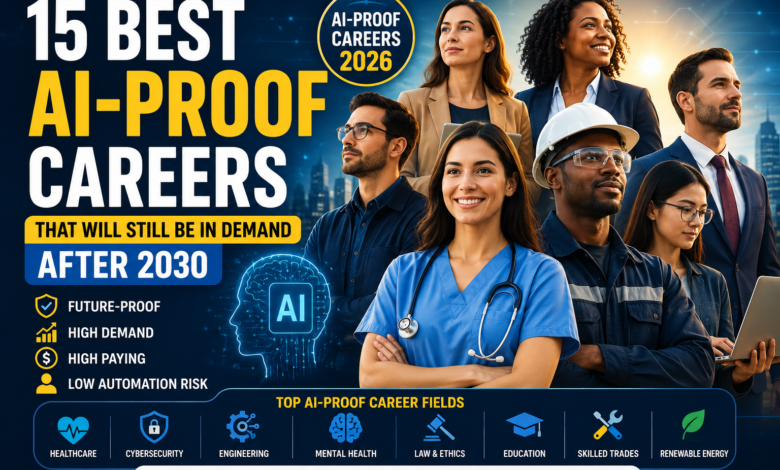
Last month, a colleague received an automated email from HR explaining how AI would be “optimizing” her department. Three weeks later, she was job hunting. Sound familiar? AI-proof careers 2026 will rather be improving, so position yourself for better opportunities.
The anxiety hits differently when automation targets your actual paycheck. ChatGPT writes marketing copy. Algorithms trade stocks faster than any human. AI reviews legal documents in minutes instead of hours. And if you are currently choosing a degree or wondering whether your career has a shelf life, the fear is completely understandable.
RECOMMENDED POST: Chevening Scholarship 2026 for African Students Complete Guide & Essay Tips
But here is what the scary headlines consistently miss: AI automates tasks, not whole jobs. Every occupation is a bundle of tasks, and the ones that define quality, build trust, and require a human body or conscience in an unpredictable situation remain stubbornly hard to automate. The World Economic Forum’s Future of Jobs Report 2025 projected a net increase in global employment driven by the green transition, aging populations, and digital infrastructure even as AI reshapes clerical and repetitive cognitive work.
The question is not whether your career will be touched by AI. It will be. The question is whether AI will replace your work or simply become a tool you use. This guide identifies 15 AI-proof careers 2026 professionals and students can confidently pursue roles projected to grow, pay well, and stay deeply, structurally human for the next decade and beyond.
What you will learn:
- The three pillars that actually determine whether a career is AI-resistant
- 15 specific careers with salary data, education requirements, and why each holds up
- A complete at-a-glance comparison table
- Expert strategies to strengthen any career against automation
- Common mistakes people make when choosing “safe” paths
- Honest answers to the questions everyone is actually asking
What Actually Makes a Career AI-Proof in 2026
Before listing jobs, it is worth understanding the framework. Not every career labeled “safe” deserves the title, and the reasoning matters as much as the conclusion. Three core pillars define genuine AI resistance:
High Touch and High Empathy
Roles where the quality of human connection directly determines the outcome. Patients need to feel heard by someone who notices a slight hesitation in their voice, not just abnormal lab values. Students learn best from someone who can read the room and adjust in real time. A machine can simulate empathy. It cannot yet build genuine therapeutic trust or earn it over months of difficult sessions.
Physical Presence in Non-Routine Environments
Robots perform well in controlled, predictable spaces factory floors with consistent lighting and fixed parameters. They struggle in an attic full of tangled century-old wiring, on a construction site after unexpected rain, or in a patient’s home where every setup is different. Careers demanding physical dexterity and on-the-spot improvisation in messy, variable environments remain largely automation-resistant.
Ethical Accountability and Legal Responsibility
When a decision carries serious consequences a surgery, a verdict, an engineer’s structural sign-off society demands a human who can be held accountable. An algorithm can recommend. It cannot bear moral responsibility. As long as legal systems, healthcare, and infrastructure require someone to answer for outcomes, these careers need licensed humans at the center.
Why AI Anxiety Is Growing and Why It Is Partially Justified
The concern is not imaginary. Companies across industries already use AI for customer support, data analysis, content generation, basic coding, scheduling, and marketing automation. If software can handle 50% of routine tasks in a department, companies may hire fewer people for that department even if no job title officially disappears.
What surprises many professionals is that some high-skill, high-education roles face earlier disruption than traditional blue-collar work. A radiologist whose primary task is reading scans encounters AI competition sooner than a plumber navigating the cramped, unpredictable basement of a 1940s house. The reversal challenges the old assumption that a university degree guarantees stability. What actually guarantees stability is a role where the tasks that define quality cannot be reduced to pattern recognition.
15 AI-Proof Careers to Study and Build in 2026
1. Nurse Practitioner
Healthcare is the most cited category on every serious labor analysis of AI resistance, and Nurse Practitioners represent its strongest entry point for 2026 students. NPs diagnose, prescribe, and manage patient care independently in most jurisdictions — combining clinical judgment with the deeply relational work that defines good medicine.
The U.S. Bureau of Labor Statistics projects approximately 45% growth in NP roles between 2024 and 2034, driven by an aging population and a persistent physician shortage that shows no signs of reversing. An NP notices a slight tremor not listed in the chart, catches the hesitation that changes a diagnosis, and adjusts a treatment plan based on a family dynamic that no algorithm would consider.
AI can flag abnormal lab values. It cannot hold a patient’s hand, earn trust over months of visits, or make the nuanced call when symptoms refuse to fit the textbook.
Education: Master of Science in Nursing (MSN) or Doctor of Nursing Practice (DNP) Typical 2026 salary: $125,000–$160,000 AI resistance pillars: Empathy, physical care, complex clinical judgment
2. Mental Health Counselor and Therapist
Talk therapy depends entirely on the therapeutic alliance the bond between counselor and client that research consistently identifies as the strongest predictor of treatment success. AI chatbots can offer cognitive behavioral therapy prompts and do provide some value for mild anxiety. They cannot sit in uncomfortable silence, notice micro-expressions, or challenge a client’s distorted thinking with the kind of genuine care that makes confrontation feel safe rather than threatening.
Demand for mental health services has grown significantly since 2020, and the supply of licensed counselors remains far below need particularly in schools, rural communities, and addiction treatment settings. This career benefits from the uncomfortable reality that AI-driven work environments are themselves contributing to the mental health crisis, increasing demand for the very profession that addresses it.
Education: Master’s in counseling, clinical psychology, or social work, plus state licensure Typical 2026 salary: $60,000 – $110,000 depending on setting and specialization AI resistance pillars: Therapeutic relationship, emotional nuance, cultural competence
3. Skilled Electrician
Trade careers are the original AI-proof jobs, and electricians sit near the top of that list. No two job sites are identical. A licensed electrician might spend Monday troubleshooting tangled wiring in a 1920s brownstone and Tuesday installing smart building systems in a new commercial development. The combination of complex problem-solving, fine motor dexterity, safety-critical decision-making, and constant physical improvisation is extraordinarily difficult to automate.
In 2026, the skilled trades face a severe shortage as veteran professionals retire faster than new ones enter the pipeline. The work cannot be offshored, cannot be done remotely, and pays increasingly well as that shortage deepens. This is one of the strongest AI-proof careers 2026 offers for students who prefer not to carry four-year university debt.
Education: Apprenticeship (4–5 years) and licensing; some technical colleges offer electrical technology associate degrees Typical 2026 salary: $60,000–$100,000+ for journeyman and master electricians AI resistance pillars: Non-routine physical dexterity, variable environments, safety responsibility
4. Physical Therapist
Robotics and AI can assist with rehabilitation exercises, but they cannot replicate the hands-on assessment of a skilled physical therapist. PTs manually manipulate joints, feel muscle tension with trained hands, and adjust a treatment plan based on real-time feedback — both verbal and nonverbal. A patient who is in pain, discouraged, and questioning whether they will ever walk normally again needs a human presence that can adapt not just the exercise but the entire tone of a session.
The aging population means more joint replacements, strokes, and mobility challenges. Demand is projected to grow well above average, and the Doctor of Physical Therapy degree, while demanding, leads to a career that faces essentially no meaningful automation risk.
Education: Doctor of Physical Therapy (DPT), a three-year post-baccalaureate program Typical 2026 salary: $95,000–$120,000 AI resistance pillars: Manual treatment, patient motivation, adaptive assessment
5. Cybersecurity Incident Responder
Cybersecurity sits in an interesting position: AI tools are used by both attackers and defenders, creating a permanent arms race that actually increases the value of human analysts rather than reducing it. Incident response specifically the work of investigating an active breach, containing damage, and rebuilding compromised systems requires strategic thinking that cannot be scripted.
You are not running a checklist during a ransomware attack. You are dealing with an adversary who is also adapting in real time, making decisions about where to pivot, and communicating clearly with panicked leadership who need guidance, not jargon. The human element of reading an attack pattern, anticipating the next move, and making containment calls under extreme pressure is exactly what machines cannot replicate reliably.
Education: Bachelor’s in cybersecurity, computer science, or information systems; certifications including CISSP, CEH, and SANS GIAC are highly valued Typical 2026 salary: $95,000–$150,000 AI resistance pillars: Adversarial intuition, crisis decision-making, human judgment under pressure
6. Surgeon and Specialist Physician
Robotic surgical systems are increasingly common, but the robot is a tool, not the decision-maker. A surgeon needs to make split-second judgments when anatomy is unexpectedly different from imaging, when bleeding changes the visual field, or when a patient’s condition shifts during a procedure. That judgment comes from years of tactile training and direct experience that an AI model trained on data cannot replicate.
This is the ultimate high-paying AI-resistant job. The barriers to entry are steep — roughly a decade of training — but the result is a career that will always require a human at the helm, because the consequences of failure demand a responsible party with a license, a moral code, and something real at stake.
Education: Medical degree (MD or DO), residency, fellowship, and board certification in a surgical specialty Typical 2026 salary: $250,000–$500,000+ depending on specialty AI resistance pillars: Tactile expertise, intraoperative decision-making, ethical accountability
7. Special Education Teacher
Teaching already resists automation because of its inherently relational nature. Special education pushes that resistance further. Teachers working with students on the autism spectrum, with learning disabilities, or with emotional and behavioral challenges constantly adapt communication, pacing, physical positioning, and emotional tone — often several times within a single hour.
No lesson plan survives contact with reality. The relational and behavioral management work that defines quality special education is as human as any profession gets. And in most districts, the shortage of qualified special education teachers is so severe that job security is practically written into the role.
Education: Bachelor’s in special education and state licensure; a master’s in special education strengthens earning potential Typical 2026 salary: $55,000–$85,000 in public school settings, higher in specialized private placements AI resistance pillars: Continuous behavioral adaptation, mentorship, individualized instruction
8. Clinical Social Worker
Clinical social workers navigate the most complex and unpredictable human systems imaginable — poverty, addiction, child protective services, domestic violence, housing crises, and mental health emergencies. They walk into homes, assess risk under difficult circumstances, and build trust with people who have every reason not to trust institutions.
No AI is going to sit with a teenager freshly removed from an unsafe home and convincingly say “you’re going to be okay” in a way that the teenager believes. That presence matters in a way that changes outcomes. Demand for social workers continues rising in healthcare settings, schools, and community organizations.
Education: Bachelor of Social Work (BSW) for entry-level; Master of Social Work (MSW) for clinical licensure Typical 2026 salary: $55,000–$90,000 AI resistance pillars: Trauma-informed presence, resource navigation, trust-building under difficult conditions
9. Environmental Engineer
The clean energy transition and global infrastructure investment have created genuine urgency for environmental engineers. These professionals design water treatment systems, remediate contaminated sites, ensure regulatory compliance, and advise governments and corporations on sustainable infrastructure. The work requires site visits, localized ecosystem judgment, and constant collaboration with communities and regulators none of which can be handed off to a model.
With ongoing global sustainability mandates and major public infrastructure spending, this field has both immediate demand and decades of runway. It is an AI-resistant career that also aligns with a clear societal need a combination that matters for long-term job satisfaction as well as security.
Education: Bachelor’s in environmental engineering or civil engineering; Professional Engineer (PE) licensure for senior advancement Typical 2026 salary: $85,000–$130,000 AI resistance pillars: Site-specific design, regulatory judgment, community collaboration
10. Trial Attorney and Public Defender
AI already assists with document review and contract generation. It cannot stand in front of a jury and argue a case. Trial law depends on human persuasion, reading twelve strangers in a courtroom, thinking on your feet when opposing counsel takes an unexpected turn, and building a narrative that connects with people who know nothing about legal procedure. The very presence of a human advocate who bears the weight of a client’s fate is non-negotiable in a functioning justice system.
While paralegal and document review roles face real automation pressure, the courtroom lawyer remains one of the safest careers in future legal work. As AI becomes embedded in business and government, legal complexity will grow, not shrink.
Education: Juris Doctor (JD) and passing the bar exam Typical 2026 salary: $60,000–$80,000 for public defenders starting out; $150,000+ for experienced private trial attorneys AI resistance pillars: Persuasion, on-the-feet strategic thinking, moral advocacy
11. Occupational Therapist
Like physical therapists, occupational therapists work hands-on with clients recovering or developing skills for daily living. An OT helping a stroke survivor regain independence in their own kitchen is not following a script — they are improvising with whatever is available in that specific space, for that specific person’s physical and cognitive profile. It is creative problem-solving grounded in deep clinical knowledge, and it changes entirely from client to client.
The profession’s focus on restoring independence rather than treating symptoms makes it particularly resistant to automation. Aging populations and increasing neurological diagnoses ensure strong long-term demand.
Education: Master’s or Doctorate in Occupational Therapy Typical 2026 salary: $85,000–$110,000 AI resistance pillars: Adaptive creativity, physical intervention, personalized care
12. Human Resources and Organizational Development Specialist
AI already filters résumés, and algorithmic bias in early-stage screening has become a widely documented problem. The more strategic HR functions employee relations, leadership coaching, succession planning, conflict mediation, organizational culture require exactly the kind of human judgment and cultural competence that algorithms consistently mishandle.
When a company needs to navigate a sensitive termination, rebuild morale after restructuring, or manage a workplace discrimination complaint, the last thing they want is a chatbot. The strategic, human-centered side of HR is growing in importance precisely because organizations are realizing that technology cannot manage people effectively.
Education: Bachelor’s in human resources, industrial-organizational psychology, or business; professional certifications such as SHRM-CP or PHR are highly valued Typical 2026 salary: $70,000–$120,000 AI resistance pillars: Conflict resolution, cultural intelligence, organizational leadership
13. Creative Director and Art Director
Generative AI can produce thousands of image variations and write functional advertising copy. It cannot exercise taste. It cannot know when a technically flawless campaign concept feels culturally tone-deaf or emotionally hollow in a way that no prompt can capture. Creative direction involves understanding brand identity over years, reading a client’s real concerns beneath their stated brief, and making the call that one idea out of a hundred actually resonates.
The more companies use AI for production-level creative work, the more valuable senior creative professionals become for providing the vision and oversight that gives AI output meaning. This career is AI-resistant not because AI is absent, but because human oversight of AI becomes the essential work.
Education: Bachelor’s in graphic design, marketing, or a related creative field; a strong portfolio matters more than the degree in most hiring decisions Typical 2026 salary: $90,000–$160,000 AI resistance pillars: Artistic vision, cultural insight, strategic brand understanding
14. Construction Project Manager
Building a hospital, a bridge, or a residential development requires orchestrating a dozen different trades, navigating regulatory inspections, managing weather delays, and making constant real-time decisions on-site. AI can assist with scheduling and cost modeling, but the leader walking the site, reading the crew, negotiating with subcontractors, and making hard calls when the unexpected happens as it always does is irreplaceable.
With the ongoing global infrastructure boom driven by housing demand, climate adaptation, and clean energy construction, this is one of the best careers after AI for professionals who prefer leadership and logistics over hands-on trade work.
Education: Bachelor’s in construction management, civil engineering, or architecture; years of field experience carry significant weight in this profession Typical 2026 salary: $90,000–$140,000 AI resistance pillars: On-site leadership, real-time problem solving, stakeholder management
15. Data Ethicist and AI Governance Specialist
An AI-related job on an AI-proof list and it absolutely belongs here. As artificial intelligence gets embedded in healthcare decisions, hiring systems, credit scoring, and criminal justice, someone has to ensure those systems are not discriminatory, opaque, or dangerous. Data ethicists and AI governance specialists craft policy, audit algorithms, advise regulators, and act as the human conscience behind the machine.
This role requires philosophical reasoning, legal understanding, and a genuine moral framework qualities no AI system possesses. Demand is growing rapidly as the EU AI Act, proposed U.S. frameworks, and corporate governance standards create pressure for qualified human oversight. It is one of the smartest career paths available at the intersection of technology and human accountability.
Education: Interdisciplinary background in law, public policy, computer science, or philosophy; specialized master’s programs in AI ethics are emerging at major universities Typical 2026 salary: $110,000–$170,000 AI resistance pillars: Moral reasoning, policy judgment, accountability oversight
AI-Proof Careers At a Glance
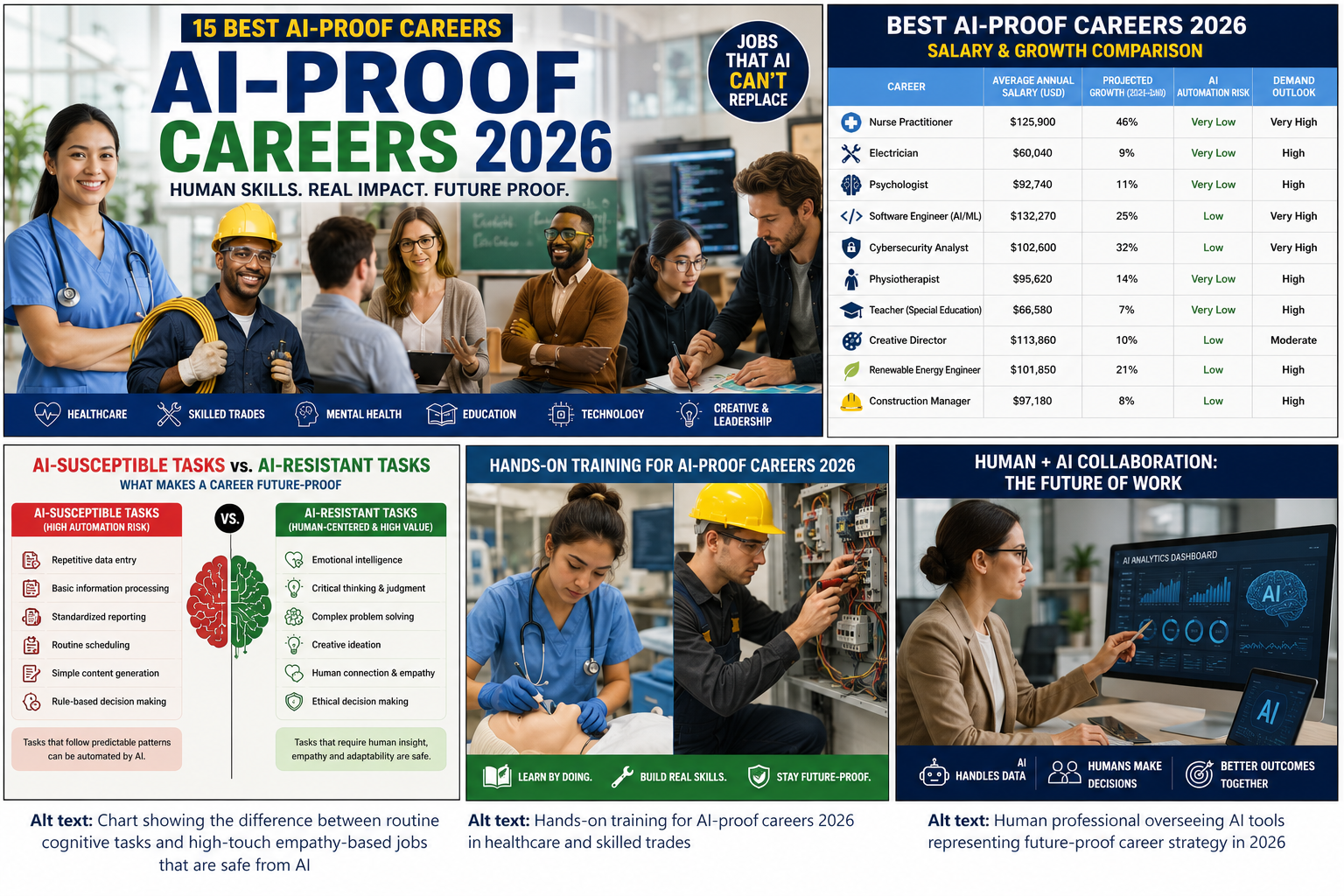
| Career | AI-Resistance Factor | Education Required | 2026 Salary Range (USD) |
|---|---|---|---|
| Nurse Practitioner | Empathy, physical care, complex clinical judgment | MSN or DNP | $125,000–$160,000 |
| Mental Health Counselor | Therapeutic relationship, emotional nuance | Master’s + licensure | $60,000–$110,000 |
| Skilled Electrician | Non-routine physical dexterity, safety decisions | Apprenticeship + license | $60,000–$100,000+ |
| Physical Therapist | Manual manipulation, adaptive motivation | Doctor of PT (DPT) | $95,000–$120,000 |
| Cybersecurity Responder | Adversarial intuition, crisis decisions | Bachelor’s + certifications | $95,000–$150,000 |
| Surgeon / Specialist Physician | Tactile skill, intraoperative judgment | MD + residency | $250,000–$500,000+ |
| Special Education Teacher | Behavioral adaptation, individualized instruction | Bachelor’s + licensure | $55,000–$85,000 |
| Clinical Social Worker | Trust-building, trauma-informed navigation | BSW/MSW + licensure | $55,000–$90,000 |
| Environmental Engineer | Site-specific design, regulatory judgment | Bachelor’s (PE for senior) | $85,000–$130,000 |
| Trial Attorney | Persuasion, on-feet strategic thinking | JD + bar exam | $60,000–$200,000+ |
| Occupational Therapist | Adaptive creativity, hands-on intervention | Master’s or Doctorate | $85,000–$110,000 |
| HR and OD Specialist | Cultural intelligence, conflict resolution | Bachelor’s + certifications | $70,000–$120,000 |
| Creative Director | Artistic vision, cultural insight | Bachelor’s + portfolio | $90,000–$160,000 |
| Construction Project Manager | Site leadership, real-time problem solving | Bachelor’s + experience | $90,000–$140,000 |
| Data Ethicist / AI Governance | Moral reasoning, policy oversight | Interdisciplinary degree | $110,000–$170,000 |
Best University Degrees for the AI Era
Choosing a degree that aligns with AI-resistant careers matters more now than at any previous point. The most future-secure programs combine domain expertise with skills that resist commodification.
| Degree | AI Resistance Level | Career Flexibility |
|---|---|---|
| Nursing / Health Sciences | Very High | Strong global mobility |
| Medicine and Surgery | Very High | Broad specialty options |
| Engineering (Environmental, Civil, Electrical) | High | Excellent cross-sector value |
| Psychology and Counseling | High | Multiple clinical and organizational paths |
| Computer Science (with ethics / human factors focus) | High | Broad technology oversight roles |
| Law | Moderate-High | Scales with specialization |
| Education | Moderate-High | Stable long-term demand |
| Occupational / Physical Therapy | High | Strong aging population demand |
| Renewable Energy Engineering | High | Growing urgency globally |
Hybrid programs combining technical depth with ethics, communication, or human-computer interaction offer particularly strong positioning. Internships, apprenticeships, and professional certifications matter significantly alongside formal degrees for practical employment advantage.
Careers Most Vulnerable to AI Disruption
Understanding what is at risk helps clarify why AI-resistant choices hold value. Roles at higher automation risk include:
Basic data entry and document processing, routine bookkeeping and accounts payable, repetitive customer support scripts, generic content writing without strategic context, simple administrative scheduling, and low-level repetitive coding tasks. These jobs are not necessarily disappearing overnight, but competition in these categories will intensify while salary growth softens.
This does not mean anyone currently in these roles is without options. The question is whether to double down on the vulnerable aspects of a role or pivot toward higher-judgment, human-facing functions within the same organization.
Expert Strategies to Build an AI-Resistant Career
Become the translator between technology and people. Even in nursing, law, or education, the professional who understands how AI tools work and can explain their limitations clearly to colleagues and clients becomes indispensable. You do not need to code. You need to understand what the tool is doing and where it should not be trusted.
Double down on the soft skills AI fakes badly. Genuine active listening in a difficult conversation, conflict de-escalation with someone who is genuinely frightened, honest performance feedback delivered with care — these are not things a language model does well when it actually matters. Developing these skills intentionally separates leaders from replaceable workers.
Build a portfolio of messy, real-world problem solving. Document the time you diagnosed a patient when the tests pointed elsewhere, redesigned a classroom approach mid-semester, or contained a cybersecurity breach at midnight. Those stories demonstrate exactly the contextual judgment that separates human professionals from automated systems.
Stay curious, not panicked. Read industry reports, attend professional conferences, and talk to senior practitioners in your field about what is actually changing versus what is being hyped. Panic produces bad career decisions. Curiosity keeps you ahead of the curve without freezing you in place.
Develop hybrid skills deliberately. The nurse who understands digital health records and data flags. The lawyer who understands AI regulation. The teacher who integrates learning technology effectively. Hybrid competency at the intersection of a human profession and digital tools is the hardest profile to automate and the easiest to advance.
RECOMMENDED POST: How to Study Smarter Not Harder in 2026: Proven Methods That Actually Work
Common Mistakes When Choosing an AI-Proof Career
Picking a career you dislike just because it appears safe. Burnout will arrive long before any AI threat does. A sustainable career must align with your genuine strengths and interests, not just your fear of automation.
Assuming a job title is safe without examining the actual daily tasks. “Doctors are AI-proof” is an oversimplification. A radiologist whose work consists primarily of reading scans faced automation pressure far earlier than a primary care physician managing long-term patient relationships. The task composition of a role matters far more than its title.
Ignoring the education and licensing timeline. Physical therapy, nursing, and law all require serious multi-year commitments. Underestimating the financial and time investment leads to incomplete transitions and wasted preparation. Build a realistic timeline and budget before committing.
Assuming AI-resistant means AI-absent. The most future-proof professionals are not the ones who avoid AI tools they are the ones who leverage those tools while providing judgment that the tool cannot. Refusing to engage with AI in your field might leave you less competitive than a colleague who uses it to double their productivity.
Choosing based purely on current salary without checking growth trajectory. A role that pays well today but faces increasing automation pressure will see both demand and compensation erode. Prioritize long-term stability alongside starting pay.
People Also Ask
What careers are safest from AI automation? Healthcare professions, skilled trades, cybersecurity, psychology, legal practice, and education rank consistently among the careers least vulnerable to automation, based on their reliance on physical presence, emotional intelligence, and ethical judgment.
Which jobs can AI not replace completely? Any role where the quality of the outcome depends on human trust, unpredictable physical environments, or moral accountability is extremely difficult to automate fully. Therapists, surgeons, electricians, and trial lawyers all fit this profile.
Is computer science still worth studying in 2026? Yes, but the emphasis matters. Roles focused on repetitive coding face pressure from AI coding tools. Roles in cybersecurity, systems architecture, AI governance, and human-computer interaction remain strong because they require strategic and ethical judgment that tools cannot substitute.
What are the best careers after AI for people already mid-career? Shifting toward higher-judgment, client-facing, or oversight aspects of your current field is often more effective than a full career change. Cybersecurity, healthcare management, legal specialization in AI regulation, and organizational development all welcome experienced professionals who can learn the domain-specific elements.
Frequently Asked Questions
Will AI eliminate most jobs by 2030?
No serious labor analysis supports that conclusion. What AI does is shift which tasks humans perform within jobs, not eliminate the jobs wholesale. The WEF projects net job creation in many sectors through 2030, particularly in care, green infrastructure, and technology oversight. The key is positioning yourself in the human-essential portions of a field.
Are creative careers dying because of AI?
Creative industries are changing significantly, not dying. The roles that are under pressure are production-level generative tasks. The roles gaining value are strategic creative direction, brand judgment, cultural insight, and the human oversight that makes AI-generated work usable. Senior creative professionals are increasingly in demand precisely because companies have AI tools they cannot effectively direct without human expertise.
Is healthcare the safest long-term industry?
It consistently ranks at the top of AI-resistance analyses, and for structural reasons: an aging global population, a persistent shortage of trained professionals, regulatory requirements for human licensure, and the essential nature of patient trust. No single industry is bulletproof, but healthcare offers some of the strongest long-term foundations available.
Should students still pursue university degrees?
Yes, but degree selection matters far more than it did a decade ago. Programs that develop complex judgment, client-facing skills, and domain expertise in high-demand fields remain excellent investments. Programs focused on tasks that are increasingly automated without building adjacent human skills carry more risk. Research the job market for your specific field and location before committing.
What if I am already in a vulnerable field?
Identify the higher-judgment, client-facing, or oversight elements of your current role and invest in developing those specifically. Learn how the AI tools entering your industry work so you can supervise and improve their output rather than compete against it. Many professionals successfully pivot within a field toward the portions that are structurally harder to automate.
How can I tell whether a specific job is genuinely AI-proof or just currently hyped as safe?
Look at the daily task composition. If more than 60–70% of the work is predictable, rule-based, or involves processing digital information without meaningful human judgment, the role carries real automation risk. If the job requires physical presence in variable settings, ethical accountability, or building human trust over time, it is structurally more resistant regardless of how it is currently marketed.
Conclusion: Your Human Edge Is the Strategy
The machines are getting smarter. They are also still indifferent. They do not wonder what is fair. They cannot earn a patient’s trust over six difficult months, coax a breakthrough out of a hesitant student, or walk a crime scene and know from instinct where to look next. The AI-proof careers 2026 needs most are not defined by what you know they are defined by who you are when situations get messy, emotional, and genuinely unpredictable.
Pick a path that plays to those strengths and the security you build will not depend on outrunning technology. It will depend on doing work that technology cannot replicate at the level that actually matters to the people receiving it.
The 15 careers in this guide offer different entry points, different salary ceilings, and different lifestyle realities but they share a common thread. Human beings at their center, doing work that changes outcomes in ways an algorithm cannot touch. If any of those paths aligns with your strengths and interests, the best time to start preparing is now.