Chevening Scholarship 2026 for African Students Complete Guide & Essay Tips
Chevening Scholarship 2026 for African Students Complete Breakdown of Requirements, Essays & Selection Tips

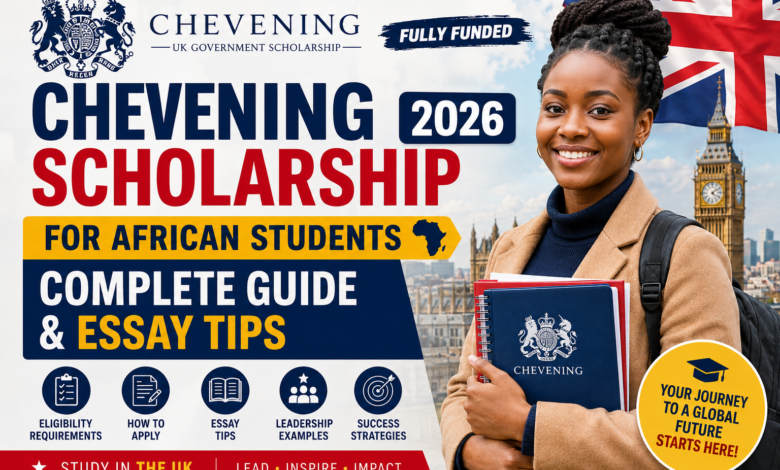
There is a quiet, lingering fear that hits almost every African student staring at the Chevening Scholarship 2026 for African Students application form. It is usually not the transcripts or recommendation letters causing anxiety. Instead, it is the sinking feeling that you may not have “enough leadership experience” or that your work experience somehow does not count.
Bother. Because the scholars who win are almost entirely made up of people who nearly did not click submit.
The truth about the Chevening Scholarship for African students in 2026 is not about superhuman CVs or political connections. It is about pattern recognition. The UK Foreign, Commonwealth & Development Office (FCDO) is not hunting for future CEOs alone. They are looking for specific behavioral signals embedded in your essays — signals that show you can lead, connect, and return home to create measurable change.
This guide breaks down the unwritten eligibility rules, the exact anatomy of winning essays, practical leadership examples from real African contexts, and a timeline strategy built around how applications actually fall apart.
What Is the Chevening Scholarship?
The Chevening Scholarship is the UK government’s flagship international awards program, funded by the FCDO and partner organizations. It supports outstanding professionals to pursue a one-year master’s degree at a UK university.
| Benefit | Covered |
| Full tuition fees | Yes |
| Monthly living stipend | Yes |
| Return airfare | Yes |
| Arrival and departure allowances | Yes |
| Visa application fees | Yes |
| Thesis grant | Yes |
Unlike academic scholarships, Chevening does not primarily reward grades. It rewards leaders: people with proven influence, clear career direction, and a credible plan to return home and create change. That distinction is where many strong African candidates quietly fall short.
RECOMMENDED POST: Study in Germany for International Students 2026: Tuition-Free Universities, DAAD Scholarships & Visa Guide
Why Chevening Is Particularly Competitive for African Students in 2026
Three factors make the 2026 cycle especially significant.
First, the UK Graduate Route visa remains a major pull factor. The scholarship’s real value is not just the free master’s degree it is the automatic two-year post-study work authorization that follows, giving African professionals access to UK salary rates, global networks, and international experience.
Second, Chevening alumni communities across Nigeria, Ghana, Uganda, Kenya, and South Africa have become increasingly visible. The pool of applicants grows each year. The bar rises.
Third and often overlooked administrative disqualifications are rising. Many competitive applicants lose out not because of weak essays, but because of sloppy paperwork. British embassy screening teams are zero-tolerance on incomplete or mismatched documentation. Mastering the admin side alone places you ahead of a significant portion of the field.
Chevening Scholarship 2026 Eligibility for African Students
Before spending weeks on essays, confirm you genuinely qualify. All 54 African countries are Chevening-eligible.
Core Requirements
- Be a citizen of an eligible Chevening country
- Hold an undergraduate degree equivalent to a UK upper second-class honors (2:1) or better
- Have completed your undergraduate studies at least two years before the application deadline
- Have at least 2,800 hours of work experience gained after graduation
- Apply to three different eligible UK master’s courses
- Commit to returning to your home country for at least two years after the scholarship ends
If you are unsure about your degree equivalency, the UK ENIC database allows you to check early. Do not wait until October to discover a classification issue.
The Work Experience Question: Clearing Up the Biggest Myth
You do not need a formal 9-to-5 office job. Chevening requires 2,800 hours — not two calendar years of employment. That opens far more options than most people realize.
What counts toward your 2,800 hours:
- Full-time or part-time paid employment
- NYSC (for Nigerian applicants — your service year qualifies in full)
- Mandatory national service in other African countries
- Paid or unpaid internships
- Volunteering with a registered organization
- Freelance or self-employment
- Family business involvement in a verifiable capacity
You can combine up to 15 different roles or periods. Many Nigerian applicants piece together 18 months in a bank or NGO, six months of freelance consulting, and documented volunteer hours — and comfortably clear the threshold.
Important 2026 update: Only post-graduation experience counts. Internships or roles completed during your undergraduate degree no longer qualify. Check your graduation date carefully.
How to Apply for the Chevening Scholarship 2026
Step 1: Research UK Courses Strategically
Applicants select three eligible UK master’s programs. This step has more impact than most people expect. Avoid choosing programs because they sound prestigious. Connect your course choices to your career goals, sector challenges, and future leadership plans.
Research specific modules. Read faculty publications. Understand what makes each program different. Committees notice when applicants engage at that level.
| Practical Example A public health professional from Rivers State focusing on maternal healthcare should not just name an MSc in Public Health. They should explain which modules address community health systems, which faculty research aligns with their work, and how that framework applies directly to challenges at home. |
Structure your three choices as: an ambitious first at a strong research university, a solid second with industry links, and a reliable third with unique specialization. All three must align with the same career narrative.
Step 2: Build Your Application Timeline
| Period | Key Task |
| May to July | Research courses and verify eligibility hours |
| August | Begin document collection and first essay drafts |
| September | Deep essay revision and external review |
| October | Final submission before deadline |
| November to January | Reading committee assessment |
| February to April | Interview stage (if shortlisted) |
| Mid-year | Final results and university offer deadline |
Step 3: Lock Down Your Documents Early
Document delays kill strong applications. Go to your university registrar in person if necessary.
Your essential document checklist:
- Full academic transcripts and degree certificate (officially certified)
- Valid passport — details must exactly match your application
- Two reference letters from people who know your specific work
- Updated CV using action-driven language, not duty descriptions
- English proficiency evidence if required by chosen universities
On references: the fatal mistake is choosing the most impressive name you know who barely knows your work. Choose the person who can speak to specific examples of your leadership. Send them your CV, a bullet list of three or four things you want highlighted, and a draft if helpful.
Understanding the Chevening Essays
This is where the vast majority of applications succeed or fail. Chevening essays are not academic statements. They are evidence-based leadership narratives. For the 2026 cycle, each essay carries a maximum of 300 words — tighter than many previous cycles. Every sentence must earn its place.
The four essays:
- Leadership and Influence
- Networking and Relationship Building
- Studying in the UK
- Career Plan and Future Impact
Treat these not as four separate stories, but as four chapters of the same book your future impact.
RECOMMENDED POST: Fully Funded Scholarships for African Students 2026: Masters & PhD Opportunities in UK, Germany & Canada
How to Write Each Chevening Essay
Essay 1: Leadership and Influence
Chevening defines leadership very differently from how most African applicants have been trained to think about it. It is not a title. It is evidence that you influenced people, projects, or outcomes often without formal authority.
Use the STAR-R structure:
- Situation: What was the context?
- Task: What needed to happen?
- Action: What did you specifically do?
- Result: What changed, and by how much?
- Reflection: What did you learn about yourself or leadership?
| Weak Example I am passionate about helping young people in my community. |
| Stronger Example I identified a recurring reconciliation error at my branch causing a 3% monthly variance. I developed a tracking template, piloted it with three colleagues, and reduced the variance to 0.2% within two months — without a managerial title or formal directive. |
One detailed, meaningful story outperforms a laundry list of achievements every time.
Essay 2: Networking and Relationship Building
Chevening views networking as deliberate relationship-building that creates opportunities, collaboration, and shared impact. They want evidence that you build and maintain professional relationships for a purpose.
| Weak Example I have a strong professional network on LinkedIn. |
| Stronger Example I created a WhatsApp community of 50 early-career science graduates to share research opportunities. I introduced a bioinformatics researcher to a logistics startup seeking data infrastructure support. Three members secured internships through connections made in that community. I maintain the group by sharing weekly journal articles and curated opportunities. |
Essay 3: Studying in the UK
Do not write a love letter to the UK. “I want to study in the UK because of its world-class education” is invisible — every single applicant writes something like that.
Be surgically specific. Name your first-choice program, specific modules, and a faculty member’s recent research you have actually read. Explain why this combination serves a problem you are working to solve at home.
| Example I am not looking for a generalist Development Studies degree. I need the Crisis States module at LSE, combined with the empirical focus on political settlements at SOAS. The agricultural policy failures I have observed are not primarily technical — they are political. I need that diagnostic framework to design interventions that actually hold. |
Essay 4: Career Plan and Future Impact
Chevening is an investment. They expect a return. Show you have thought seriously about what comes next in specific, realistic steps.
- Short-term (first two years home): Be realistic. Describe the role you will return to and how UK training directly changes your approach.
- Mid-term (three to five years): Show progression with intent.
- Long-term (five-plus years): This is where ambition belongs — tied to a specific, measurable outcome.
Connect the UK experience to the African problem at every step. That golden thread must run through all four essays coherently.
Chevening Leadership Examples That Work for African Applicants
Strong leadership stories come from ordinary environments. What matters is the impact, the initiative, and the measurable contribution — not the job title.
| Context | Example |
| Community Health | Organized malaria awareness outreach across three communities, helping 300 households access free testing and treatment |
| Campus Initiative | Launched peer mentorship connecting 50 final-year students with industry professionals, resulting in 12 internship placements |
| Digital Skills | Taught coding in an underserved community program where participants went on to secure remote income |
| Public Sector | Identified a clearance backlog, proposed a digital tracker, trained resistant colleagues, reduced clearance from 5 days to 2 days |
| Emergency Response | Coordinated flood response logistics for 40 volunteers across 3 sites with no prior emergency management experience |
Expert Tips That Actually Move Applications Forward
- Start three months before the deadline — the first draft is always wrong
- Get feedback from a Chevening alumnus. Ask: “What does this essay prove about me?”
- Know your home country’s current political and economic affairs deeply — interview panels test this
- Treat your CV as an achievement document, not a job description
- Record yourself answering practice interview questions out loud before the interview
Common Mistakes That Quietly Destroy Applications
| Mistake | What to Do Instead |
| Generic essays with vague language | Use one specific story with measurable outcomes |
| Choosing unrelated courses | Align all three choices to one career narrative |
| Overloading essays with achievements | Depth over breadth — one strong story beats ten shallow ones |
| Ignoring the networking essay | Show structured, purpose-driven relationship building |
| AI-sounding or overpolished language | Write like a thinking human being, not a motivational poster |
| Sounding like a grateful supplicant | Frame the scholarship as a strategic partnership |
| Last-minute applications | Plan a minimum three-month preparation window |
| Weak or generic references | Choose referees who know your specific work and impact |
| Ignoring UK priority areas | Connect your career plan to growth, climate, security, or inclusion |
| Not calculating hours precisely | Build a spreadsheet and document every eligible period |
RECOMMENDED POST: Visa Sponsorship Jobs in Canada 2026: Complete Guide for International Students & Graduates
Interview Preparation for Chevening Scholarship 2026
Reaching the interview stage places you ahead of thousands of other applicants. The panel — typically held at the British High Commission — will cross-reference your essays closely. They assess whether your leadership examples are authentic, your career plan realistic, and whether you can communicate with clarity under scrutiny.
Common interview questions to prepare for:
- Why did you choose these three courses?
- How will this scholarship benefit your home country specifically?
- Describe a leadership challenge you faced and how you navigated it
- What does networking mean to you in practice?
- Why should Chevening invest in you over other strong candidates?
- What is happening in your sector at home right now?
Stay composed if challenged. Panels sometimes push back to test how you handle disagreement. That is not an attack — it is part of the evaluation. Respond with calm reasoning, not defensiveness.
Frequently Asked Questions
Does Chevening require two years of work experience in 2026?
The requirement is 2,800 hours gained after your undergraduate graduation. This can be assembled from part-time work, voluntary roles, internships, freelance work, and mandatory national service. Document your hours precisely.
Can recent graduates apply for Chevening?
It depends on the cycle. If you graduated before the required cutoff and have already accumulated 2,800 post-graduation hours, you may qualify. Your essays will need exceptional depth to compensate for a shorter post-graduation track record.
What makes a strong Chevening leadership essay?
A strong essay presents one specific, results-driven example of influence or problem-solving, quantifies the outcome, and ends with a genuine reflection on what the experience taught you. It never just describes job duties or speaks in vague motivational language.
I have a 2:2 degree. Can I still apply?
It is a significant challenge, but not impossible if you hold a subsequent master’s degree or have five-plus years of strong, progressive professional experience with measurable impact. Address the academic gap directly — do not hope the committee overlooks it.
How competitive is Chevening for Nigerian applicants?
Nigeria consistently produces one of the highest application volumes on the continent, making competition extremely intense. Strong storytelling, specific leadership evidence, and strategic course selection become essential differentiators.
Can I apply if I already hold a master’s degree?
Yes. Chevening permits a second master’s if it clearly advances your career goals and you can demonstrate why the specific UK qualification is necessary for your next stage of impact.
A Final Note
When you click submit this application cycle, the feeling should not be relief. It should be quiet confidence that you have translated your African story into a global language.
Chevening does not want perfection. It wants potential, expressed through a structured, honest, and deeply specific application. You are not asking for a gift. You are proposing a partnership. You have experience, influence, and a plan. Chevening has a network and a platform.
Start early. Research your courses properly. Build your essays around real experiences. Edit thoroughly. Get feedback from people who will tell you the truth.