PTDF Scholarship 2026/2027 Nigeria: Eligibility, NIN Verification, Documents & Application Guide
How to Apply for the Fully Funded PTDF Scholarship: A Complete Guide for Nigerians

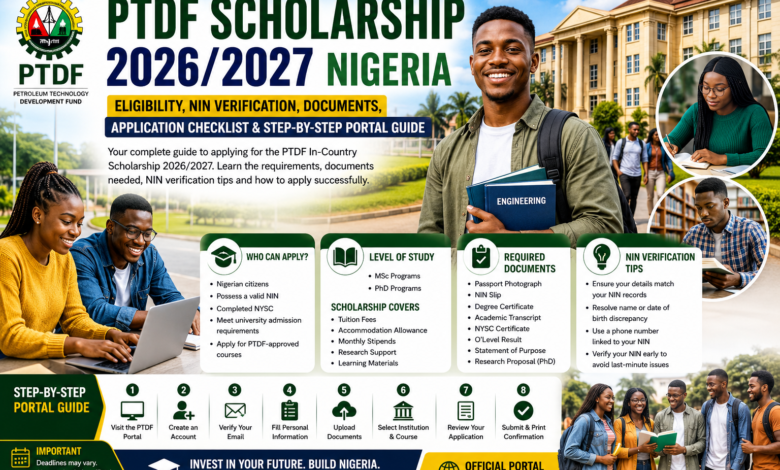
Every year, thousands of qualified Nigerian graduates lose PTDF scholarships not because of poor grades, but because of a blurry document scan, a name mismatch on their NIN, or an application submitted two hours after portal congestion made submission impossible. The gap between a strong candidate and a successful applicant is almost always preparation.
RECOMMENDED POST: Fully Funded Scholarships for African Students 2026: Masters & PhD Opportunities in UK, Germany & Canada
The Petroleum Technology Development Fund Scholarship is one of the most substantial government-funded education programmes in Nigeria. It does not just cover tuition; it packages financial support, research allowances, health insurance, and in some categories, return flights. For postgraduate students in engineering, geosciences, energy, and related technical fields, it is genuinely transformative.
The 2026/2027 cycle is already underway. The Overseas Postgraduate Scholarship window closed on 27 February 2026. The In-Country Scholarship Scheme (ISS) closes on 5 June 2026. If you are reading this before that date, there is still time but not much margin for last-minute scrambling.
This guide pulls together everything you need: what PTDF actually funds, which category fits your profile, the exact eligibility conditions per scheme, how NIN verification works and why it fails, the complete document checklist with upload tips, and a precise step-by-step walkthrough of the application portal. Whether you are applying for an MSc locally or a PhD abroad, the information here is built for the 2026/2027 cycle specifically.
What the PTDF Scholarship Actually Is
The Petroleum Technology Development Fund is a Federal Government agency established under the PTDF Act Cap P26, Laws of the Federation of Nigeria 2004. Its mandate is direct: build Nigerian capacity in oil, gas, energy, and allied technical sectors so the country is not perpetually dependent on foreign expertise in its most critical industry.
The scholarship is the most visible arm of that mandate. It funds Nigerian students through two main tracks one for overseas postgraduate study, one for local undergraduate and postgraduate programmes and the selection criteria reflect exactly what PTDF exists to achieve. They are not awarding general academic excellence. They are investing in people who will bring something back to Nigeria’s energy sector.
That focus matters when you write your Statement of Purpose, choose your course, and frame your research proposal. Every part of your application should connect to that mission. Reviewers can tell when an applicant understands PTDF’s purpose and when they are simply chasing funding.
What the Scholarship Covers
For the Overseas Postgraduate Scholarship (OSS), successful candidates receive:
- Full tuition and bench fees at a partner university
- Return economy-class flight tickets
- Health insurance for the duration of the programme
- Monthly living allowance
- Accommodation support
For the In-Country Scholarship Scheme (ISS), the award includes:
- NGN 700,000 per year
- A laptop computer
- Study at an accredited Nigerian public university
These are not token grants. The overseas award in particular is a full-package government investment, which is exactly why competition for it is severe.
Types of PTDF Scholarships in the 2026/2027 Cycle
Overseas Postgraduate Scholarship (OSS)
This funds MSc and PhD studies at PTDF partner universities in the United Kingdom, Germany, France, and Malaysia. UK PhD placements often run as split-site programmes with the College of Petroleum and Energy Studies, Kaduna (CPESK).
The overseas category is the most competitive. Academic performance thresholds are higher, a strong Statement of Purpose or research proposal is non-negotiable, and the selection process includes interviews conducted simultaneously across Nigeria’s six geopolitical zones.
In-Country Scholarship Scheme (ISS)
The ISS funds study at Nigerian public universities and covers three academic levels:
- Undergraduate (200-level students)
- Masters (MSc)
- Doctoral (PhD)
The in-country option remains highly competitive despite the local study requirement. For many applicants, it is more accessible than the overseas track while still delivering meaningful financial support.
Previous Beneficiary Rule
This applies across both schemes. If you previously received a PTDF scholarship, you cannot apply for the same level or a lower one. An MSc beneficiary may apply for PhD funding. They may not apply for another MSc, whether overseas or in-country. This is checked during verification and misrepresentation leads to disqualification.
PTDF Scholarship 2026/2027 Key Dates
| Scheme | Application Opened | Closing Date |
|---|---|---|
| Overseas Postgraduate (OSS) | 16 January 2026 | 27 February 2026 |
| In-Country Scholarship (ISS) | Late April 2026 | 5 June 2026 |
The OSS window has closed. The ISS window remains open through early June 2026. Always verify exact dates directly on the official portal at scholarship.ptdf.gov.ng, as some ISS subcategories may have slightly earlier internal deadlines.
PTDF Scholarship 2026/2027 Eligibility Requirements
Eligibility rules differ by scheme and by degree level. Applying under a category you do not qualify for is one of the most common disqualification reasons — the system flags it before a human reviewer ever sees your file.
General Conditions (All Applicants, All Schemes)
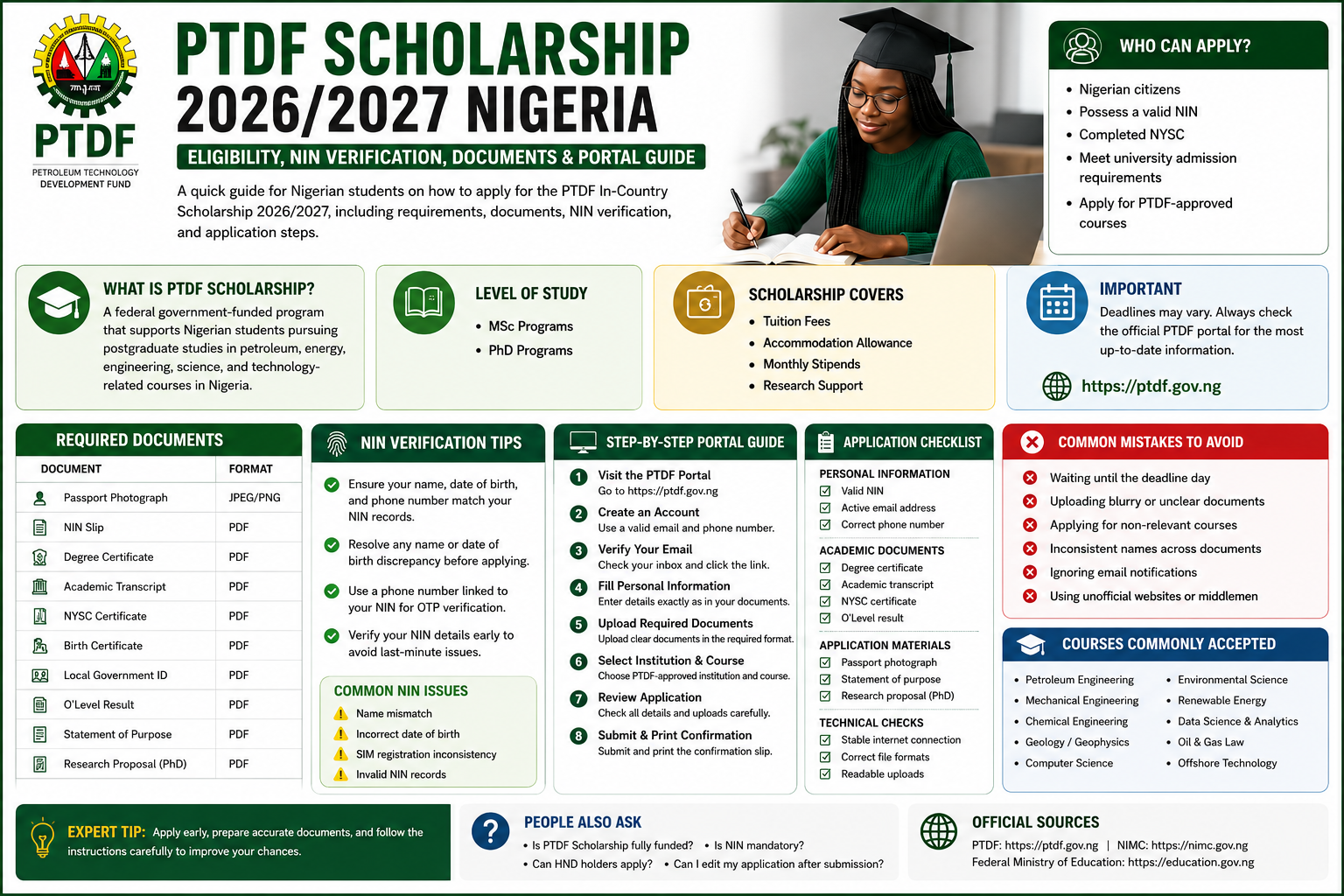
- Must be a Nigerian citizen
- Must hold a valid, verified National Identification Number (NIN)
- Must not currently be a beneficiary of another Federal Government scholarship (NNPC, BEA, or similar)
- Must be medically fit — a certificate from a government hospital is required
- Must have no criminal record (confirmed by sworn affidavit or police clearance)
- Must be within the applicable age limit (typically 35 years for postgraduate, 26 years for undergraduate)
Overseas MSc — Eligibility Requirements
| Requirement | Details |
|---|---|
| Undergraduate degree | Minimum Second Class Lower (2.2); preference given to 2.1 and above |
| NYSC | Discharge certificate or exemption letter required |
| O’Level | Five credits in one or two sittings, including English and Mathematics |
| English proficiency | IELTS 6.5+ or TOEFL iBT 90+ (UK/Germany programmes) |
| Computer literacy | Demonstrated proficiency required |
| Other scholarships | Must not be a current government scholarship beneficiary |
Overseas PhD — Eligibility Requirements
| Requirement | Details |
|---|---|
| Master’s degree | In a relevant field (oil/gas, energy, or allied discipline) |
| Undergraduate degree | Minimum Second Class Lower (2.2) |
| NYSC | Discharge or exemption certificate |
| Research proposal | Mandatory — 5 to 6 pages using the PTDF portal template |
| Research relevance | Must demonstrate clear application to Nigeria’s energy sector |
| Lecturer applicants | Letter from Vice-Chancellor confirming no other scholarship benefit |
In-Country Undergraduate (ISS)
| Requirement | Details |
|---|---|
| Academic level | Full-time 200-level student in a Nigerian public university |
| Minimum CGPA | 2.4/5.0 (Second Class Lower equivalent) |
| Course | Must fall within PTDF-approved disciplines |
| Documents | First-year transcript, signed and stamped by institution |
| O’Level | Five credits including English and Mathematics |
In-Country Postgraduate MSc/PhD (ISS)
Requirements mirror the overseas track but are focused on Nigerian public universities. An admission letter from the institution is mandatory. PhD applicants must submit a well-developed research proposal. A Second Class Lower is the minimum degree class, though Second Class Upper gives a considerably stronger application.
NIN Verification: The Step That Stops Many Applications Cold
Every PTDF applicant must complete NIN verification before the application form can proceed. This is not optional and cannot be deferred. The portal connects directly to the NIMC database, and if verification fails, no amount of documentation will move your application forward.
How the Process Works
When you reach the NIN verification stage at scholarship.ptdf.gov.ng, the system prompts you to enter your 11-digit NIN. A payment is triggered via Paystack (typically NGN 500) as the NIMC verification charge. After payment, the system checks your NIN against the NIMC database.
If the name linked to your NIN matches the name on your PTDF registration, verification passes. If it does not, it fails.
Why NIN Verification Fails
Name mismatch. This is the leading cause. If your NIN record reads “Emeka Joseph Okafor” but you registered on the PTDF portal as “Joseph Emeka Okafor,” the system flags a mismatch. Even a middle name that appears on one document but not another can cause a failure. Every name arrangement on your NIN must match your application registration exactly.
Unverified NIN. Some people enrolled with NIMC but never completed the full verification process. An NIN exists in the system but is flagged as unverified. This will fail the PTDF check. Confirm your NIN status at the NIMC self-service portal before you begin the PTDF application.
Network timeout. Portal traffic during peak application periods can cause verification requests to time out. PTDF explicitly warns against clicking the verify button multiple times each attempt triggers a payment charge.
RECOMMENDED POST: Chevening Scholarship 2026 for African Students Complete Guide & Essay Tips
What to Do If Verification Fails
Do not keep clicking retry. Use the “Click here for all failed NIN verification” option on the portal, input your payment reference and NIN, and attempt resolution through the support channel. If the issue is a name mismatch in the NIMC database, visit an NIMC enrolment centre directly and have it corrected before attempting verification again.
Practical steps before applying:
- Check your NIN status at self-service.nimc.gov.ng or dial
*346#on your registered SIM - Confirm that your full name in the NIMC database exactly matches how it appears on every other document you are submitting
- Ensure your NIN is linked to an active phone number for OTP delivery
- If you lack a NIN entirely, visit the nearest NIMC enrolment centre — bring your birth certificate, a passport photograph, and valid ID. Processing typically takes two to five business days.
Required Documents: The Complete Checklist
Document errors — wrong format, blurry scans, mismatched names, missing files — are the second most common reason applications fail after NIN issues. Prepare every document on this list before you open the portal. Uploading under deadline pressure is where small mistakes become disqualifying ones.
Documents Required by All Applicants (All Schemes)
| # | Document | Format | Notes |
|---|---|---|---|
| 1 | Valid means of identification | PDF or JPEG | National ID card, international passport, or driver’s licence |
| 2 | NIN slip | PDF or JPEG | Downloaded from NIMC portal |
| 3 | Recent passport photograph | JPEG | Plain background, taken within 6 months |
| 4 | O’Level certificate(s) | WAEC, SSCE, or NECO — both sittings if applicable | |
| 5 | Birth certificate or age declaration | Must match all other documents | |
| 6 | Certificate of state of origin | From your Local Government Area | |
| 7 | Medical certificate of fitness | From a government hospital | |
| 8 | Police clearance or sworn affidavit | Confirming no criminal record |
Additional Documents for Overseas and Local MSc Applicants
| # | Document | Notes |
|---|---|---|
| 9 | First degree certificate | Minimum Second Class Lower |
| 10 | Official academic transcript | Sealed and stamped by institution registry |
| 11 | NYSC discharge or exemption certificate | Must be current and valid |
| 12 | Statement of Purpose | Maximum 500 words — PTDF-specific, not a recycled university SOP |
| 13 | Two referee letters | From academic staff, on institutional letterhead |
Additional Documents for PhD Applicants (Overseas and In-Country)
| # | Document | Notes |
|---|---|---|
| 14 | Master’s degree certificate | In a relevant discipline |
| 15 | Research proposal | 5 to 6 pages using the PTDF portal template — mandatory |
| 16 | Evidence of publications | Where applicable — strengthens the application |
| 17 | NYSC discharge or exemption certificate | Required |
Additional for Overseas Applicants
| # | Document | Notes |
|---|---|---|
| 18 | IELTS or TOEFL certificate | IELTS 6.5+ or TOEFL iBT 90+ for UK/Germany |
| 19 | Unconditional admission offer (preferred) | From a PTDF-approved partner university |
Additional for In-Country Undergraduate (ISS)
| # | Document | Notes |
|---|---|---|
| 20 | Admission letter from Nigerian public university | Current academic session |
| 21 | First-year transcript | Signed and stamped by institution |
Upload Tips
File sizes on the PTDF portal are typically capped between 500KB and 2MB per document. Use a reliable PDF compression tool to reduce file sizes without degrading readability. Blurry scans are a silent disqualifier — review every uploaded document at full size before submission.
Naming convention that works:
Good: John_Okafor_WAEC_Certificate.pdf / NIN_Slip_Amaka_Eze.pdf
Bad: FINAL2.pdf / SCAN(1).pdf / documentnew.pdf
Sensible file names are a small signal of professionalism that reviewers notice.
PTDF Scholarship Application Checklist 2026
Before You Open the Portal
- [ ] Confirmed eligibility for the correct scholarship category and degree level
- [ ] Verified NIN at NIMC self-service portal — status is active and verified
- [ ] Confirmed name spelling is identical across NIN, birth certificate, O’Level result, and degree certificate
- [ ] Collected all required documents in correct formats
- [ ] Obtained official sealed transcript from university registry
- [ ] Medical fitness certificate collected from a government hospital
- [ ] Two academic referee letters collected on institutional letterhead
- [ ] Research proposal or Statement of Purpose drafted and reviewed
- [ ] Created and verified an email address you actively use
During the Application
- [ ] Registered on the PTDF portal with personal details matching your NIN exactly
- [ ] Completed NIN verification successfully
- [ ] All sections of the online form completed — no blank mandatory fields
- [ ] All documents uploaded in correct slots and formats
- [ ] Scholarship category correctly selected
- [ ] All spellings verified against original documents
- [ ] Application reviewed end-to-end before final submission
- [ ] Confirmation reference number saved and stored
Step-by-Step PTDF Scholarship Portal Guide
The application portal is HERE CLICK at it and use the address. There are phishing sites and unofficial clone pages circulating always confirm you are on the .gov.ng domain before entering any personal information.
Step 1: Create Your Account
Click “Create Applicant Account.” Enter your full name exactly as it appears on your NIN and identification documents, a valid email address, your phone number, and a strong password. Submit the form. A verification email will arrive — check your inbox, spam, and promotions tabs. Click the activation link before proceeding.
Step 2: Log In and Navigate to the Dashboard
Use your email and password to access the applicant dashboard. Here you will see the active application categories. Select the scholarship type that matches your situation: Overseas MSc, Overseas PhD, In-Country Undergraduate, or In-Country Postgraduate.
Step 3: Complete NIN Verification
Before filling any other section, the portal will direct you to complete NIN verification. Enter your 11-digit NIN. Complete the Paystack payment when prompted. Wait for the system confirmation. If verification fails, use the support channel rather than repeating the payment process unnecessarily.
Step 4: Fill Personal Information
Enter your biodata — full name, date of birth, gender, LGA, state of origin, contact address, phone number. Every field must match your original documents precisely. This section is cross-checked against your uploads during screening.
Step 5: Enter Educational Background
Input your secondary school details including O’Level results, and your tertiary institution details — institution name, course, year of entry, graduation year, degree class, and CGPA. Be accurate. Discrepancies between what you enter and what you upload are flagged automatically.
Step 6: Select Your Course and Institution
Choose only from the PTDF-approved course and institution list available within your portal profile after login. If your intended programme is not on that list, it is not eligible for this cycle. Do not attempt to apply for an unapproved course — it will be disqualified during document screening regardless of academic strength.
Step 7: Upload All Required Documents
The portal presents individual upload slots for each document type. Upload files in the correct slot, in the correct format, within the size limit. Use the file naming convention described above. After each upload, verify the file rendered correctly — open the preview if available.
Step 8: Complete the Referee Section
Enter full names, designations, institutional affiliations, and email addresses for two academic referees. Some versions of the portal send automated requests to referee email addresses. Inform your referees before submitting — an unanswered referee request leaves your application incomplete.
Step 9: Review and Submit
Use the preview function to check every section. Confirm there are no blank mandatory fields, all documents are uploaded, the scholarship category is correct, NIN verification is complete, and all spellings are accurate. Once you click “Submit,” editing is no longer possible in most cases.
Step 10: Save Your Confirmation
After submission, a confirmation message and reference number will be displayed. Download or print this. Keep both a digital copy and a printed one. The reference number is what you use to track your application and raise any post-submission issues with PTDF.
Expert Tips for a Competitive Application
Start document collection six to eight weeks before the deadline. Getting an official sealed transcript from some Nigerian universities takes three to four weeks minimum. The application deadline is not the time to discover your registry has a three-week processing backlog.
Write a PTDF-specific Statement of Purpose — not a recycled university application essay. A university SOP explains why you want to study at that institution. A PTDF SOP must explain how your proposed study connects to Nigeria’s energy development, what you intend to contribute after graduating, and why PTDF’s investment in you is a sound use of public resources. The screening panel reviews hundreds of submissions. Generic essays are identifiable within the first paragraph.
For PhD applicants, your research proposal is the most important document in the application. It should be built around a real, specific problem in Nigeria’s energy sector, with clear objectives, a credible methodology, and a plan for how your findings will generate practical value. Practice presenting your proposal in three to five minutes — interview panels ask PhD candidates to do exactly this.
Choose referees who know your work, not just your name. A detailed letter from an assistant lecturer who supervised your final-year project is more persuasive than a vague endorsement from a professor who barely recognizes your face. What matters is specificity and genuine knowledge of your capabilities.
Apply in the first week of the window, not the last two days. Portal traffic surges dramatically near deadlines. Technical failures, payment gateway errors, and server slowdowns are common and PTDF cannot extend personal deadlines for applicants who waited too long. An application that is ready but cannot be submitted is equivalent to no application.
For overseas applicants, begin the university admission process in parallel. Some categories of the overseas scholarship prefer or require candidates who already hold an unconditional offer from a PTDF-approved institution. Starting both processes simultaneously gives you a significant edge and avoids having a scholarship award you cannot use.
Common Mistakes That Get Applications Rejected
Using inconsistent names across documents. Your name on your NIN, birth certificate, O’Level result, NYSC certificate, and degree certificate must be identical in spelling and arrangement. A middle name that appears on one document but not another is enough to trigger a verification flag. Resolve name discrepancies with NIMC and the relevant institutions before applying.
Uploading a photocopy of a transcript instead of an official sealed one. Many applicants do not know the difference. An official transcript comes sealed in an envelope with the registrar’s stamp and signature. A photocopy — even a high-quality one — is not accepted and will result in document screening failure.
Applying for courses outside PTDF’s approved list. This is an automatic disqualification. The approved course list is accessible through your profile after portal login. Check it before you begin the form.
Submitting a generic Statement of Purpose. The selection panel reads applications from candidates across every state. A Statement of Purpose that could have been written for any scholarship, by any applicant, in any country, is a liability. Specificity to PTDF’s mandate is what distinguishes strong applications.
Using someone else’s NIN or submitting falsified documents. The NIMC verification check matches the name on the NIN record against the name on the application. Any mismatch, whether accidental or deliberate, triggers disqualification. PTDF has also stated that falsified documents result in blacklisting from future scholarship cycles.
Ignoring the referee section. Entering referee details without informing the actual people is a silent application killer. If the portal sends automated requests and they go unanswered, your submission is treated as incomplete.
Waiting until the final 48 hours. This mistake combines the risks of all the others into one decision. There is no remedy for a portal that goes down the night before a hard deadline.
What Happens After You Submit
After the application window closes, PTDF processes submissions in three stages. The first is automated: the portal runs a system check on document completeness and NIN verification status. Applications with missing or flagged items are filtered at this stage.
The second stage involves manual review by PTDF staff, who assess academic records, Statements of Purpose, research proposals, and document quality. The third stage is external review by a consultant panel that evaluates applications against PTDF’s strategic priorities.
Shortlisted candidates receive formal interview invitations specifying date, time, and geopolitical zone centre. For the 2026/2027 overseas cycle, interviews commenced on 16 April 2026 — MSc candidates in the first week, PhD candidates in the second.
Selection follows the Federal Character principle. Candidates compete within their states of origin, and top performers from each state advance. Representatives from the Federal Character Commission observe the process. Final results are published on the PTDF website and the scholarship portal. Successful candidates receive award letters with instructions on placement, visa processing (for overseas scholars), and disbursement arrangements.
Approved Courses and Disciplines
PTDF restricts applications to programmes relevant to Nigeria’s petroleum and energy sectors. Common eligible fields include:
Engineering: Petroleum engineering, chemical engineering, mechanical engineering, electrical engineering, civil engineering, marine engineering
Geosciences and Environment: Geology, geophysics, environmental science and management, offshore technology
Technology and Computing: Computer science, data science, artificial intelligence applied to energy systems, cybersecurity
Energy and Economics: Renewable energy, energy economics, gas engineering, oil and gas law
Management: Project management (energy focus), supply chain management for oil and gas
Humanities and pure social science programmes outside this scope are generally ineligible. If you are uncertain whether your course qualifies, check the approved course list on the portal directly rather than assuming.
Frequently Asked Questions
When does the PTDF In-Country Scholarship 2026 close? The ISS deadline is 5 June 2026. Some subcategories may close on 31 May 2026. Always confirm the exact date on the official portal at scholarship.ptdf.gov.ng.
Is the PTDF scholarship fully funded? Yes. The overseas scholarship covers return flights, full tuition, bench fees, health insurance, accommodation, and living allowances. The in-country scholarship provides NGN 700,000 per year plus a laptop.
Can I apply for both the Overseas and In-Country scholarships simultaneously? No. Multiple applications are prohibited. Submitting more than one application results in automatic disqualification across all submissions.
Can I apply with a Second Class Lower (2.2) degree? Yes, for some categories. The Overseas MSc accepts 2.2 candidates with relevant industry experience. The In-Country MSc accepts 2.2 as the minimum. For the overseas PhD, a 2.2 undergraduate degree combined with a strong Master’s qualification may qualify. A 2.2 alone without supporting strengths will face significant competition from 2.1 candidates.
What happens if my NIN verification fails? Do not click retry repeatedly — each attempt triggers a payment charge. Use the “failed NIN verification” support function on the portal and contact PTDF support. If your NIN itself has issues, visit an NIMC enrolment centre to resolve them before attempting again.
Can I edit my application after submitting? No. The portal locks after final submission. Review every section carefully before clicking Submit.
I previously received a PTDF scholarship. Can I apply again? You can apply for a higher degree level. If you received an MSc scholarship previously, you are eligible to apply for PhD funding. You cannot apply for another MSc or undergraduate award.
Can HND holders apply? Generally no. PTDF eligibility is degree-based. HND holders who have subsequently completed a Bachelor’s degree that meets the minimum classification requirements may qualify through that route.
What is the age limit for PTDF scholarship applicants? Typically 35 years for postgraduate and 26 years for undergraduate at the time of application. These limits are stated in each annual circular and should be verified for the current cycle.
How competitive is the PTDF scholarship? Extremely. Thousands apply annually. Selection considers academic performance, Statement of Purpose quality, research proposal relevance, professional experience, and alignment with PTDF’s energy sector mandate. Federal Character representation means competition is partly state-based, but merit within each state remains the deciding factor.
Where do PTDF interviews take place? Interviews are held simultaneously at centres across Nigeria’s six geopolitical zones. You are assigned to the centre closest to your state of origin.
Does PTDF require university admission before application? Requirements vary by category and year. For the In-Country scheme, an admission letter is mandatory. For the Overseas scheme, holding an unconditional offer from a PTDF-approved university is strongly advantageous and may be required for certain categories. Confirm through the current cycle’s official guidelines.
Conclusion
The PTDF Scholarship 2026/2027 is a rigorous, merit-based programme with real selection standards and a genuine purpose. Every year, candidates with strong academic profiles are passed over because their documents were incomplete, their NIN failed verification, their Statement of Purpose said nothing specific, or they submitted on deadline day and the portal would not cooperate.
The difference between a competitive and a rejected application is almost always preparation. Know exactly which scheme you qualify for. Get your NIN verified weeks before the portal opens. Collect an official sealed transcript from your university now, not the week the portal closes. Write a Statement of Purpose that reflects genuine understanding of PTDF’s mandate, not a recycled version of something you wrote for university admission.
The In-Country Scholarship window closes 5 June 2026. For anyone still within that window, the time to start is now.
Monitor official announcements at ptdf.gov.ng and the application portal at scholarship.ptdf.gov.ng. Do not rely on social media rumours for deadline or requirement updates. Third-party summaries help with orientation, but the portal is the only authoritative source for what the current cycle requires.