UK Graduate Route Visa 2026: Rules, Eligibility & Switching Guide
Step-by-Step Process to Switch From UK Graduate Route Visa 2026 to Skilled Worker Visa

I still remember sitting across from a final-year engineering student from Lagos in late 2025. He had a countdown on his phone 97 days until his student visa expired. “I just need two more years,” he said. “Enough to land a sponsored job and prove I belong here.”
Thousands of international students are watching the same clock right now. The UK Graduate Route visa 2026 remains the most popular bridge between a British degree and a long-term career in the UK, but confusion about the current rules, upcoming changes, and the path to a Skilled Worker visa has never been higher.
If your Graduate Route visa is approaching its end or you’re planning ahead before graduation this guide is built for the practical, high-stakes decisions you’re actually facing. You’ll find a clear eligibility walkthrough, a step-by-step switching roadmap to Skilled Worker, a cost breakdown, updated dependant rules, common rejection reasons, and a timeline you can adapt to your own situation.
UK Graduate Route Visa 2026: Key Facts at a Glance
| Feature | Details |
|---|---|
| Visa purpose | Post-study work period after eligible UK qualification |
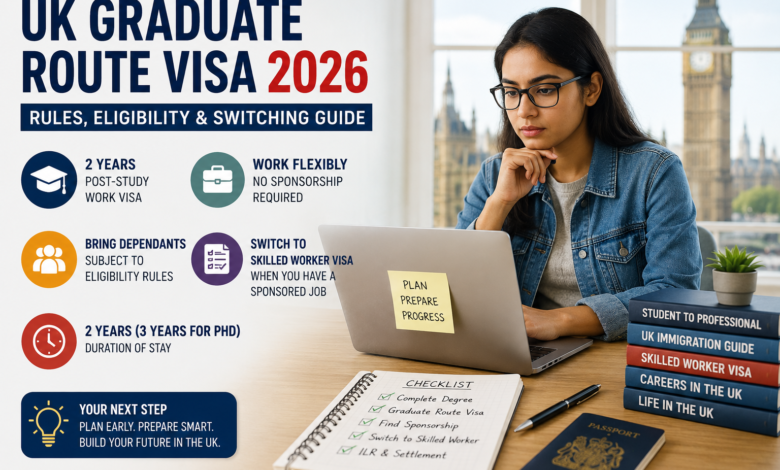
| Standard duration | 2 years (Bachelor’s / Master’s) |
| PhD duration | 3 years |
| Employer sponsorship required? | No — unsponsored at application |
| Work restrictions | Minimal — most work permitted including self-employment |
| Dependants allowed? | Limited — existing Student visa dependants only in most cases |
| Leads directly to ILR? | No — time on Graduate Route does not count toward ILR |
| Can switch to Skilled Worker? | Yes — from inside the UK with a valid job offer |
| Application location | Inside the UK only, while Student visa is valid |
What Is the UK Graduate Route Visa?
The Graduate Route is an unsponsored post-study work visa that allows eligible international graduates to remain in the UK after completing a qualifying degree. Unlike the Skilled Worker visa, it requires no job offer at the point of application — you can work at any skill level, switch employers freely, look for work, freelance, or become self-employed.
It was reintroduced in 2021 to replace the old Post-Study Work visa that had been scrapped in 2012. You may still see it referred to as the PSW visa UK in older search results — in 2026, the Graduate Route is what most people mean when they use that term. If you’re reading requirements pages, use “Graduate Route” to make sure you’re reading current guidance rather than outdated information about a discontinued category.
The Graduate Route is a bridge, not a permanent destination. It gives you a defined window to build UK work experience and secure employer sponsorship before you either switch to a longer-term visa or leave the country. That framing matters, because students who treat it as a destination — rather than a transition phase — routinely run out of time.
2026 Duration Rules and the 2027 Change You Need to Know
Duration currently depends on when you apply and your qualification level.
Applications on or before 31 December 2026:
- Bachelor’s or Master’s graduates: 2 years
- PhD / Doctoral graduates: 3 years
Applications from 1 January 2027:
- Bachelor’s or Master’s graduates: 18 months (reduced from 2 years)
- PhD graduates: 3 years (unchanged)
This reduction was announced in 2025 as part of broader government efforts to manage net migration. If you’re finishing a Bachelor’s or Master’s course in late 2026, applying before the December cutoff secures you the full two-year period. Students who start courses now should factor the shorter 18-month window into their long-term sponsorship planning — six months less runway is a meaningful compression when hiring cycles often take three to six months on their own.
PhD graduates retain the longer three-year period, reflecting the research investment involved and the typically longer employer transition timelines in research-based careers.
Am I Eligible? The Five Non-Negotiable Conditions
The Graduate Route approval rate sits above 95% for correctly submitted applications. Most refusals happen because one of the following conditions wasn’t met — not because of complex immigration issues.
Condition 1: Valid Student Visa at the Time of Application
You must apply from inside the UK while your current Student visa (or Tier 4) is still valid. If your visa has already expired, your options narrow dramatically. Late applications based on exceptional circumstances are theoretically possible but extremely difficult to argue successfully.
Condition 2: Eligible Qualification and Course Level
Your completed qualification must meet the Graduate Route criteria. Bachelor’s degrees, Master’s degrees, PhDs, PGCEs, and certain professional qualifications count. Diplomas, foundation programs, short courses, and sub-degree qualifications typically do not.
Common misunderstanding: “I studied in the UK for three years” is not the same as “I completed an eligible qualification.” The degree level and the structure of your award matter, not simply the time spent.
Condition 3:
guidance for sponsors – Sponsor a skilled worker
You must have received your final results, and your education provider must have confirmed successful completion to UK Visas and Immigration (UKVI). You cannot apply based on an expectation that you’ll pass, or before your results are formally notified.
Practical implication: Do not apply immediately after finishing exams. Wait until your university’s international student or visa compliance team confirms that your completion has been reported to UKVI.
Condition 4: Application Within Your Personal Window
There is no universal application date. Your personal window opens once your university reports completion to UKVI and closes when your current Student visa expires. Many students assume there’s a standard national deadline and miss their individual window as a result.
Actionable step: Pull your award letter and graduation confirmation dates now. Contact your institution’s international office to ask exactly when they will report your completion to UKVI — then plan your application date around that.
Condition 5: Eligible Education Provider
Your course must have been completed at a Higher Education Provider with a track record of compliance. Most major UK universities qualify, but private colleges that have lost their UKVI sponsor licence do not. If you studied at a smaller institution, verify eligibility through official government guidance before you pay the application fee.
You also cannot apply for the Graduate Route if you previously held one at the same qualification level — unless you’ve since completed a higher-level qualification (for example, moving from a master’s to a PhD).
What Work Can You Do on the Graduate Route?
The Graduate Route’s flexibility is one of its most valuable features. During your Graduate Route period, you can generally:
- Work full-time or part-time at any skill level
- Switch employers without restriction
- Work for multiple employers simultaneously
- Freelance or contract independently
- Become self-employed or start a business
There are narrow exceptions — professional sportsperson roles, for example — but for the vast majority of graduate career paths, the work rights are genuinely open.
How to Think About Work Rights Strategically
Instead of asking only “can I work?”, ask the questions that actually move your plan forward:
- “Can I work in a role that maps onto Skilled Worker occupation codes?”
- “Will the employer in this sector typically sponsor, or am I building experience in a non-sponsorship industry?”
- “Does this part-time or contract role give me UK-based references who can vouch for me in a sponsored application?”
The Graduate Route is investment time. The best use of it is building evidence — references, UK employment history, sector-specific experience — that makes a Skilled Worker application stronger, not just filling time before a deadline arrives.
UK Graduate Visa New Rules 2026: Dependants
Dependant rules are one of the most anxious search areas for Graduate Route holders, and the rules have tightened significantly in recent years.
Who Can Stay as Your Dependant
Dependants who were already on your Student visa in the UK can typically extend their stay alongside you on the Graduate Route — provided your own application is approved and your Graduate Route status is maintained.
Children born in the UK during your Student or Graduate permission can usually be added as dependants.
Who Cannot Be Added as New Dependants
For most non-research postgraduate students, the January 2024 dependant rule change means new dependants cannot join you on the Graduate Route. If you couldn’t bring your spouse or children on your Student visa under the current rules, the Graduate Route does not create a new right for them to join.
Practical advice: If dependants are part of your plan, don’t treat it as something to sort out later. Their application timing must align with your Graduate Route status, and the eligibility picture is more complicated than it was two years ago. Get current, case-specific guidance from a regulated immigration professional before assuming your family can join or remain.
How Much Does the Graduate Route Visa Cost in 2026?
The Graduate Route involves two main costs, both paid upfront at application.
| Cost Item | Amount |
|---|---|
| Application fee | £937 |
| IHS — 2-year visa (Bachelor’s / Master’s) | £2,070 |
| IHS — 18-month visa (from Jan 2027) | approx. £1,552.50 |
| IHS — 3-year visa (PhD) | £3,105 |
Each dependant pays the same IHS rate per person. A couple with one child switching together to a subsequent visa can face IHS costs of £6,000 or more — a figure many students don’t budget for until it’s too late.
There is no maintenance (savings) requirement for the Graduate Route application itself. However, you should budget for any legal advice fees, document translations, or UKVCAS appointment travel costs.
Fees can change. Always verify the current amounts on GOV.UK before submitting your application.
RECOMMENDED POST: Fully Funded Scholarships for African Students 2026: Masters & PhD Opportunities in UK, Germany & Canada
Graduate Route Visa Rejection Reasons: What Actually Goes Wrong
Most Graduate Route refusals are preventable. Based on patterns from immigration advisers and real refusal letters, the common failure modes cluster into five areas.
Applying Before University Completion Is Reported to UKVI
This is the most common mistake. UKVI will check whether your institution has confirmed your completion. If they haven’t yet, your application is refused — and you lose the £937 application fee. Always confirm with your university’s compliance team before you submit.
Applying After Your Student Visa Has Expired
If you leave it too late and don’t submit before midnight on your visa expiry date, you become an overstayer. That has consequences for future applications that extend far beyond the Graduate Route. Build a calendar buffer do not schedule your submission for the final week.
Incorrect or Inconsistent Personal Details
Small discrepancies — a name spelled differently across documents, a course date that doesn’t match your award letter, a passport number entered incorrectly — can trigger delays or refusals. Run a document consistency check before you apply: line-by-line comparison of your passport, award letter, CAS history, and application form.
Incorrect Dependant Applications
Trying to add a spouse or child who wasn’t on your previous Student visa (and who doesn’t qualify under the current rules) leads to a refusal for the dependant and complications for your own application.
Prior Immigration Compliance Issues
If you previously overstayed any visa, worked beyond permitted hours, or had another breach of your immigration conditions, those issues may affect your Graduate Route application. Disclose and seek advice early — trying to avoid the issue doesn’t make it go away.
If you’re refused: You have the right to an administrative review within 14 days, but new evidence cannot be submitted at that stage. The cost of rework — and the visa timeline risk — is always higher than the cost of getting it right the first time.
Can I Switch from Graduate Route Visa to Skilled Worker?
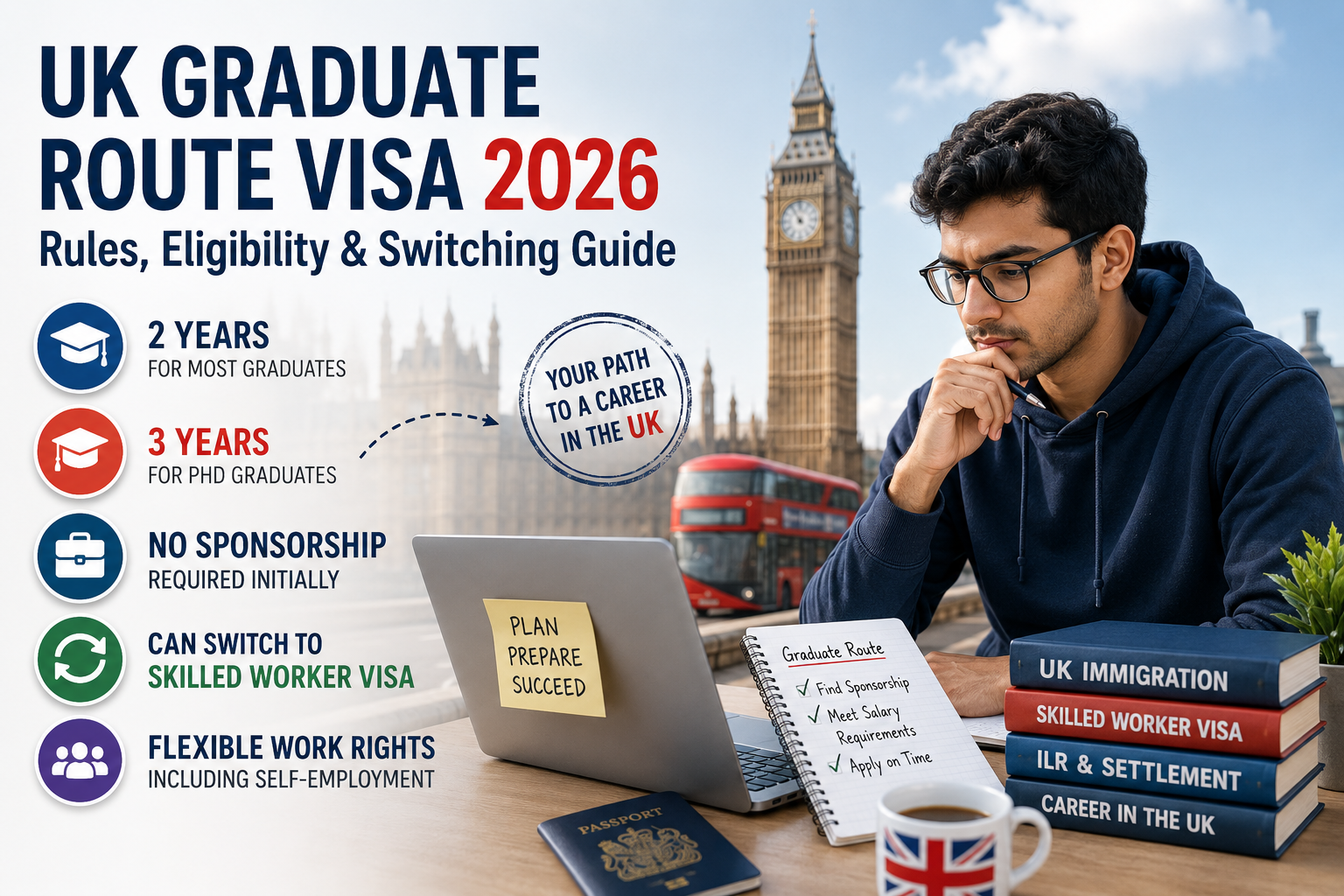
Yes — and this is the whole point of the Graduate Route for most international students. You have a two-year (or three-year for PhDs) window to find an employer willing to sponsor you, then switch to a Skilled Worker visa without leaving the UK. That ability to switch in-country is a significant advantage that is still intact in 2026.
The switch is not automatic. You need three things in place before your Graduate Route expires.
What You Need to Switch
1. A job offer from a UK employer with a valid sponsor licence
Not every employer can sponsor. The Home Office maintains a public register of licensed sponsors — download it, filter by your sector, and target companies that already have sponsorship infrastructure in place. Convincing a small business to obtain a licence from scratch is possible, but it adds months to an already time-pressured process.
2. The role must meet skill and salary thresholds
As of 2026, the standard minimum salary for Skilled Worker visas is generally £38,700 or the going rate for the specific occupation code, whichever is higher. However, new entrants — which includes graduates switching from the Graduate Route — may qualify for a lower salary threshold (often 70% of the going rate, or approximately £20,960 in some cases). The exact figures depend on the occupation code and your circumstances.
Healthcare and education roles often benefit from different salary rules based on national pay scales. Always verify the specific threshold for your occupation on the official Skilled Worker guidance pages before assuming a salary offer qualifies.
3. A Certificate of Sponsorship (CoS) from your employer
Once your employer assigns a CoS, you have three months to submit your Skilled Worker application. This is a hard deadline don’t let it slip.
Switching While Your Graduate Route Is Still Valid
You can apply for a Skilled Worker visa at any point during your Graduate Route — you don’t need to wait until you’re close to expiry. Applying earlier gives you time to handle any processing delays without your Graduate Route becoming a pressure point.
If your Graduate Route expires while your Skilled Worker application is being processed, you’re covered by Section 3C leave, which means you remain in the UK lawfully until a decision is made. But this only applies if your Skilled Worker application was submitted before your Graduate Route expired not after.
The ILR Clock: Why Timing Matters
Time spent on the Graduate Route does not count toward the five years needed for Indefinite Leave to Remain (ILR) via the Skilled Worker route. Only time on the Skilled Worker visa (or other qualifying routes) counts. The earlier you switch, the earlier your ILR clock starts ticking.
Graduate Route vs Skilled Worker: Quick Comparison
| Category | Graduate Route | Skilled Worker |
|---|---|---|
| Purpose | Post-study work period | Long-term sponsored employment |
| Employer sponsorship | Not required | Required — licensed sponsor only |
| Salary requirement | None | £38,700+ or going rate (with new entrant discounts) |
| Duration | 2–3 years (non-extendable) | Up to 5 years (renewable) |
| Work flexibility | Any role, any employer | Tied to sponsored role and employer |
| Counts toward ILR? | No | Yes — 5-year pathway |
| Best use | Build UK experience, find sponsor | Stable long-term employment and settlement |
A Realistic Switching Timeline (Adapt to Your Situation)
The most damaging pattern I’ve seen is students treating month 20 as the time to start job hunting. Here’s a timeline framework that gives you a realistic chance.
Months 1–3 After Graduate Route Starts
- Confirm your Graduate Route status details and expiry date
- Overhaul your CV to target Skilled Worker-compatible roles
- Download the licensed sponsor register and create a target employer list by sector
- Begin networking: LinkedIn, alumni events, career fairs, sector-specific groups
Months 4–6
- Apply consistently — quality proposals tailored to each role, reasonable volume
- Track what type of roles generate interviews versus silence; adjust your CV accordingly
- Ask recruiters early (and politely) about sponsorship availability — not at offer stage
Months 7–12
- Focus applications on confirmed sponsorship-capable companies
- Start collecting supporting documents: employment references, professional certificates
- If you’re getting interviews but no offers, get specific feedback and adjust
Months 13–18
- If you don’t have an offer, shift strategy: broaden compatible role types, increase application volume
- Consider whether adjacent roles in high-sponsorship sectors healthcare, engineering, fintech, education — might work
- Explore whether the Global Talent or Innovator Founder visa might be relevant if you have exceptional credentials or a viable business idea
Months 19–24 (Critical Window)
- If you still don’t have a sponsored offer: escalate urgency immediately
- Begin parallel planning: could you qualify for another route? Enrol in further study? This is case-specific take regulated advice
- Do not overstay. The consequences affect future applications long after the Graduate Route period ends
Industries With Stronger Sponsorship Pathways
Some sectors are structurally more sponsorship-friendly than others. This isn’t because immigration rules treat sectors differently it’s because companies in these areas already have sponsor licence infrastructure, established HR processes for international hires, and active recruitment pipelines.
Sectors where Graduate Route holders consistently find sponsorship more accessible in 2026:
- Healthcare (NHS and private sector)
- Software engineering and technology
- Data analytics and cybersecurity
- Finance and fintech
- Engineering (civil, mechanical, electrical)
- Education and teaching (especially where shortage occupations apply)
This doesn’t mean other sectors won’t sponsor — but if you’re running short on time, targeting companies and roles in these areas gives you a statistically better chance of finding employers who already know the sponsorship process.
Expert Tips for Making the Most of Your Graduate Route
Start before you graduate. While still a student, attend career fairs, connect with sector recruiters on LinkedIn, and look for internships that might convert to full-time sponsored roles. Seeds planted before graduation reduce panic afterwards.
Build UK-specific references. Any UK employment — part-time work, a short-term contract, a volunteer role with a professional organisation gives you a UK-based manager who can vouch for you. That credibility carries weight in Skilled Worker applications.
Understand the new entrant salary rule. When a hiring manager says the salary threshold is too high, explain that switching from a Graduate visa qualifies you as a “new entrant,” which can reduce the required salary by up to 30%. Many HR teams don’t know this, and it can make you significantly more hireable.
Treat the job description as a visa eligibility checklist. Skilled Worker applications depend heavily on the role description matching your actual responsibilities. If the description is vague or doesn’t reflect the real job, it creates problems. Work with your employer to ensure the CoS accurately reflects the role.
Keep your documents consistent. Use identical name spellings, date formats, and personal details across your CV, employment references, and visa application forms. Inconsistencies that look minor are genuine refusal risks.
Build a proof portfolio. Even for non-academic roles, maintain brief summaries of projects you’ve worked on: what you were tasked with, what you delivered, measurable outcomes where possible. This has obvious CV value but also helps with Skilled Worker sponsor interviews where employers want to demonstrate the role is genuine.
Common Mistakes to Avoid
Waiting until month 20 to start job hunting. UK hiring cycles average six to eight weeks, and that’s before the visa application process. Students who start late compress their options into a window that simply doesn’t accommodate the timeline.
Assuming any job will qualify. A Skilled Worker visa requires a genuine, skilled role at an appropriate level. Employment as a barista or in unrelated manual work won’t support a Skilled Worker application regardless of how much the employer values you.
Ignoring the IHS budget. The Immigration Health Surcharge has increased significantly. A Graduate Route holder switching to Skilled Worker and adding a spouse and one child can face IHS costs of £6,000 or more before other application fees.
Travelling outside the UK after submitting your application. Once you’ve submitted a Graduate Route application, do not leave the UK for any destination outside Ireland, the Channel Islands, or the Isle of Man. Doing so automatically withdraws your application — and this has caught out students who thought a weekend trip to Europe was fine.
Relying on social media or forum advice for immigration decisions. Rules change. What applied to someone’s application 12 months ago may not apply to yours. Always verify current requirements through GOV.UK or a regulated adviser.
Not planning for alternatives. The Skilled Worker route is the most common path, but it isn’t the only one. The Innovator Founder visa suits graduates with a viable business idea. The Global Talent visa suits those with exceptional credentials in science, arts, or digital technology. If Skilled Worker sponsorship isn’t materialising, these alternatives deserve serious attention — not last-minute consideration.
Frequently Asked Questions
Can I extend my Graduate Route visa?
No. The Graduate Route cannot be extended in the standard sense. When it ends, you must either have switched to another eligible immigration route — most commonly Skilled Worker — or leave the UK. There is no renewal mechanism.
What is the minimum salary to switch to a Skilled Worker visa in 2026?
The standard threshold in 2026 is generally £38,700 per year or the “going rate” for your specific occupation code, whichever is higher. Graduate Route holders switching to Skilled Worker often qualify as “new entrants,” which can reduce the required salary to around £20,960 in some occupations. The exact figure depends on the occupation code and your circumstances — verify against the current official Skilled Worker guidance for your specific role.
Can my dependants stay with me on the Graduate Route?
Dependants who were already on your Student visa can typically apply to remain with you under the Graduate Route. However, new dependants generally cannot be added under the current rules unless specific exemptions apply (for example, children born in the UK). If dependants are part of your plan, take specific regulated advice rather than relying on general guidance.
How early can I apply for the Graduate Route?
You can apply as soon as your university has officially reported your course completion to UKVI and your Student visa is still valid. There’s no standard date across all students — it depends entirely on when your institution reports completion and when your current visa expires. Contact your university’s international student support team to find out their reporting timelines.
Does time on the Graduate Route count toward ILR?
No. Time spent on the Graduate Route itself does not count toward the five-year continuous residence requirement for Indefinite Leave to Remain via the Skilled Worker pathway. The ILR clock starts once you’ve switched to Skilled Worker (or another qualifying route). This is a significant planning consideration: the sooner you switch, the sooner your ILR timeline begins.
Can I work as a freelancer or start a business on the Graduate Route?
Yes. Self-employment and business activities are generally permitted on the Graduate Route. If your business grows into something viable, the Innovator Founder visa may become a relevant next step.
What happens if I don’t find a sponsored job before my Graduate Route expires?
You have several options, each case-specific: switching to a Student visa to pursue further study, applying under an alternative route (Global Talent, Innovator Founder), or leaving the UK. Overstaying is not a viable option — it creates serious immigration consequences that affect future visa applications. If you’re approaching expiry without a sponsored offer, take regulated advice early enough to explore your real options.
Do I need an ATAS certificate for the Graduate Route?
No ATAS is not required for the Graduate Route itself. It may be required for your subsequent Skilled Worker application if your role involves sensitive research subjects.
People Also Ask
“What happens after 2 years on Graduate Route visa UK?”
If you haven’t switched to another eligible route, you must leave the UK when your Graduate Route expires. Section 3C leave protects you if a Skilled Worker application is already pending — but only if it was submitted before your Graduate Route lapsed. The safest approach is always to have a Skilled Worker application in process well before the two-year mark.
“Can I switch from Graduate Route visa to Skilled Worker visa without a job offer?”
No. The Skilled Worker visa requires a genuine job offer from a licensed sponsor and a Certificate of Sponsorship. Without both, switching is not possible through that route.
“How do I know if my course qualifies for the Graduate Route?”
Check your award documentation against the official Graduate Route eligibility criteria on GOV.UK. Your institution’s international student support office can usually confirm whether your specific course qualifies and whether they’re on the UKVI approved list. Don’t assume — verify before applying.
“PSW visa UK requirements is this the same as the Graduate Route?”
Yes. “PSW visa UK” and “Graduate Route” refer to the same post-study work pathway in 2026 context. “PSW” terminology sometimes appears in older content referencing the version discontinued in 2012, so always confirm you’re reading current Graduate Route guidance rather than historical information.
Your 2026 Action Plan: What to Do Right Now
If you’re a current Graduate Route holder, one action determines everything else: set a calendar reminder for six months before your Graduate Route expiry date. Title it “Skilled Worker application deadline.” Everything your job search, your sponsorship targeting, your employer conversations should be oriented toward having a CoS in hand before that date.
If you’re approaching graduation and planning your Graduate Route application: apply promptly once your university reports your completion to UKVI. If you’re completing a Bachelor’s or Master’s before the end of 2026, applying before the December cutoff secures you the full two-year period rather than the 18 months that apply from January 2027.
The Graduate Route is genuinely one of the most valuable post-study immigration options available to international graduates anywhere in the world. It gives you unsponsored flexibility in a country where building a skilled career is realistic and the job market for international talent — in the right sectors — remains active.
What it doesn’t do is work on autopilot. The students who navigate it successfully treat it as a strategic transition, not a holding pattern. They start job searching early, target companies that already sponsor, understand the Skilled Worker eligibility rules before they need them, and plan their dependent and document situations without leaving anything to assumption.
Your degree already cost you years and significant investment. The Graduate Route is what turns that investment into a long-term career. Plan it like it matters because it does.