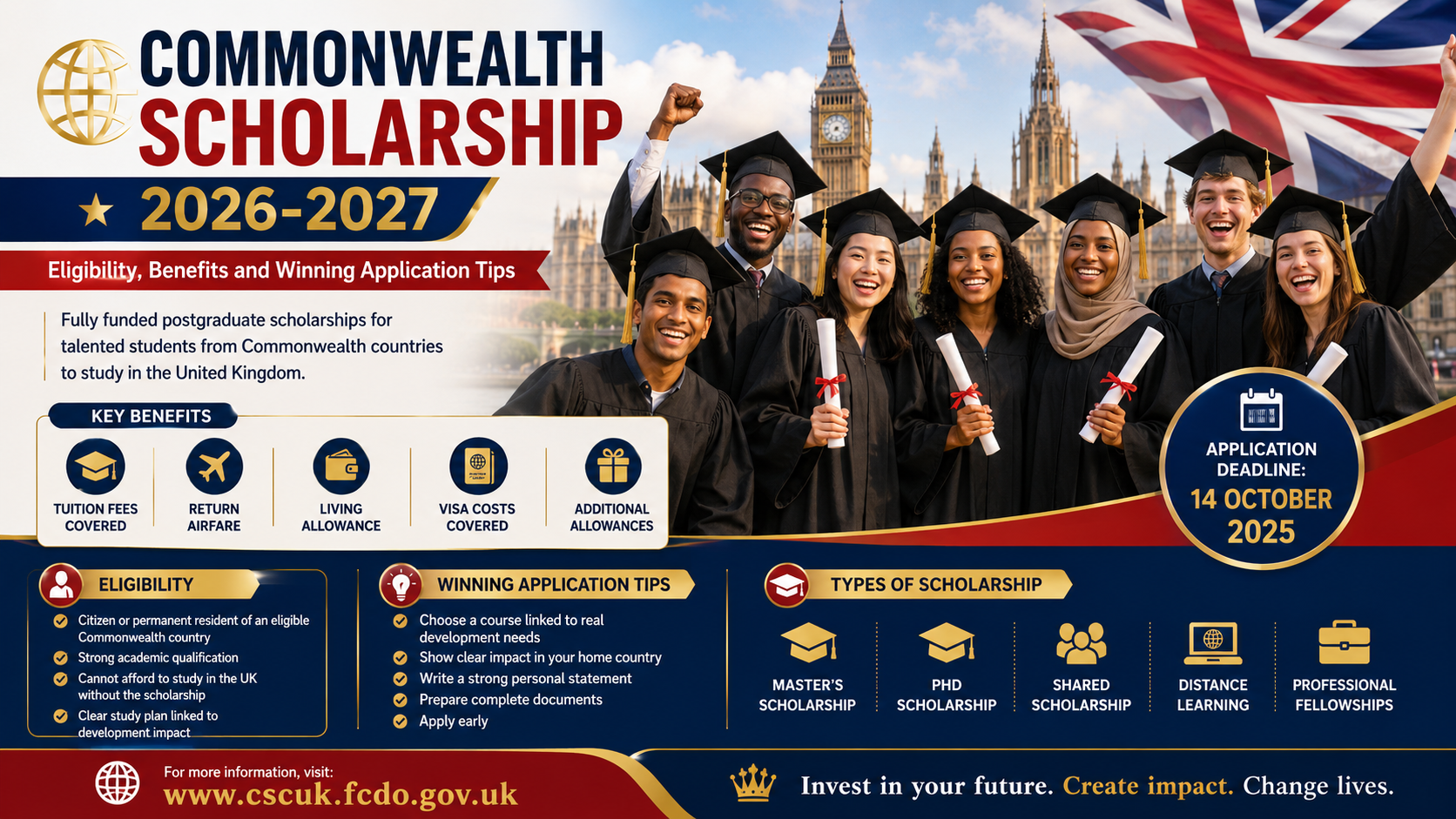
Commonwealth Scholarship 2026–2027 Eligibility, Benefits & Winning Application Tips
A Comprehensive Guide for Applicants from Commonwealth Countries

Introduction
If you have ever stared at a UK university prospectus and felt that quiet ache of knowing it is simply too expensive, the Commonwealth Scholarship 2026 is one of those rare doors that actually opens fully, not just a crack. It does not matter whether you are in Lagos, Dhaka, Nairobi or Kingston; this is a fully funded route to a UK master’s or PhD that is built for people who combine intellectual promise with a genuine hunger to solve problems back home.
Every year, hundreds of students from developing Commonwealth countries transform their lives through this programme, pursuing master’s and PhD degrees at top UK universities. But here is what most applicants do not realise success is not just about academic excellence. The single most important insight: the biggest hurdle is proving, with absolute clarity, that your study plans will create tangible development impact in your home country. That shapes everything, from your course choice to how you structure your personal statement.
This guide is a practical, battle-tested walkthrough for the 2026–2027 cycle. It explains what selection panels actually look for, which mistakes sink strong candidates, and how to build an application that feels impossible to ignore.
What Is the Commonwealth Scholarship?
Historical Foundation and Mission
The Commonwealth Scholarship Commission (CSC) was established in 1959 following the first Commonwealth Education Conference. The initiative emerged from a simple yet powerful idea: develop future leaders who return to their home countries and drive sustainable development. The programme is managed by the CSC in the UK and funded by the UK government through the FCDO.
Unlike scholarships that focus purely on academic merit, the Commonwealth Scholarship emphasises development impact and leadership potential. Successful applicants often have professional experience in healthcare, education, agriculture, engineering, environmental science, or social policy, and can articulate how their proposed studies will enhance their ability to create solutions.
Programme Categories
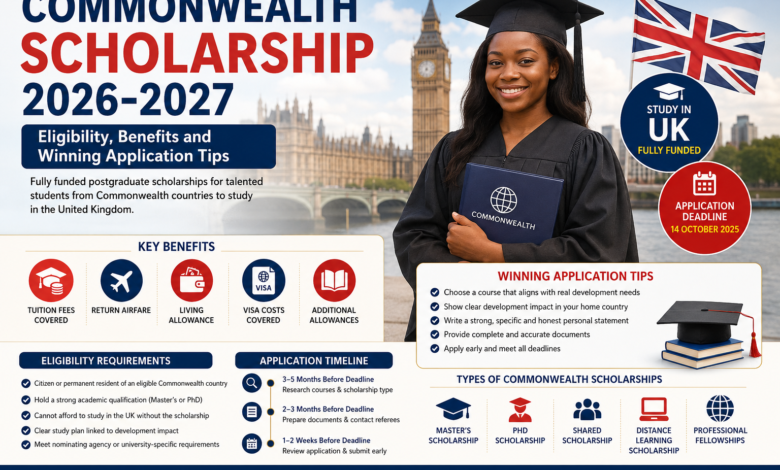
The Commonwealth Scholarship is not a single award. It is a family of scholarships:
| Scholarship Type | Best For | Study Format |
| Commonwealth Master’s Scholarship | Applicants from eligible low- and middle-income Commonwealth countries | Full-time Master’s in the UK |
| Commonwealth Shared Scholarship | Students applying to specific eligible UK university courses | Full-time Master’s in the UK |
| Commonwealth PhD Scholarship | Doctoral applicants from eligible countries | Full-time PhD in the UK (up to 3 years) |
| Commonwealth Split-site Scholarship | PhD candidates who want to spend time researching in the UK | Split research study |
| Commonwealth Distance Learning Scholarship | Students who want UK postgraduate study without relocating | Online study |
| Professional Fellowships | Mid-career professionals | Short professional development |
For most applicants — particularly from African countries such as Nigeria, Ghana, Kenya, Uganda, Tanzania, and Sierra Leone — the Master’s and Shared Scholarships are the most commonly pursued routes.
Eligibility Requirements
This is where the first wave of rejections happens — not because people are unqualified, but because they do not read the fine print. Review each criterion honestly before investing weeks in an application.
Country of Citizenship
You must be a citizen or hold refugee status in an eligible Commonwealth country. The CSC publishes a specific list each cycle. Typically, it includes nations classified as low- and middle-income by the World Bank. Eligible countries for 2026 include:
- Africa: Botswana, Cameroon, Eswatini, Ghana, Kenya, Lesotho, Malawi, Mauritius, Mozambique, Namibia, Nigeria, Rwanda, Seychelles, Sierra Leone, South Africa, Tanzania, Uganda, Zambia
- Asia: Bangladesh, Brunei, India, Malaysia, Maldives, Pakistan, Papua New Guinea, Solomon Islands, Sri Lanka, Tonga, Tuvalu, Vanuatu
- Caribbean: Antigua and Barbuda, Bahamas, Barbados, Belize, Dominica, Grenada, Guyana, Jamaica, Saint Kitts and Nevis, Saint Lucia, Saint Vincent and the Grenadines, Trinidad and Tobago
- Pacific: Fiji, Kiribati, Nauru, Samoa
Dual citizenship is acceptable as long as one citizenship is from an eligible country, but you must demonstrate strong ties to your eligible home country and convincing plans to return.
Academic Requirements
For Master’s scholarships, you need a first degree of at least upper second class (2:1) standard. For PhD scholarships, you typically need a master’s degree (often with distinction) plus a strong research background evidenced through publications, conference presentations, or significant research projects. Grade equivalencies for common applicant countries:
- Nigeria: First Class (70%+) for PhD; Second Class Upper (60–69%) for Master’s
- India: First Division (60%+) for PhD; Second Division (50–59%) for Master’s
- Kenya: First Class Honours for PhD; Upper Second Class for Master’s
If you hold a lower second class (2:2) alone, you are generally not eligible for Master’s awards, but may qualify for a PhD scholarship if you also hold a relevant postgraduate qualification with strong results.
RECOMMENDED POST: Chevening Scholarship 2026 for African Students Complete Guide & Essay Tips
Development Need (Financial Eligibility)
The CSC requires you to demonstrate that you cannot afford to study in the UK without the scholarship. You will need to submit a financial declaration. If you have previously funded study in a high-income country, address that context clearly in your application — it can raise a red flag if left unaddressed.
Work Experience
You are expected to have some post-undergraduate work experience, especially for Master’s awards. Most successful Master’s candidates have 2–5 years of relevant professional experience, though exceptional recent graduates may be considered. The key is to show you have already started contributing to your country’s development — through employment, internships, or substantial volunteer work. For PhD awards, research experience is crucial.
English Language Proficiency
An IELTS certificate is not required at the scholarship application stage, but you must meet your chosen UK university’s English language requirements before their admission deadline. Accepted tests and minimum scores generally required by UK universities:
- IELTS Academic: Overall 6.5, no component below 6.0
- TOEFL iBT: Overall 88, minimum 17 in each section
- Pearson PTE Academic: Overall 62, minimum 51 in each component
Book your test early — popular test centres fill quickly. Securing a valid score before or shortly after submitting your scholarship application avoids last-minute complications.
| Quick Eligibility Snapshot: Be a citizen of (or hold refugee status in) an eligible Commonwealth country • Hold a first degree of at least upper second class (2:1) level • Be unable to afford study in the UK without the scholarship • Have relevant post-graduation work or research experience • Meet the English language requirements of your target UK university • Commit to returning home within one month of completing your award |
Benefits and Financial Coverage
The Commonwealth Scholarship is fully funded — there is no partial award, and you repay nothing. The only obligation is moral and contractual: you return home and use what you have learned. Here is what the award covers:
| Benefit | Details |
| Full tuition fees | Paid directly to your university. No upper limit — covers programmes at any UK institution including Oxford, Cambridge, LSE, and Imperial. |
| Living allowance | Approximately £1,347/month (outside London; London rates slightly higher). Reviewed annually — plan around this figure. |
| Return airfare | Economy flights from your home country to the UK at the start and end of your award. |
| Warm clothing allowance | One-time grant (approx. £300) for scholars from tropical climates. |
| Study travel grant | Up to £500 annually for academic travel within the UK (conferences, field research, library visits). |
| Thesis grant | Up to £500 towards dissertation preparation costs (PhD scholars). |
| Immigration Health Surcharge | Covered by the CSC as part of the visa process — giving you full NHS access. |
| Family allowance | Approx. £259/month for accompanying spouse, plus £259/month per child under 16, if family joins for the full study period. |
For scholars bringing dependants: you must arrange visas and accommodation independently. The stipend does not adjust for higher family costs in expensive cities like London, so careful budgeting is essential. The allowance is only payable if family members accompany you for the full duration of the award.
Application Timeline and Deadline 2026
Missing the Commonwealth Scholarship deadline happens more often than you would believe. The system opens once a year, with no second window. The 2026–2027 cycle is expected to follow this schedule (verify on the official CSC website):
| Stage | Expected Date |
| Applications open | Early September 2025 |
| Application closing date | Mid-October 2025 (approximately 16:00 GMT) — verify on the CSC portal |
| Shortlisting by national nominating agencies | November – December 2025 |
| CSC review and selection | January – March 2026 |
| Results announced | April – May 2026 |
| Awards begin (UK departure) | September / October 2026 |
| Critical Note: Most Commonwealth countries have a national nominating agency (often the Ministry of Education or a designated scholarship body) that reviews applications first. For example, applicants from Nigeria apply through the Federal Scholarship Board; in India it is through the Ministry of Human Resource Development. Some agencies have internal deadlines a week or more before the CSC closing date. Always verify your country’s specific process immediately. |
A smart preparation timeline: 12 months before research eligible courses and scholarship types, begin English language test preparation; 6 months before draft your personal statement, contact potential referees; 3 months before finalise documents and conduct mock interviews; 1 month before final review and early submission. Commonwealth Shared Scholarships are applied for directly through the offering university, not through a national agency.
How to Build a Strong Application
A strong Commonwealth Scholarship application is not a collection of good grades and documents. It is a clear argument. You are demonstrating: (1) academic ability, (2) understanding of a real development problem, (3) relevance of your chosen course, (4) a practical post-graduation plan, and (5) realistic potential for measurable impact.
1. Choose Your Course Strategically
Do not choose a course because the university is prestigious. Choose a course that directly addresses a documentable development gap in your home country. Before touching the application form, identify three specific, evidence-based problems in your country that your proposed field can address. Then find the programme that equips you to attack them. That level of precision separates top applicants from the generic crowd.
Examples of strong course-problem alignment:
- A public health applicant connecting their course to maternal mortality rates, disease prevention, or rural healthcare access gaps — not just ‘improving healthcare’
- An agricultural scientist from Ghana linking an MSc in Postharvest Technology to documented post-harvest losses in the yam value chain
- An education applicant connecting a digital learning programme to specific literacy gaps in underserved communities
The CSC selection criteria include academic merit and development impact. Master’s applications are also assessed on the quality of the study plan, while PhD applications are assessed on the quality of the research proposal.
2. Personal Statement Strategy
The personal statement is where most applications live or die. You typically get a set of prompt questions rather than a blank page. The CSC wants to see:
Opening (50–75 words)
Start with a specific moment, data point, or professional experience that anchors your commitment — not ‘since childhood’ or ‘I have always been passionate.’ Example: ‘Nigeria loses an estimated 40% of its fresh produce before it reaches markets. I intend to use an MSc in Postharvest Technology to build a national cold chain training programme for smallholder cooperatives.’
Academic and Professional Journey (150–200 words)
Connect your education and work experience to your development focus. Highlight specific achievements, always linking them to broader impact. Quantify results wherever possible: ‘My research on drought-resistant crops increased average yields by 23% across five pilot villages.’ Avoid adjectives without evidence — show, do not tell.
Why This Course, Why Now (100–150 words)
Demonstrate specific knowledge of your chosen UK programme. Explain how particular modules, research facilities, or faculty expertise align with your goals. Avoid generic praise of UK education quality — panels know what an MSc in Public Health covers. Tell them what you will do with it.
Future Impact Vision (100–150 words)
Articulate specific, realistic post-study plans: ‘Within three years of returning, I will train 200 rural midwives in emergency obstetric care using clinical protocols I develop during my MSc.’ Avoid ‘I will get a good job.’ The CSC wants to know how your changed skills will ripple outward — through your workplace, community, and sector.
Why You Need the Scholarship (brief)
Briefly explain your financial need without sounding entitled. Keep it factual and sincere.
3. Development Impact Statement
Some applications include a separate Development Impact Statement field. Either way, you must address four things:
- The development need in your country — with evidence (government statistics, World Bank data, NGO reports)
- How your proposed study directly addresses that need
- Your concrete plans for applying your new expertise upon return
- How you will measure and share the impact
Weak statement: ‘I want to help my country develop.’ Stronger: ‘I want to use advanced public health policy training to support evidence-based maternal health programmes in underserved communities, where distance, cost, and shortages of trained staff reduce access to care for women in the third trimester.’
4. References That Actually Support Your Case
You need two references typically one academic, one professional. Do not pick the most famous person who barely knows you. Pick someone who has directly supervised work relevant to your development goals. Brief your referees thoroughly: share your draft personal statement, give bullet points of the specific qualities you want highlighted, and ask them well in advance at least 6–8 weeks before the deadline. Your references should reinforce the same story your application tells.
Ideal referee profile: direct supervisors who can speak to work performance and leadership potential; academic supervisors familiar with research capabilities; senior colleagues who can comment on community impact and development relevance. Common mistake: choosing referees who cannot comment on your development-relevant skills, or contacting them days before the deadline.
5. Required Documents
The exact documents depend on the scholarship category, but prepare the following:
- Valid passport or national identification
- Full academic transcripts — all years of study, not only the final year
- Degree certificate(s)
- Two references (academic and/or professional)
- Personal statement and development impact responses
- CV / résumé (maximum 2 pages)
- Research proposal for PhD or research-based applications (up to 2,000 words)
- Admission letter from your chosen UK university (not required at application stage, but strongly advisable to seek early)
| Important: Transcripts must include full pages covering marks from all years of study — not only the final year. Incomplete transcripts are a common and avoidable reason for disqualification. |
Interview Preparation
If shortlisted, you may face an interview often conducted by a panel from your national nominating agency or a university. Panels typically include 3–4 people: academic experts, development professionals, and sometimes previous Commonwealth scholars. Interviews last approximately 20–30 minutes and are not tests of academic trivia. They are conversations about feasibility, commitment, and development relevance.
Common Interview Questions
- Walk us through the development problem you have chosen and why it matters now.
- What specific skills will you gain from this course that you could not acquire at home?
- How does this scholarship align with your country’s national development priorities?
- What is your plan if your primary post-study project hits a bureaucratic or funding obstacle?
- How will your family situation be managed so it does not disrupt your studies?
- What evidence supports the effectiveness of your proposed approach?
How to Answer Effectively
Use the Problem → Preparation → Plan → Impact structure. Example: ‘The problem I want to address is limited access to quality digital learning in rural secondary schools. My academic background in education and volunteer teaching experience have shown me how this gap affects exam performance and confidence. The MSc I have selected will give me expertise in education policy, digital learning design, and inclusive teaching systems. After my study, I will work with schools and NGOs to support scalable digital learning projects for underserved students.’
Practice aloud — but never sound scripted. The panel wants to hear someone who thinks on their feet. Show humility: acknowledge potential obstacles and explain how you will navigate them. For remote interviews, test your internet connection, camera, and microphone in advance. Have backup options ready.
Expert Tips for Standing Out
The Commonwealth Scholarship acceptance rate sits below 5% in many categories. Every word in your application is real estate.
- Start before the portal opens. Gather transcripts, draft your personal statement, and alert referees in July or August 2025.
- Download your country’s national development plan and quote it. Align your proposal with one of its pillars — this shows you are not operating in a vacuum.
- Identify the CSC development theme that fits your course (science and technology for development; health systems; global prosperity; peace and governance; resilience and crisis response; access, inclusion and opportunity) and shape your answers around it.
- Use the optional fields. If the application allows a CV or additional documents, use them — but only if they add substance.
- Get a ‘reality check’ reader — someone who works in development, not just a friend who will say it is good. Ask them: ‘Does this plan sound feasible?’
- If you are a mid-career professional, do not hide it. Your experience is an asset. Show how a master’s will amplify existing work rather than pivot you entirely.
- Avoid repeating the course description. Show what you will do with the degree.
- Be specific in your impact projections — but keep them realistic. ‘Transform my country’s entire education system in five years’ undermines credibility. A pilot project reaching 200 teachers in three years is far more compelling.
Common Mistakes That Sink Strong Applications
Content and Messaging Errors
- Picking a course first, then inventing a development need to match. Start with the need, then find the course.
- Writing a personal statement that reads like a university admissions essay — this is not about your personal growth journey; it is about your country’s development.
- Generic development focus: ‘I want to reduce poverty in my country’ is far less compelling than ‘I will establish microfinance cooperatives targeting women entrepreneurs in rural textile production, with a goal of creating 500 new jobs within three years.’
- Weak problem-solution alignment: describing agricultural challenges but proposing to study international relations without connecting how diplomatic skills improve farming outcomes.
- Using AI tools to generate a personal statement without heavy personalisation. Panels are increasingly able to identify generic, fluent-but-soulless prose. Your voice and specific examples are your protection.
Application Process Errors
- Missing the national nominating agency’s internal deadline — some agencies require submission a week before the CSC closing date.
- Submitting incomplete transcripts (final year only, when full transcripts are required).
- Uploading unsigned or incorrectly formatted documents.
- Being vague or inconsistent in the financial need declaration — this triggers automatic suspicion.
- Submitting at the last minute — the portal can slow under heavy load, and technical issues are not accepted as excuses.
Strategic Positioning Errors
- Choosing universities or courses purely by ranking rather than programme fit. A perfect match with a mid-ranked programme is often stronger than a poor fit with a prestigious institution.
- Focusing so heavily on personal career advancement that you fail to connect it to broader development impact.
- Assuming you only compete against applicants from your own country. While countries have allocation guidelines, weak applications are rejected regardless of competition levels in that country.
RECOMMENDED POST: Visa Sponsorship Jobs in Canada 2026: Complete Guide for International Students & Graduates
Commonwealth Scholarship vs Chevening: A Quick Comparison
Many applicants consider both. Here is the key difference: the Commonwealth Scholarship emphasises development impact and academic/research contribution; Chevening emphasises leadership potential and professional networking. Both require returning home for at least two years after your award.
| Factor | Commonwealth Scholarship | Chevening Scholarship |
| Funder | UK FCDO via the Commonwealth Scholarship Commission | UK Foreign, Commonwealth & Development Office |
| Target countries | Low- and middle-income Commonwealth countries only | Over 160 countries globally (not Commonwealth-only) |
| Programmes | Master’s (1 yr), PhD (3 yrs), Split-site, Distance Learning | One-year taught Master’s only |
| Post-study requirement | Return home within one month; remain 2+ years | Return home for at least two years |
| Selection emphasis | Development impact, study plan quality, academic merit | Leadership potential and networking ability |
| Financial support | Full tuition, airfare, living stipend, family allowance | Full tuition, slightly higher living stipend |
Neither is ‘easier’ they look for different dimensions of strong candidates. If you are from an eligible Commonwealth country, you can apply to both in the same year, but tailor each application to the specific funder’s mission.
Frequently Asked Questions
Who can apply for the Commonwealth Scholarship 2026?
Citizens or refugees of eligible low- and middle-income Commonwealth countries may apply, provided they meet the academic requirements (typically upper second-class honours or equivalent), demonstrate financial need, have relevant experience, and can articulate a clear plan to contribute to their country’s development after their studies.
Is the Commonwealth Scholarship fully funded?
Yes. There is no partial funding. If awarded, you receive comprehensive financial support for the entire programme, including tuition, airfare, living allowance, and additional grants. You are not required to repay a single pound. The only obligation is the commitment to return home.
Do I need IELTS before applying?
You do not need an IELTS certificate at the scholarship application stage. However, you must meet your chosen UK university’s English language requirements before their admission deadline. Strongly recommended: book and sit the test before or shortly after submitting your scholarship application to avoid last-minute complications.
Do I need a UK university offer letter before applying?
For Master’s, PhD, Shared Master’s, Split-site PhD, and Distance Learning Scholarships, an offer letter is not required at the scholarship application stage. However, applicants are strongly advised to seek admission at the time of applying or soon after. For Master’s and PhD scholarships, you can select up to three institutions in your application — your order of preference cannot be changed after submission.
Can I apply with a 2:2 degree?
For Master’s scholarships, a 2:2 alone is generally not sufficient. However, if you hold a relevant postgraduate qualification (such as a PGDip or master’s degree) with strong results, you may be eligible for a PhD scholarship. Always check the specific requirements for the award category you are targeting.
Is work experience compulsory?
Employment experience is not a formal requirement to apply, but it is a significant differentiator. Relevant professional experience directly strengthens the development impact section of your application. Most competitive Master’s scholarship applicants have 2–5 years of post-graduation experience in a relevant field.
Can I stay in the UK after the scholarship?
Commonwealth Scholars commit to returning to their home country after the scholarship ends. The CSC does not support scholars remaining in the UK under the Graduate Immigration Route, except in limited further-study circumstances. This commitment is moral and contractual.
How competitive is the selection process?
Acceptance rates are typically below 5% in many categories. Countries like India, Pakistan, Nigeria, and Ghana often have hundreds of applicants competing for a limited number of spots. However, success depends more on application quality and development impact potential than on academic grades alone. A well-prepared applicant from a competitive country can outperform a stronger academic record with a weaker development case.
When will the Commonwealth Scholarship deadline be for 2026?
Based on previous cycles, the portal is expected to open in early September 2025 and close in mid-October 2025 (around 16:00 GMT). However, your country’s nominating agency may have an earlier internal deadline. Always verify directly with your agency and on the official CSC website at cscuk.fcdo.gov.uk.
Your Next Steps Start Early, Stay Focused
This is not a lottery. It is a merit-based competition where clarity of purpose almost always beats raw academic firepower. If you can show, without fluff, that you understand a real problem in your country and that a specific UK programme will give you the tools to attack it, you are already ahead of half the applicant pool.
A strong application demonstrates deep understanding of development issues, realistic plans for creating impact, and genuine commitment to returning home to implement solutions. The application process itself is an opportunity for professional growth it forces you to articulate your vision and defend your approach.
Three Things to Do Right Now
- Bookmark the official Commonwealth Scholarship Commission website (cscuk.fcdo.gov.uk) and check it weekly from July 2025.
- Open a document and draft the first paragraph of your personal statement around a single development statistic that moves you.
- Identify the two people you will ask for references and send them a polite heads-up this week.
The difference between a ‘maybe’ candidate and a funded scholar often comes down to how early they started and how brutally honest they were about whether their plan made sense beyond their own ambition. Start building that plan today.