Canada Study Permit 2026: Cap Rules, Requirements, Exemptions and Student Visa Strategy
International student reviewing Canada study permit 2026 application documents

Introduction
If you started 2026 reading headlines about Canada “capping” study permits and immediately felt your plans unravel, you are not alone. The news made it sound like the door was slammed shut. The truth, as is often the case with immigration policy, is more nuanced than the headlines suggest.
RECOMMENDED POST: Visa Sponsorship Jobs in Canada 2026: Complete Guide for International Students & Graduates
Yes, there is a cap. Yes, the process is more selective. But thousands of genuine international students will still receive study permits this year and understanding exactly how the system works can put you well ahead of the crowd.
This guide covers the Canada study permit 2026 reality from the ground up: who the cap actually affects, who bypasses it entirely, what documents now carry extra weight, and the strategic decisions that separate a well-prepared application from one that earns a refusal letter. By the time you finish reading, you will have a clear roadmap not a recycled checklist.
What Is a Canada Study Permit?
A Canada study permit is the official document issued by Immigration, Refugees and Citizenship Canada (IRCC) that allows foreign nationals to study at a Designated Learning Institution (DLI) in Canada. Most foreign nationals need one before they study in Canada, and IRCC advises applicants to apply before travelling.
A few important clarifications before going further:
- A study permit is not a visa. Depending on your nationality, you may also need a Temporary Resident Visa (TRV) or an Electronic Travel Authorization (eTA) to enter the country.
- You need a study permit if your program lasts more than six months. Programs shorter than that may not require one, though you will be unable to extend your stay without a permit.
- Your acceptance letter must come from a DLI. IRCC is direct about this: if the institution is not on the DLI list, your application will be refused.
- The study permit application fee is CAD $150.
RECOMMENDED POST: Fully Funded Scholarships for African Students 2026: Masters & PhD Opportunities in UK, Germany & Canada
What Is the Canada Study Permit 2026 Cap?
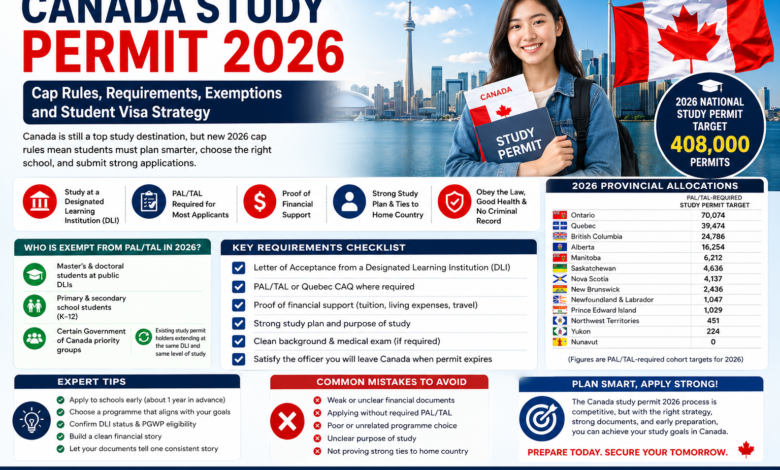
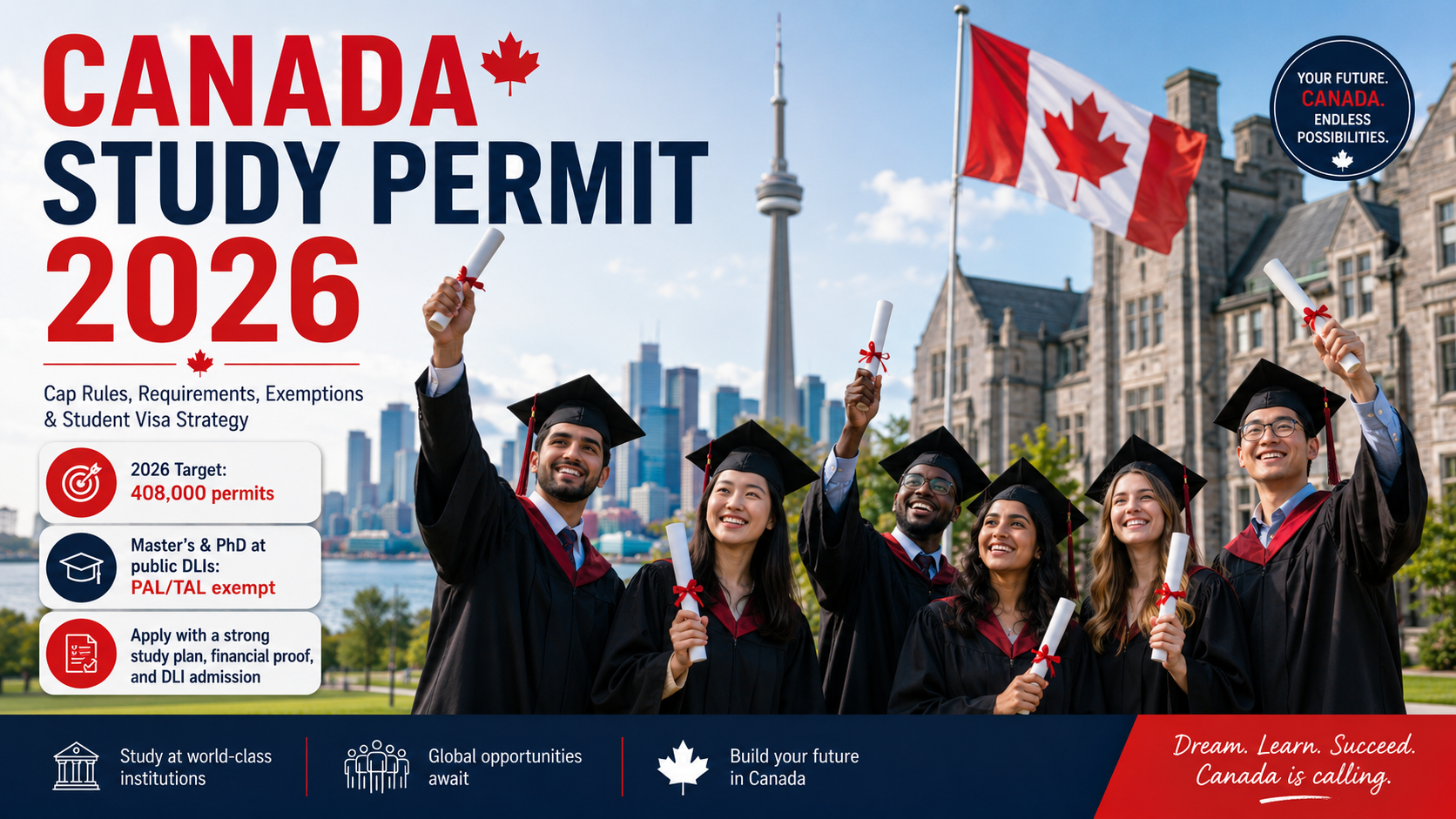
Canada has placed a structured annual limit on the number of study permits it will process each year. For 2026, IRCC’s national target is 408,000 study permits total, broken down as follows:
| Student Group | 2026 Target |
|---|---|
| Master’s and doctoral students at public DLIs (PAL/TAL-exempt) | 49,000 |
| Primary and secondary (K-12) students (PAL/TAL-exempt) | 115,000 |
| Other PAL/TAL-exempt applicants | 64,000 |
| PAL/TAL-required applicants | 180,000 |
| Total | 408,000 |
This target is roughly 7% lower than 2025 and significantly reduced from 2024 levels. The cap was introduced in response to real pressures: housing shortages, rising costs of living, and concern that some institutions were enrolling far more students than they had the infrastructure to support.
The mechanism works through Provincial Attestation Letters (PAL) and Territorial Attestation Letters (TAL). Most applicants for post-secondary programs must include one of these letters in their study permit application. IRCC distributes the overall allocation to provinces and territories based on population and capacity, and provinces then assign spaces to their DLIs.
For 2026, the provincial breakdown for PAL/TAL-required applicants looks like this:
| Province/Territory | 2026 Target (PAL/TAL-required) |
|---|---|
| Ontario | 70,074 |
| Quebec | 39,474 |
| British Columbia | 24,786 |
| Alberta | 21,582 |
| Manitoba | 6,534 |
| Saskatchewan | 5,436 |
| Nova Scotia | 4,680 |
| New Brunswick | 3,726 |
| Newfoundland and Labrador | 2,358 |
| Remaining territories | Varies |
These are issuance targets, not guaranteed approvals. Actual outcomes depend on application quality, refusal rates, and how quickly institutions request PALs for their students.
What gets lost in the panic: the cap applies primarily to new study permit applications processed from outside Canada. Students already in Canada renewing or extending their status at the same DLI and same study level are generally not affected.
Who Is Affected and Who Is Exempt from the 2026 Cap?
Understanding whether you fall inside or outside the cap completely changes your application strategy.
Applicants subject to the cap (PAL/TAL required)
- Most post-secondary students applying for undergraduate degrees, college diplomas, or certificate programs
- Many English-as-a-second-language (ESL) and pathway program students with programs exceeding six months
- Students applying from outside Canada for new study permits at private institutions
Applicants exempt from the cap (no PAL/TAL required)
- Master’s and doctoral degree students at public DLIs. Effective January 1, 2026, graduate students at public institutions are fully exempt. IRCC considers them essential to Canada’s research and innovation goals.
- Primary and secondary (K-12) students. These students are not counted against any provincial cap.
- Existing study permit holders extending at the same DLI and same level of study. If you are already in Canada and simply continuing your program, you do not compete for cap space.
- Certain Government of Canada priority groups and vulnerable cohorts.
- Family members of diplomats or foreign representatives.
The graduate studies exemption is significant. For Nigerian, Indian, Filipino, Pakistani, and other high-demand applicants, a master’s program at a public Canadian university steps you completely outside the numbers game. That is deliberate policy, not a workaround — and it explains why a growing number of students are now pivoting toward graduate study plans as their primary route.
Canada Study Permit Requirements for 2026
The core requirements have not changed dramatically, but scrutiny is noticeably higher. Because applications are now capped, IRCC officers apply existing rules more rigorously. The refusal rate for incomplete or weak files has climbed. This is not a year for a “let’s see what happens” approach.
1. Letter of Acceptance from a DLI
Your starting point. Before anything else, confirm your institution is on the official DLI list. Without a genuine offer from a DLI, nothing else in your application matters.
Before paying tuition deposits or agent fees, verify:
- The school is listed as a DLI
- The program aligns with your academic background
- The institution can assist with PAL/TAL requests if required
- The program may support PGWP eligibility, if post-graduation work is part of your plan
2. Provincial Attestation Letter (PAL) or Territorial Attestation Letter (TAL)
For capped applicants, this is now the most critical document in the file. The PAL or TAL confirms the province has counted you within its federal allocation. You must include it with your study permit application — applications missing a required PAL will not be processed.
The PAL is typically requested by your institution after you accept an offer and pay your deposit. In high-demand provinces like Ontario and British Columbia, PALs can run out months before the semester starts. Ask your DLI early about their PAL timeline. A 2026 PAL or TAL is valid until December 31, 2026, unless it has an earlier expiry date.
If you are studying in Quebec, you will also need a Quebec Acceptance Certificate (CAQ). For 2026, IRCC has indicated that Quebec’s updated CAQ can serve as both the CAQ and provincial attestation in relevant cases.
3. Proof of Financial Support
For applications submitted on or after September 1, 2025, updated financial thresholds apply. A single applicant studying outside Quebec must demonstrate:
- Full first-year tuition fees
- CAD $22,895 for living expenses in the first year
- Return transportation costs
- CAD $4,000 for the first accompanying family member, plus CAD $3,000 for each additional family member
Accepted financial evidence includes:
- Bank statements from the past three to six months
- Canadian GIC (Guaranteed Investment Certificate)
- Scholarship or funding award letters
- Student loan documentation
- Sponsor letters supported by the sponsor’s bank statements and proof of income
Weak financial proof is the most common reason for refusal. Avoid unexplained lump-sum deposits that appeared recently without context. Show a consistent, explainable funds history — not just the exact required amount sitting in an account opened three days before you applied.
4. Study Plan / Statement of Purpose
This is where many applicants underestimate the standard. Your study plan is not a checkbox item — it is the narrative core of your application. A personalized, specific, and honest plan that answers the following questions gives your file credibility no bank statement alone can provide:
- Why this specific program?
- Why this institution?
- Why Canada, and why now?
- How does this connect to your previous education or professional history?
- How are you funding your studies?
- What ties do you have to your home country?
- What is your realistic career or life plan after completing the program?
Generic templates written for “any applicant” are easy to identify and often cited in refusal letters. Write your own — even if it takes longer.
5. Valid Passport
Your passport must remain valid for the entire duration of your study program. Renew before applying if it expires mid-program.
6. Language Test Scores
Your institution’s admission process will have required IELTS, TOEFL, PTE, Duolingo, or an equivalent test. Even though the study permit application does not impose its own language minimum, a strong result adds credibility to your overall profile. If your institution waived the requirement, including a test result voluntarily can strengthen your file.
7. Medical Exam
Citizens of certain countries must complete an Immigration Medical Exam (IME) conducted by a panel physician approved by IRCC before applying. Check whether your country is on the required list early — panel physician appointments in some regions book weeks out.
8. Police Clearance Certificate
Required from every country where you have lived for six months or more in the past ten years.
9. Biometrics
Unless you have given biometrics for a Canadian application within the last ten years, you will need to provide fingerprints and a photo at a Visa Application Centre. Book your appointment early — delays here can hold up your entire application.
Canada Study Permit Processing Time 2026
Processing times vary based on your country of citizenship, application type, and volume at the time of submission.
| Application Type | Estimated Processing Time |
|---|---|
| Online application (standard) | 4–12 weeks |
| Student Direct Stream (SDS) | 20 calendar days (goal) |
| Paper application | 8–16+ weeks |
Apply at least three to four months before your program start date. Processing times fluctuate, and delays are more common than applicants expect.
What Is the Student Direct Stream (SDS)?
The Student Direct Stream is a faster processing pathway for students from select countries including Nigeria, India, China, the Philippines, Vietnam, Senegal, Pakistan, Morocco, and several others. SDS is worth pursuing if you are eligible.
To qualify, you must:
- Hold a Guaranteed Investment Certificate (GIC) of at least CAD $20,635 from a participating Canadian financial institution
- Have paid your first year of tuition in full
- Have an IELTS score of 6.0 or higher in each band (or equivalent French-language test score)
- Have completed a medical exam
- Have no criminal record
Many applicants who go the SDS route report both faster processing and higher approval rates — though neither is guaranteed.
How to Strengthen Your Canada Study Permit Application in 2026
With caps making every application count more than before, the difference between approval and refusal often comes down to preparation and coherence.
Secure Your PAL Early and Understand Your Province
In Ontario and British Columbia, where demand is highest, PAL spaces can be exhausted months before the semester. Contact your DLI as soon as you accept your offer. Ask specifically how many PAL spaces remain and what their internal deadline is. If your first-choice institution runs out, a school in Nova Scotia, Manitoba, or Saskatchewan may have more availability — and lower living costs to match.
Write Your Study Plan in Your Own Voice
Mention specific courses, faculty research areas, or career outcomes by name. Connect the program to your actual history. A plan that could belong to anyone in any country is the fastest way to raise doubt. If you are a master’s applicant exempt from the cap, this document still matters: it establishes genuine student intent.
Show a Clean Financial Story
Three to four months of consistent bank statements are more convincing than a large balance with no history. If your parents are sponsoring you, show their employment letter, payslips, and a clear affidavit. Avoid relying on bulk deposits made shortly before the application date without documenting their origin.
Address Red Flags Directly
Previous visa refusals from Canada, the UK, the US, Australia, or any other country do not automatically disqualify you — but leaving them unexplained does far more damage than addressing them honestly. The same applies to study gaps, career changes, or any inconsistency between your form and your supporting documents. Officers always notice.
Confirm PGWP Eligibility Before Committing
If working in Canada after graduation is part of your plan, verify whether your specific program at your specific institution supports Post-Graduation Work Permit (PGWP) eligibility before paying any fees. Field of study restrictions and institutional requirements apply, and not every Canadian diploma leads automatically to a PGWP.
Consider Paying First-Year Tuition Upfront
IRCC does not require you to pay tuition before applying, but submitting a payment receipt for your first year signals genuine financial commitment. It also reduces the living-expense amount you need to prove, since the tuition portion is already covered.
Common Reasons for Canada Study Permit Refusal in 2026
Most refusals are avoidable. Here are the patterns that appear most consistently.
Missing PAL or TAL. For capped applicants, this is the single most common 2026-specific error. Applications submitted without a required PAL are returned unprocessed — wasting time and potentially costing your admission slot.
Weak financial documentation. Insufficient funds, unexplained deposits, or thin sponsor documentation. Use the official IRCC thresholds; do not estimate.
Vague or generic study plan. Statements that reference Canada’s “world-class universities” without specific detail raise immediate suspicion. Officers read hundreds of these.
Poor program choice. A program that does not match your academic or professional background without explanation. Career transitions are acceptable; unexplained ones are not.
Weak ties to home country. You must satisfy the officer that you will leave Canada when your permit expires. Include evidence of family, property, employment prospects, or business interests at home — especially if you are from a country with historically high refusal rates.
Inconsistencies in the application. A mismatch between your form, your documents, and your stated history — even minor ones — raises credibility issues that officers take seriously.
Acceptance from a non-DLI. If the school is not on the DLI list, the application fails regardless of everything else in the file.
Canada Study Permit 2026: Special Considerations for Nigerian and African Students
For applicants from Nigeria, Ghana, Kenya, and across Africa, the strongest strategy is to build a file that is academically credible, financially coherent, and personally honest — not one that chases shortcuts.
A practical route:
- Start with your academic history and genuine career goal.
- Choose a program that logically supports that goal.
- Confirm the school is a DLI and that the program is relevant to your background.
- Check PAL/TAL requirements for your program and province.
- Verify PGWP eligibility if post-graduation work matters to your plan.
- Prepare financial documents early and build a consistent history.
- Write a study plan that reflects your actual story.
- Apply early do not let timing pressure you into a careless submission.
One caution: do not choose a school because someone promises “fast admission.” Fast admission to the wrong program at the wrong institution can damage your visa credibility and close doors later. Choose for fit, not for speed.
If you come from a high-refusal country, invest extra effort in your home-tie evidence: employment confirmation, property documents, family business records, previous travel history, or a post-graduation job offer letter. These do not guarantee approval, but their absence creates doubt that is hard to overcome.
Can You Work on a Canada Study Permit?
Yes, and this remains one of the most attractive aspects of studying in Canada. As of 2026, international students with a valid study permit can work up to 24 hours per week off-campus during their academic session. During scheduled breaks, including winter and summer, full-time work may be permitted.
You can also work on-campus without a separate work permit as long as you are enrolled full-time.
Always verify current working hour policies directly on the IRCC website before making employment plans, as these rules have changed in recent years and can change again.
After Your Studies: Pathways to Stay in Canada
One of the strongest draws of a Canadian education is the Post-Graduation Work Permit (PGWP), which allows eligible graduates to work in Canada for up to three years after completing their program, depending on program length and other criteria.
From there, many graduates pursue permanent residency through:
- Express Entry (Federal Skilled Worker Program, Canadian Experience Class)
- Provincial Nominee Programs (PNPs) — especially popular in Ontario, British Columbia, Alberta, and Atlantic provinces
- Atlantic Immigration Program
- Rural and Northern Immigration Pilot
Canada’s immigration system is explicitly designed with international students in mind. Your degree is not just an academic credential it is a potential entry point to a longer-term Canadian future.
Canada Alternatives if the Cap Affects Your Plans
If the Canada study permit 2026 cap creates obstacles for your specific situation, you do not need to abandon international education entirely. Some practical alternatives:
Shift to a graduate program in Canada. If you hold a bachelor’s degree, a Canadian master’s program bypasses the cap, opens stronger immigration pathways, and often leads to better employment outcomes.
Look at lower-competition provinces. Atlantic Canada and the Prairie provinces often have more PAL availability than Ontario or BC, lower living costs, and their own strong immigration pathways.
Consider comparable destinations. Germany offers largely tuition-free public university education. Ireland has a straightforward post-study work scheme. The Netherlands and Sweden have strong English-taught programs. Australia and New Zealand have established international student frameworks. A short detour through another country does not close the door to Canada permanently — many students complete a degree elsewhere and pursue Canadian work or graduate study later.
The main point: a flexible Plan B is not a fallback. In 2026, it is a strategy.
Expert Tips
Treat admission and visa approval as two separate challenges. Getting an offer letter from a Canadian institution is step one. Your visa application must still independently prove eligibility, financial capacity, genuine intent, and credibility. Conflating the two leads to rushed, underprepared files.
Let your documents tell one consistent story. Your admission letter, study plan, bank statements, sponsor documents, academic records, and career narrative should all support the same explanation. Contradictions — even small ones — do damage.
Choose program value over institutional fame. A less famous institution in a less competitive province with a program that genuinely fits your background can produce a stronger application than a prestigious address with a mismatch profile.
Avoid unregulated consultants who promise guaranteed results. The only people who can legally provide immigration advice for a fee in Canada are Regulated Canadian Immigration Consultants (RCICs) or Canadian lawyers. Agents who claim special connections for PALs or guaranteed approvals are not just unreliable — they can put your entire application at legal risk.
Check official sources before acting on anything. IRCC policies change. Every requirement, fee, and threshold referenced in this article should be verified directly on Canada.ca before you submit your application.
Frequently Asked Questions
What is the Canada study permit cap for 2026?
IRCC’s national target for 2026 is 408,000 study permits total, including exempt groups and PAL/TAL-required applicants. Of that, 180,000 are allocated to the main PAL/TAL-required category, distributed among provinces by population and capacity.
Are master’s and PhD students exempt from the 2026 cap?
Yes. Students enrolled in degree-granting master’s or doctoral programs at public DLIs do not need a PAL or TAL from January 1, 2026 onward. They still need a letter of acceptance, proof of funds, and other standard study permit documents.
How much proof of funds is required for the 2026 Canada study permit?
A single applicant studying outside Quebec must show CAD $22,895 in living expenses plus full first-year tuition and return travel costs. These thresholds apply to applications submitted on or after September 1, 2025.
What causes Canada study permit refusal in 2026?
The most common reasons are missing PAL/TAL for capped applicants, insufficient or unexplained financial proof, a weak or generic study plan, poor program fit, weak ties to the home country, and acceptance from a non-DLI institution.
Can I apply for a Canada study permit in 2026 without a PAL?
Only if you fall into an exempt category (master’s/PhD at a public DLI, K-12, existing in-Canada permit holder extending at the same institution and level, or certain priority groups). For all other post-secondary applicants, a PAL or TAL is required.
Does the cap affect study permit extensions inside Canada?
No. Extensions for students already in Canada on a valid study permit are not subject to the cap and do not require a PAL.
Can I apply for a Canada study permit without IELTS?
Some institutions accept Duolingo, PTE Academic, TOEFL, or proof of previous education in English. However, IELTS remains the most widely accepted. For the Student Direct Stream, IELTS is typically mandatory.
How long is a 2026 PAL or TAL valid?
Unless it carries an earlier expiry date, a 2026 PAL or TAL is valid until December 31, 2026. It must be valid at the time of application but does not need to remain valid through your program start date.
Can I work while studying in Canada?
Yes. International students with a valid study permit can work up to 24 hours per week off-campus during academic sessions, and full-time during scheduled breaks, subject to current IRCC policy.
What happens if my study permit application is refused?
You can reapply. Read your refusal letter carefully — IRCC is required to give reasons, and addressing each concern directly in a new application significantly improves your chances. Many applicants succeed on a second attempt with stronger documentation.
Conclusion
The Canada study permit 2026 process is more structured and more selective — but it is not closed. The students who succeed are those who understand the cap, know whether they need a PAL, choose credible institutions and programs, prepare thorough financial documentation, and submit a study plan that actually tells their story.
The cap has raised the bar. But it has not moved the goal. Thousands of international students will receive Canadian study permits this year. With preparation, honest documentation, and a clear sense of purpose, you can be among them.
Start early. Verify every requirement on the official IRCC website. And build an application that holds together from first page to last.
What is the Canada study permit 2026 cap?: Canada’s 2026 study permit cap sets a national target of 408,000 study permits. Most post-secondary applicants must secure a Provincial Attestation Letter (PAL) or Territorial Attestation Letter (TAL) before IRCC will process their application. Master’s and doctoral students at public DLIs, K-12 students, and students extending existing permits at the same institution are exempt from this requirement.


The website design looks great—clean, user-friendly, and visually appealing! It definitely has the potential to attract more visitors. Maybe adding even more engaging content (like interactive posts, videos, or expert insights) could take it to the next level. Keep up the good work!